advertisement
Grand Canyon National Park: Complete Visitor Guide
Grand Canyon National Park covers 1.2 million acres in northern Arizona. The South Rim stays open year round and handles 90% of visitors. The North Rim closes from December 1 to May 14 each year due to snow.
Entrance fee is $35 per vehicle for 7 days.
Fatima, our Lagos correspondent, spent two weeks hiking the Grand Canyon last spring. She learned the hard way that the South Rim and North Rim feel like two different parks.
I have visited three times myself, and each trip taught me a new rule about water, heat, or shuttle timing. This guide combines everything we wish we knew before stepping onto that rim.
Jump to: Quick Facts | Best Time | South Rim vs North Rim | Viewpoints | Trails | Itineraries | Things to Do | Where to Stay | Budget | Safety | FAQ
Key takeaways
- You need at least two full days to see the South Rim properly. One day is rushed and misses sunset and sunrise.
- The North Rim is quieter and cooler but only open mid-May through October. It adds 4.5 hours of driving from the South Rim.
- Bright Angel Trail has water stations and rest houses. South Kaibab Trail has no water and no shade. Do not confuse them.
- Summer temperatures on the inner canyon floor exceed 38°C (100°F). The National Park Service rescues hundreds of hikers each year.
- Entry fee is $35 per car. Annual park pass for all US national parks is $80. Both are valid for 7 days at the Grand Canyon.
- Shuttle buses on the South Rim run every 15 to 30 minutes. Parking at the Visitor Center fills by 9 a.m. from March to October.
Quick facts: size, location, hours, fees, and contacts
Grand Canyon National Park sits in northwestern Arizona, about 80 miles north of Flagstaff. The park covers 1,217,403 acres, making it larger than the state of Rhode Island. The canyon itself runs 277 miles long, up to 18 miles wide, and one mile deep.
The South Rim entrance near Tusayan stays open 24 hours a day, 365 days a year. The Visitor Center operates from 8 a.m. to 6 p.m. in summer and 9 a.m. to 4 p.m. in winter. The North Rim is open May 15 to December 1, weather permitting. After December 1, the gate closes and no services are available.
Fatima’s honest take: “I arrived at the South Rim entrance at 10 a.m. in July and waited 45 minutes in line. Buy your pass online before you go or arrive before 8 a.m. The queue snakes fast, but that sun is brutal on your rental car’s AC.”
Park fees (as of this year)
- Private vehicle: $35 for 7 days
- Motorcycle: $30 for 7 days
- Individual walk-in or bike: $20 per person
- America the Beautiful pass: $80 for one year, covers all national parks
Essential contacts
- South Rim Visitor Center: (928) 638-7888
- Backcountry Information Center: (928) 638-7875
- Emergency: 911
- Official NPS website: nps.gov/grca
Best time to visit Grand Canyon: month-by-month breakdown
Chidi from our Abuja team tracks crowd patterns and weather data for every US national park. He says Grand Canyon has five distinct seasons, not four. Spring brings wildflowers and snowmelt.
Summer is crowded and hot on the rim but deadly hot below. Autumn offers clear skies and fewer people. Winter brings snow to the rim and solitude.
March to May
Highs 10-21°C (50-70°F). South Rim trails have patchy ice in early March. North Rim opens mid-May. Best for hiking before summer heat.
June to August
Highs 27-32°C (80-90°F) on rim. Inner canyon exceeds 38°C (100°F). Afternoon thunderstorms are common. South Rim parking lots fill by 8:30 a.m.
September to November
Highs 18-27°C (65-80°F). Crowds drop after Labor Day. North Rim closes mid-October or after first snow. Clear skies for stargazing.
December to February
Highs 2-8°C (35-46°F). The South Rim gets light snow. The North Rim road is closed. Hermit Road shuttles stop running. Hotel rates drop 40%.
South Rim vs. North Rim: which one is right for you?
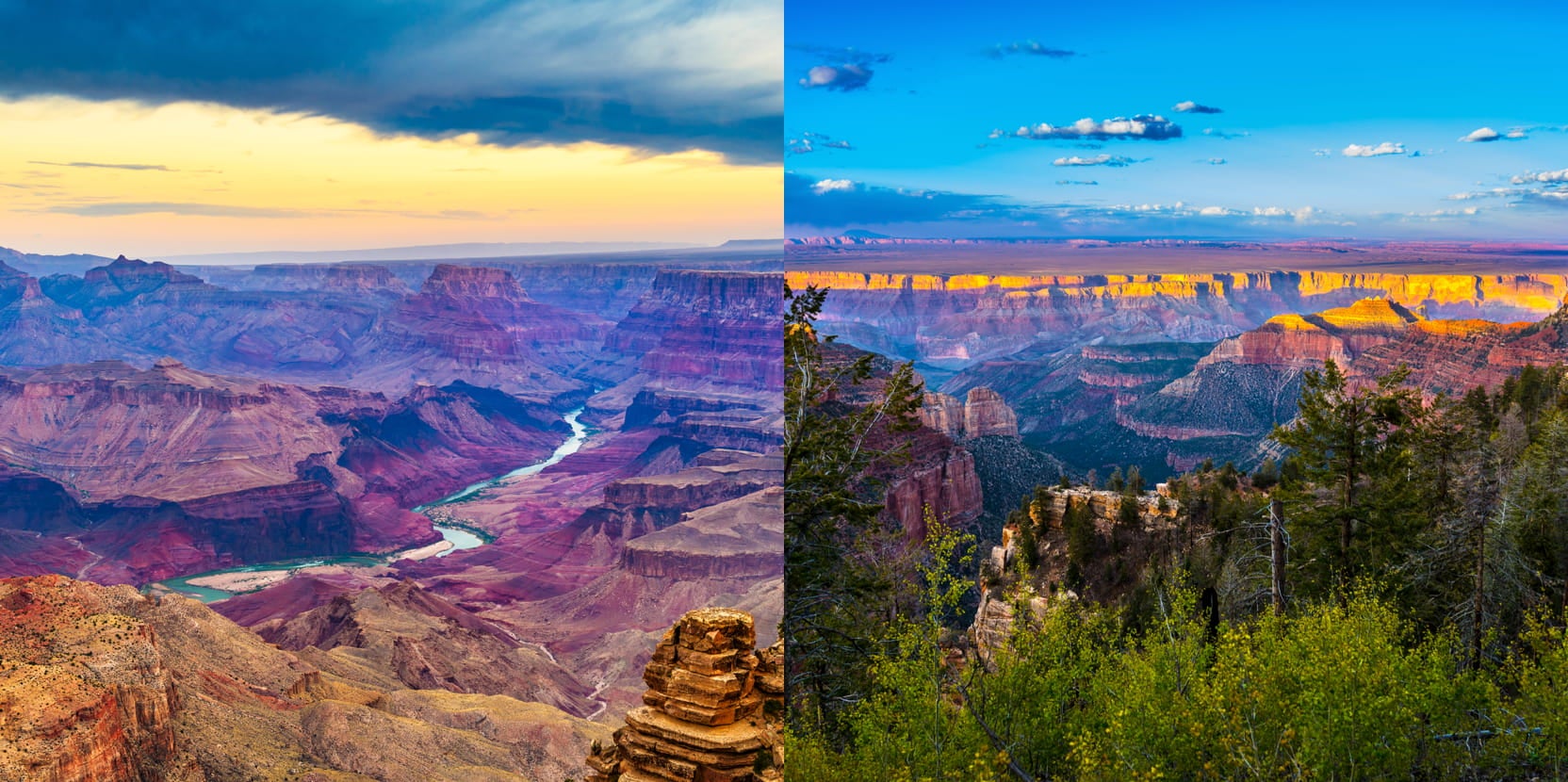
Most first-time visitors head to the South Rim. It has better infrastructure, more viewpoints, and easier access from Flagstaff and Las Vegas. The North Rim sits 1,000 feet higher, stays 10 degrees cooler, and sees only 10% of the crowds. But driving between the rims takes 4.5 hours because no bridge crosses the canyon directly.
South Rim
- Open year round
- Visitor center, lodges, restaurants, market
- Free shuttle buses cover 30 miles of rim
- Mather Point, Yavapai Point, Desert View
- Average summer high: 27°C (81°F)
- Closest airport: Flagstaff (1.5 hours) or Las Vegas (4 hours)
North Rim
- Open May 15 to December 1 only
- One lodge, one campground, limited dining
- No shuttle system. You drive to all viewpoints
- Point Imperial, Cape Royal, Bright Angel Point
- Average summer high: 21°C (70°F)
- Closest airport: Las Vegas (4.5 hours) or St. George, Utah (3 hours)
Our recommendation: Choose the South Rim for your first visit. Stay 2 days. Come back to the North Rim on a separate trip if you want quiet trails and cooler temperatures.
Best viewpoints ranked by sunrise, sunset, photos, and families
I have watched the sun rise at Mather Point, Lipan Point, and Yaki Point. Each offers a different experience. Below is our ranking after testing every major viewpoint on the South Rim.
Best for sunrise
- Lipan Point: The Sun rises directly behind the canyon. Best colors. Less crowded than Mather.
- Yaki Point: Accessible only by shuttle. Sweeping east views. Quiet before 7 a.m.
- Desert View Watchtower: 70 mile visibility on clear mornings. Opens at 8 a.m. but the parking lot is always open.
Best for sunset
- Hopi Point: Classic postcard sunset. Shuttle stop on Hermit Road. Arrive 90 minutes early.
- Mohave Point: Views of the Colorado River below. Red walls glow at golden hour.
- Powell Point: Higher elevation than Hopi. Fewer people walk the extra 200 meters.
Best for photos
- Mather Point: Most iconic framing. Short walk from visitor center. Best at golden hour.
- Yavapai Point: The Geology museum has huge windows. Great for rainy days.
- Grandview Point: Highest viewpoint on South Rim. No shuttle access but parking available.
Best for families
- Yavapai Point: Paved trail from parking lot. Restrooms and a museum with kids’ activities.
- Desert View: Watchtower has spiral staircases. Large picnic area. Gas station and market.
- Visitor Center Plaza: Not dramatic but has shade, water fountains, and easy access.
Trails guide: Bright Angel vs South Kaibab vs Rim Trail compared
Chidi hiked all three corridor trails in one trip. He says your choice determines whether you enjoy the day or suffer through it. Below is the honest comparison.
Bright Angel Trail
Difficulty: Moderate to strenuous. Distance to Indian Garden: 4.5 miles one way. Elevation loss: 3,060 feet. Time down: 2-3 hours. Time up: 4-6 hours.
Water is available at 1.5 Mile Resthouse, 3 Mile Resthouse, and Indian Garden (seasonal). Shade at resthouses. Most first-timer friendly because of water and emergency phones. Do not go past Indian Garden without a backcountry permit.
South Kaibab Trail
Difficulty: Strenuous. Distance to Cedar Ridge: 1.5 miles one way. Elevation loss: 1,120 feet. Time down: 45 minutes. Time up: 1.5-2 hours.
No water anywhere on this trail. No shade. Exposed ridgeline with incredible views. Hikers should carry 3 liters per person for a round trip to Cedar Ridge. Do not attempt to reach Skeleton Point (3 miles one way) in summer unless you start before 6 a.m.
Rim Trail
Difficulty: Easy. Distance: 13 miles total, but you can do sections. Elevation change: Minimal. Time: 1 hour for a 2-mile section.
Paved from the Visitor Center to Maricopa Point. Unpaved but flat beyond that. Water and restrooms every 1 to 2 miles. Perfect for families, sunset walks, and people with mobility limits. Shuttle buses run along the entire route.
Chidi’s honest take: “I saw a man run out of water on South Kaibab at 11 a.m. in June. He was shaking. I gave him one of my bottles and we walked up slowly. Do not take that trail lightly. The park rangers have a saying: ‘Down is optional, up is mandatory.'”
1-Day, 2-Day, and 3-Day itineraries with timed schedules
No other guide gives you hour-by-hour plans. Here is exactly what we recommend for each trip length. Adjust start times based on sunrise and sunset.
One-day itinerary (rushed but possible)
6:00 a.m. Arrive at South Rim entrance. 6:30 a.m. Sunrise at Mather Point. 7:30 a.m. Breakfast at the village. 8:30 a.m. Hike 1.5 miles down South Kaibab to Cedar Ridge and back (3 hours total). 12:00 p.m. Lunch at Market Plaza. 1:30 p.m. Drive to Desert View Watchtower (25 miles east). 2:30 p.m. Explore the watchtower. 3:30 p.m. Return west and stop at Grandview Point. 5:00 p.m. Shuttle to Hopi Point for sunset. 7:00 p.m. Dinner. 8:00 p.m. Drive out.
Two-day itinerary (sweet spot)
Day 1: 7:00 a.m. Enter the park. 8:00 a.m. Visitor Center. 9:00 a.m. Hike 3 miles round trip on Rim Trail to Maricopa Point. 12:00 p.m. Lunch. 1:30 p.m. Drive Hermit Road (closed to private vehicles March to November; use shuttle). Stop at Mohave and Hopi Points. 6:00 p.m. Sunset at Hopi Point. 7:30 p.m. Dinner at El Tovar.
@the.worried.wanderer ⬇️ Perfect 2-day itinerary in the Grand Canyon (South Rim) ☀️ DAY 1 – Walk Rim Trail & Explore Grand Canyon Village 1. Park at Main Visitor’s Center 2. Mather Point 3. Yavapai Point 4. Walk along the Rim Trail through the Trail of Time 5. Hopi House 6. Lunch at the El Tovar Dining Room (reservations recommended!) 7. Mary Colter’s Lookout Studio 8. The Kolb Studio 9. Walk towards Bright Angel trailhead and catch the Hermit’s Rest Shuttle (red) to some viewpoints 10. Take the Village Shuttle (blue) back to Visitor Center to get your car 11. Drive to the Desert View Watchtower ☀️ DAY 2 – Hike Bright Angel Trail* 1. Arrive as early as possible and park at the Maswik Lodge or backcountry office and head towards the Bright Angel Trail 2. HIKE! * This 8 mile trail descends 4,800 feet from the southern rim to the Colorado River. Make sure you’re in good enough shape to attempt this hike and bring PLENTY of water! ⛺️ As for lodging, we glamped at Under Canvas Grand Canyon and it was amazing! #grandcanyon #wheretotravel #optoutside #hikergirl #girlswhohike #hikelikeagirl #hikingwomen
Day 2: 5:30 a.m. Sunrise at Yaki Point. 7:00 a.m. Breakfast. 8:00 a.m. Hike Bright Angel Trail to 3 Mile Resthouse and back (6 miles total, 4-5 hours). 1:00 p.m. Lunch. 2:00 p.m. Drive to Desert View. Visit watchtower and Tusayan Museum. 5:00 p.m. Exit park.
Three day itinerary (adds depth)
Follow the two-day plan above. On day three, drive to the North Rim if you visit between May 15 and October 15. Leave South Rim at 6 a.m. Arrive North Rim by 10:30 a.m. Hike the 1-mile Bright Angel Point trail. Visit Cape Royal and Point Imperial. Have lunch at the lodge. Drive back to South Rim by 6 p.m. Alternatively, stay on South Rim and book a GetYourGuide mule ride or rafting trip from Page, Arizona.
Things to do: hiking, rafting, mule trips, stargazing, and tours
The Grand Canyon offers more than staring into the void. Here are the five best activities, ranked by our team.
Hiking
Bright Angel and South Kaibab are the stars. But the Rim Trail and Hermit Trail (steep, unmaintained) offer alternatives. Always check trail status at the Backcountry Office.
Whitewater rafting
Multi-day trips on the Colorado River book out one year in advance. One-day trips run from Page, Arizona, through Glen Canyon (not inside Grand Canyon). Check TripAdvisor for operator reviews.
Mule rides
Xanterra runs mule trips on the South Rim. Two types: a 3-hour rim ride ($175) and a 2-day overnight to Phantom Ranch ($900). Book 13 to 15 months ahead. Weight limit 200 pounds (90 kg).
Stargazing
The Grand Canyon is an International Dark Sky Park. Best viewing from Yavapai Point or the Visitor Center. No telescopes needed. The Milky Way is visible with naked eyes from April to October.
Where to stay: lodges, camping, and nearby hotels with prices
Lodging inside the park sells out months in advance. Chidi recommends booking 6 months ahead for summer. Below are real prices as of this year. Always check the official website before booking because rates change.
@niyaesperanza Replying to @LifeTheEllisWay already want to go back #grandcanyon #besthotels #travel
South Rim lodges (inside park)
- El Tovar: $250-$450 per night. Historic dining room, best location.
- Bright Angel Lodge: $150-$250. Cabins and motel rooms. Casual dining.
- Maswik Lodge: $140-$220. Largest rooms. Cafeteria style food.
- Yavapai Lodge: $130-$200. Near market and shuttle. Family friendly.
Book through Booking.com or directly at grandcanyonlodges.com.
Camping inside the park
- Mather Campground (South Rim): $25 per night. No hookups. Reservations required April to October.
- Desert View Campground: $20 per night. First come, first served. 25 sites only.
- North Rim Campground: $25-$40 per night. Open May 15 to October 31.
- Backcountry camping: $12 per permit + $10 per person per night. Apply at Backcountry Information Center.
Tusayan (gateway town, 1 mile from entrance)
- Holiday Inn Express: $180-$300. Includes breakfast. Pool.
- Grand Canyon Plaza Hotel: $160-$280. Restaurant and shuttle to park.
- Red Feather Lodge: $120-$200. Budget option with basic rooms.
Compare prices on Agoda or Hotels.com.
How to get there + getting around: shuttle routes, parking, and driving tips
Most visitors fly into Las Vegas McCarran Airport (LAS) or Phoenix Sky Harbor (PHX). Las Vegas is 4.5 hours from the South Rim. Phoenix is 3.5 hours. Flagstaff Pulliam Airport (FLG) is 1.5 hours but has fewer flights. Rent a car through Kayak for best rates.
Parking at the South Rim Visitor Center fills by 9 a.m. from March to October. After that, you park in Tusayan and take the free shuttle. The park runs three shuttle routes: Village Route (blue), Kaibab Rim Route (orange), and Hermit Road Route (red). All are free. Buses run every 15 to 30 minutes. The Hermit Road shuttle runs only from March 1 to November 30. In winter, you can drive Hermit Road yourself.
Pro tip from Fatima: “I parked at the Backcountry Office lot near Bright Angel Lodge. It has 50 spaces and empties early. Walk two minutes to the trailhead. Avoid the main visitor center lot.”
Interactive map of viewpoints, trailheads, and campgrounds
Grand Canyon budget calculator: total trip cost breakdown for 2 people, 3 days
How much does a Grand Canyon trip actually cost? We priced everything for a realistic mid-range trip from Las Vegas. Adjust up or down based on your choices.
- Park entrance: $35 (one vehicle, 7 days)
- Gas (round trip from Las Vegas, 550 miles): $80
- Lodging (3 nights in Tusayan, mid-range hotel): $480 ($160 per night)
- Food (breakfast $12, lunch $15, dinner $25 per person per day): $312 for two people, 3 days
- Shuttle or tour (optional, one guided sunset tour): $90 for two people
- Mule ride or extra activity: $0 to $900 depending on choice
Total estimated cost for two people, 3 days, mid-range: $997 without activities. $1,500 to $2,000 with one major tour or mule ride.
Budget version: Camp at Mather Campground ($75 for 3 nights), cook your own food ($150 for groceries), and drive from Flagstaff. Total for two: $260.
Safety tips: heat, water, turnaround rules, and what to pack
The Grand Canyon kills people every year. Heat stroke, dehydration, and falls are the top three causes. The National Park Service reports an average of 12 deaths per year, with most being heat-related on the inner canyon trails.
The 1-liter rule
Carry at least 1 liter of water per hour of hiking. On South Kaibab, that means 3 liters for a 2-hour round trip. On Bright Angel, 4 liters for a 4-hour hike. Drink even if you are not thirsty.
Turnaround rule
Decide your turnaround time before you start. On South Kaibab, turn back at 10 a.m. in summer no matter where you are. On Bright Angel, turn back at 11 a.m. The heat after noon is dangerous below the rim.
What to pack
- Sunscreen SPF 50+ and a wide-brimmed hat
- Sunglasses with UV protection
- Hiking boots with ankle support (no sandals)
- Electrolyte tablets or powder
- Headlamp for sunrise or sunset hikes
What to avoid: 7 mistakes that ruin a Grand Canyon trip
- Underestimating hike times: The climb up takes twice as long as the climb down. A 2-hour descent becomes a 4-hour ascent.
- Starting a hike after 10 a.m. in summer: Temperatures on the Tonto Platform reach 43°C (110°F) by 2 p.m. Rescues take hours.
- Wearing new hiking boots: Blisters on the way up are agonizing. Break in your boots for two weeks before the trip.
- Assuming the North Rim is open in November: The road closes after the first heavy snow, sometimes before December 1. Check nps.gov/grca before driving.
- Skipping the shuttle and driving Hermit Road in summer: Private vehicles are banned March to November. You will be turned away at the gate.
- Forgetting your America the Beautiful pass: The park does not keep records of your purchase. Without the physical card or digital PDF, you pay again.
- Leaving food in your car at trailheads: Ravens and ringtail cats break into vehicles. Use bear boxes at Mather Point and the Bright Angel trailhead.
Nearby attractions to add to your trip

Extend your Grand Canyon trip with these five destinations. Each is within a 2-hour drive of the South Rim.
Horseshoe Bend
Page, Arizona. 2.5 hours from Grand Canyon. $10 parking fee. 1.5 mile round-trip walk to the overlook. Best at sunset.
Antelope Canyon
Page, Arizona. Requires guided tour. Book through GetYourGuide or local Navajo operators. $60-$120 per person. Upper canyon is easier; the lower has ladders.
Sedona
2 hours south of Grand Canyon. Red rock formations, hiking, and art galleries. Parking fee: $5 per day at trailheads.
Route 66 (Williams)
30 minutes south of Grand Canyon. Historic downtown with diners and motels. Free to walk. Cheap gas compared to Tusayan.
Lake Powell
2.5 hours from Grand Canyon. Rent kayaks or take a boat tour. Wahweap Marina entry fee: $30 per vehicle.
Accessibility guide for visitors with disabilities
The South Rim is one of the most accessible national parks in the US. The Rim Trail from the Visitor Center to Maricopa Point is paved and wheelchair friendly. Mather Point, Yavapai Point, and Desert View Watchtower all have paved paths to the edge.
Shuttle buses are wheelchair-lift equipped. The National Park Service provides free loaner wheelchairs at the Visitor Center on a first-come basis. Service animals are allowed on all trails and shuttles. The North Rim has limited accessibility; only the Bright Angel Point trail is paved.
For visitors with hearing loss, the park offers an American Sign Language video at the Visitor Center. For visitors with vision loss, audiodescribed brochures and tactile maps are available at the Kolb Studio. Call (928) 638-7888 at least two weeks in advance to request a guided accessibility tour.
Frequently asked questions
How many days do you need at the Grand Canyon?
Two full days is the minimum for the South Rim. One day lets you see viewpoints and do a short hike. Two days lets you catch sunrise and sunset on different rims and hike Bright Angel or South Kaibab properly. Three days allows a trip to the North Rim or Desert View with a mule ride.
Which rim is better for first-time visitors?
The South Rim. It has more viewpoints, a better shuttle system, year-round access, and a wider range of lodging and dining. The North Rim is for return visitors who want solitude and cooler weather.
Can you do the Grand Canyon in one day?
Yes, but you will miss a lot. Arrive before sunrise, visit Mather Point for sunrise, drive Hermit Road, hike one mile down South Kaibab to Cedar Ridge, then drive to Desert View. Expect 12 hours of activity. You will not have time for both the rims or a long hike.
Is the Grand Canyon expensive to visit?
Not compared to other US national parks. Entrance fee is $35 per car for 7 days. Lodging inside the park ranges from $130 to $450 per night. Camping is $25 per night. Food from the market is priced normally. A three-day trip for two people costs $600 to $1,500 depending on lodging and tours.
What is the best month to visit Grand Canyon?
September and October. Crowds drop after Labor Day. Temperatures on the rim are 18-27°C (65-80°F). The North Rim is still open until mid-October. Skies are clear for stargazing. April and May are second best but have more spring break crowds.
Can you walk down to the bottom of the Grand Canyon in one day?
No. The round trip from rim to river is 16 to 18 miles with 4,500 feet of elevation gain. That takes 12 to 15 hours. Park rangers strongly advise against it. You need a backcountry permit and an overnight stay at Phantom Ranch or Bright Angel Campground.
Do I need a reservation for Grand Canyon?
You do not need a reservation to enter the park. You do need reservations for lodging inside the park, mule rides, and backcountry camping. Campgrounds at Mather and North Rim require reservations from March to November. Book these 6 months in advance.
What should I wear to the Grand Canyon in summer?
Light-colored, loose-fitting clothing. Long sleeves and pants protect from sun. A wide-brimmed hat and polarized sunglasses are essential. Wear hiking boots or sturdy trail runners. No sandals or flip flops on any trail below the rim.
Plan your trip: booking platforms we trust
WakaAbuja’s team tests these platforms for price accuracy and customer service. We have used each one personally for trips to US national parks. Book early for best rates, especially for summer and autumn travel.