A trip to Glacier National Park in the current season requires three coordinated bookings: a vehicle reservation for Going-to-the-Sun Road, in-park lodging secured 6 to 13 months in advance, and a shuttle or tour reservation for Logan Pass if you cannot snag a parking spot under the new 3-hour limit.
Without these three pieces locked down, you risk spending more time at entrance gates than on trails.
I watched Chidi, our WakaAbuja logistics lead, stand in the Many Glacier Hotel lobby staring at his phone in disbelief. He had booked flights to Kalispell, rented a car, and reserved a campsite, all for a July trip. What he had missed was the vehicle reservation for Going-to-the-Sun Road. He was standing inside the park but could not drive the one road he came to see. He spent two hours that night piecing together shuttle reservations and recalibrating his entire itinerary. This guide is built so you do not have that lobby moment.
We cover the reservation systems, the regional layout, the honest difficulty of the trails, and the packing list that makes the difference between a comfortable hike and a soggy, cold retreat.
Jump to: Entry & Shuttle System | Park Layout | Day-by-Day Itineraries | Hikes by Difficulty | Where to Stay | Budget Breakdown | Bear Safety | FAQ
Key takeaways
- Vehicle reservations are required for Going-to-the-Sun Road, Many Glacier, and North Fork areas during peak season. They release on recreation.gov in staggered blocks months in advance.
- Logan Pass parking now has a 3-hour maximum stay. The park shuttle system costs roughly $1 and connects key points along GTTS Road.
- Glacier is grizzly country. Bear spray is essential and must be carried accessibly, not buried in your pack. Practice pulling it before you hit the trail.
- In-park lodging and campgrounds book 6 to 13 months out. Treat reservation opening dates like event ticket launches.
- Cell service is nonexistent across most of the park. Download offline maps and the NPS app before you leave Kalispell or Whitefish.
- A realistic mid-range trip costs $250 to $400 per day for two people inside the park, including lodging, food, and fees.
Why Visit Glacier National Park This Year?
@hikingwithhykes 🚫Don’t visit Glacier National Park before watching this reel. ✈️Follow @hikingwithhykes for our newest series on Glacier, Yellowstone, and Grand Teton National Parks! 👋🏼If you’re new to our page, WELCOME!!!🤩 We are Trevor and Riley, a travel couple from Ohio that loves sharing adventure travel inspiration, the best hikes, weekend getaways, and finding the best food everywhere we go! 🏞️Glacier National Park is known to have 4 main corridors/boundaries: 📍West Glacier is on the WEST side of the park and provides easy access to Going to the Sun Road 📍North Fork is on the NORTHWEST side of the park and is less crowded with harder but more rewarding hikes. 📍Many Glacier is on the EAST side of the park with the most stunning views and popular hikes like Grinnel Glacier and Cracker Lake. 📍Two Medicine is on the SOUTHEAST side of the park and is a total hidden gem 🚗We highly recommend visiting as many areas of the park as possible during your visit, but it is totally okay to only explore one or two! 📌Save this reel for your Glacier National Park trip! • • • • • • • • • • Glacier National Park | Where is Glacier National Park | Montana National Parks | National Park Road Trip | Glacier to Yellowstone | National Park Series | hiking Glacier National Park | #hikinghykes #nationalparkroadtrip #adventuretravel #roadtripusa #ohioblogger #glaciernationalpark
The park’s namesake glaciers are disappearing faster than climate models predicted. Of the estimated 150 glaciers present in 1850, roughly 25 active glaciers remain, and some scientists project they could vanish within decades. Visiting now is not just a recreational choice. It is a finite window.
Beyond that urgency, this year brings significant access changes. The Going-to-the-Sun Road vehicle reservation system has been refined. The Logan Pass parking lot now enforces a 3-hour maximum stay. The park shuttle system has expanded its route coverage. These changes mean that a well-prepared visitor can have a smoother experience than in previous years, while an unprepared one will be turned away at multiple checkpoints. Understanding the new rules before you book a single flight is the single largest advantage you can give yourself.
What Is the Layout of Glacier National Park?
Glacier is not one centralized destination. It is a collection of distinct regions separated by mountains and connected by narrow, slow roads. Understanding this geography is the foundation of every itinerary decision.
Going-to-the-Sun Road Corridor
The park’s spine. Runs 50 miles from West Glacier to St. Mary. Crosses Logan Pass at 6,646 feet. The road typically opens fully between mid-June and early July and closes when snow accumulates, usually by mid-October. This is the route every first-timer targets.
Many Glacier
The northeast quadrant, accessed via Babb. Often called the heart of the park for its concentration of trails, wildlife, and the iconic Many Glacier Hotel. Grizzly sightings are common here. Trail closures for bear activity happen regularly, so check at the ranger station before hiking.
Two Medicine
The quieter southeast corner. Less crowded than Many Glacier but with comparable alpine scenery. A good choice when Many Glacier parking fills, which happens by 7 AM in peak summer.
North Fork / Polebridge
The remote northwest corner, accessed via unpaved roads. Home to Bowman and Kintla Lakes. No services. No cell coverage. No pavement. This is where return visitors go to escape crowds entirely.
How Do Glacier National Park’s Vehicle Reservations and Shuttle System Work?
This section saves your trip. Glacier now requires vehicle reservations for three zones during peak season: the Going-to-the-Sun Road west side, the North Fork area, and the Many Glacier valley. Each requires its own reservation through recreation.gov. These are not entrance fees. They are timed-entry permits in addition to your park pass.
Reservations release in blocks. A large batch becomes available roughly 120 days in advance. A second batch releases the evening before the entry date at 7 PM Mountain Time. This next-day release is your best shot if you missed the early window. Log in minutes before 7 PM, have your payment method saved, and be ready to refresh. Chidi snagged a next-day GTTS Road reservation from a Kalispell motel room this exact way after his initial oversight.
The Logan Pass parking lot now enforces a 3-hour maximum stay. If you want to hike the Highline Trail or the Hidden Lake Overlook, a 3-hour window is tight. Your alternative is the park shuttle. The shuttle runs roughly July through Labor Day, costs approximately $1 per ride, and stops at major trailheads along GTTS Road including Apgar, Lake McDonald Lodge, Logan Pass, and St. Mary. You do not need a vehicle reservation to board the shuttle. Park at Apgar or St. Mary, ride the shuttle to Logan Pass, hike, and ride back. This single strategy neutralizes both the parking and reservation headaches.
Chidi’s honest take: “I was furious at myself for missing the vehicle reservation. Then I discovered the shuttle system and realized it was actually a better experience. I didn’t have to circle Logan Pass for parking. I just walked off the shuttle and onto the trail. I would now choose the shuttle even if I had the vehicle reservation.”
How Many Days Do You Need in Glacier National Park?
Fatima from our Lagos travel desk has mapped out itineraries for first-timers and return visitors. Her honest assessment: one day feels like a drive-through. Three days is the minimum for a first visit. Five to seven days lets you experience multiple regions without rushing.
1 Day (Too Brief)
Drive GTTS Road west to east. Stop at Lake McDonald, Logan Pass (if you secure parking), and St. Mary Lake. Hike the short Trail of the Cedars. This is a scenery drive, not a park experience.
3 Days (Minimum)
Day 1: GTTS Road, Avalanche Lake, Logan Pass.
Day 2: Many Glacier, Grinnell Glacier or Iceberg Lake trail.
Day 3: Two Medicine or a boat tour on Lake McDonald.
5 Days (Sweet Spot)
Add a day for the Highline Trail and a day for Waterton Lakes in Canada. This pace lets you absorb each region rather than check off viewpoints. You get one rest morning.
7 Days (Return Visitor)
Add North Fork’s Bowman Lake, a guided ranger hike, Cracker Lake, and a full day in Waterton Lakes. You will touch all five regions. You will need a laundry stop.
What Are the Best Hikes in Glacier, Ranked by Difficulty?
Fatima walked every one of these trails across two trips. Her ratings factor in distance, elevation gain, exposure, and how she felt the next morning. Distances are round-trip. Always verify current trail status at a ranger station; bear-related closures shift daily.
@jeffhyer Find my full Glacier National Park TRAIL HIKE recommendation video via the link in bio. Available on my YT channel OR on my free GNP 2026 Guide! If you’re planning a summer trip to Glacier National Park, this video is the ultimate guide to the park’s best hiking trails. I share 16 different hikes in Glacier National Park, ranked from easy boardwalks to challenging full-day treks. Whether you’re a first-time visitor looking for accessible options or a seasoned hiker chasing big miles and elevation, there’s something here for everyone. For each hike, I break down the expected distance, elevation gain, trail type (out-and-back, loop, or through), the level of difficulty, location within the park, and whether or not you can access it from a free shuttle stop. Using the Glacier National Park shuttle system is one of the best ways to avoid crowded parking lots, reduce driving stress, and maximize your time on the trail. Definitely something to look into before planning your day hike in GNP! #GlacierNationalPark #VisitMontana #Hiking
Trail of the Cedars
0.8 mi | Flat | Easy
Boardwalk loop through old-growth cedar and hemlock. Wheelchair accessible. Stroller-friendly. Connects to Avalanche Lake trailhead.
Hidden Lake Overlook
2.7 mi RT | 540 ft gain | Moderate
Starts at Logan Pass. Boardwalk through alpine meadows. Mountain goats frequent this trail. The overlook gives you a classic glacial cirque view.
Avalanche Lake
4.5 mi RT | 730 ft gain | Moderate
Popular for good reason. Ends at a lake ringed by waterfalls cascading off the cirque walls. Shaded forest walk. Arrive before 8 AM or after 4 PM to avoid crowds.
Highline Trail
11.8 mi point-to-point | 1,950 ft gain | Strenuous
Starts at Logan Pass and follows the Garden Wall shelf with a narrow exposed section (cable handhold). Fatima says this is the single best hike in the park. Take the shuttle back from The Loop.
Grinnell Glacier
10.6 mi RT | 1,840 ft gain | Strenuous
The park’s signature trail for seeing an active glacier up close. Boat shuttle across Swiftcurrent and Josephine Lakes cuts 3.4 miles off the round trip. Book boat tickets well ahead.
Iceberg Lake
9.6 mi RT | 1,200 ft gain | Moderate–Strenuous
The Many Glacier trail ends at a lake where icebergs float well into August. Grizzly activity is high on this trail. Hike in groups and make noise.
Where Should You Stay: In-Park Lodges, Campgrounds, or Gateway Towns?
In-park lodging puts you inside the vehicle reservation zone, eliminating the morning gate scramble. The trade-off is availability. Many Glacier Hotel, Lake McDonald Lodge, and Rising Sun Motor Inn book 13 months in advance through Glacier National Park Lodges. Summer weekends vanish within hours of release. If you miss these, gateway towns are your backup.
West Glacier, Columbia Falls, and Whitefish serve the west entrance. Whitefish has the most restaurants and a proper downtown. St. Mary and Babb serve the east side with far fewer amenities but closer proximity to Many Glacier and the GTTS Road eastern terminus. Compare hotels on Booking.com or vacation rentals through Vrbo, especially for larger groups needing kitchens and multiple bedrooms.
Campgrounds inside the park include Fish Creek and St. Mary (reservable on recreation.gov) and several first-come, first-served options like Many Glacier and Two Medicine. First-come sites fill by mid-morning in summer. Arrive before 8 AM and be prepared to wait. If you need flight and car rental packages, Expedia bundles for Kalispell (FCA) are the closest option.
What Does a Realistic Glacier National Park Trip Cost?
Chidi tracked expenses from two trips. Here is a per-day breakdown for two people sharing costs.
- Entrance fee: $35 per vehicle for 7 days, or $80 for an annual America the Beautiful pass. The pass pays for itself if you visit three or more national parks in a year.
- In-park lodging: $180 to $350 per night for a historic lodge room. Motels in gateway towns run $120 to $250. Campgrounds cost $15 to $35 per night.
- Food: $20 to $35 per person for a lodge dinner. Groceries brought from Kalispell or Whitefish slash that. There is a supermarket in Columbia Falls.
- Shuttle and tours: The park shuttle costs roughly $1 per ride. Boat tours on Lake McDonald or Swiftcurrent Lake run $35 to $50 per person.
- Gas and rental car: Budget one tank of gas per day of heavy driving. Rental cars from Kalispell airport are more expensive in summer; book months ahead.
- Bear spray: $40 to $50 for a canister. Cannot be flown. Buy it at an outdoor store in Kalispell or Whitefish. Do not cheap out.
How Do You Stay Safe Around Grizzly Bears in Glacier?
Glacier has one of the highest densities of grizzly bears in the lower 48 states. This is not a theoretical risk. Trails in Many Glacier, Two Medicine, and the Highline area close temporarily for bear activity multiple times each season. You will hike in bear country. Prepare accordingly.
Carry bear spray on a hip holster or chest harness, not inside your backpack. A charging bear gives you roughly three seconds. Practice pulling the safety clip and aiming. Make noise while hiking: talk loudly, clap at blind corners, and call out before entering dense brush. Hike in groups of three or more whenever possible. Bear bells are insufficient and give a false sense of security. Your voice is a far better deterrent.
If you encounter a grizzly at distance, stop, speak calmly, and back away slowly. Do not run. Running triggers a chase response. If a grizzly charges, stand your ground. Most charges are bluffs. If the bear makes contact, drop to the ground, cover your neck with your hands, and play dead. For a black bear, fight back. These are distinct species requiring different responses, and knowing the difference matters. All food, toiletries, and scented items must be stored in bear-proof lockers at campgrounds or in approved bear canisters in the backcountry. A fed bear becomes a dead bear. Rangers euthanize habituated animals. Your discipline protects wildlife.
Should You Day-Trip to Waterton Lakes National Park in Canada?
Yes, if you have a passport. Waterton Lakes sits directly across the international border from Glacier. Together they form the Waterton-Glacier International Peace Park, a UNESCO World Heritage site. The border crossing at Chief Mountain is open seasonally, typically late May through September.
Waterton townsite is walkable, with cafes, a historic hotel (the Prince of Wales), and several short, rewarding hikes. Bears Hump gives you a panorama of the lake and townsite in under 2 miles round trip. The Prince of Wales Hotel sits on a bluff with one of the most photographed views in the Canadian Rockies. You can have high tea overlooking the lake. Budget a full day for Waterton. The drive from St. Mary takes roughly 45 minutes plus border crossing time. Check Parks Canada for current entry requirements before you go. Your U.S. national park pass does not cover Waterton; you will pay a separate Canadian entry fee.
Where Are the Best Photography Spots in Glacier National Park?
Sunrise
Lake McDonald at dawn delivers still water reflecting the mountains. Swiftcurrent Lake with Many Glacier Hotel in the foreground is the classic alpine sunrise shot. Arrive 30 minutes before sunrise to set up.
Sunset
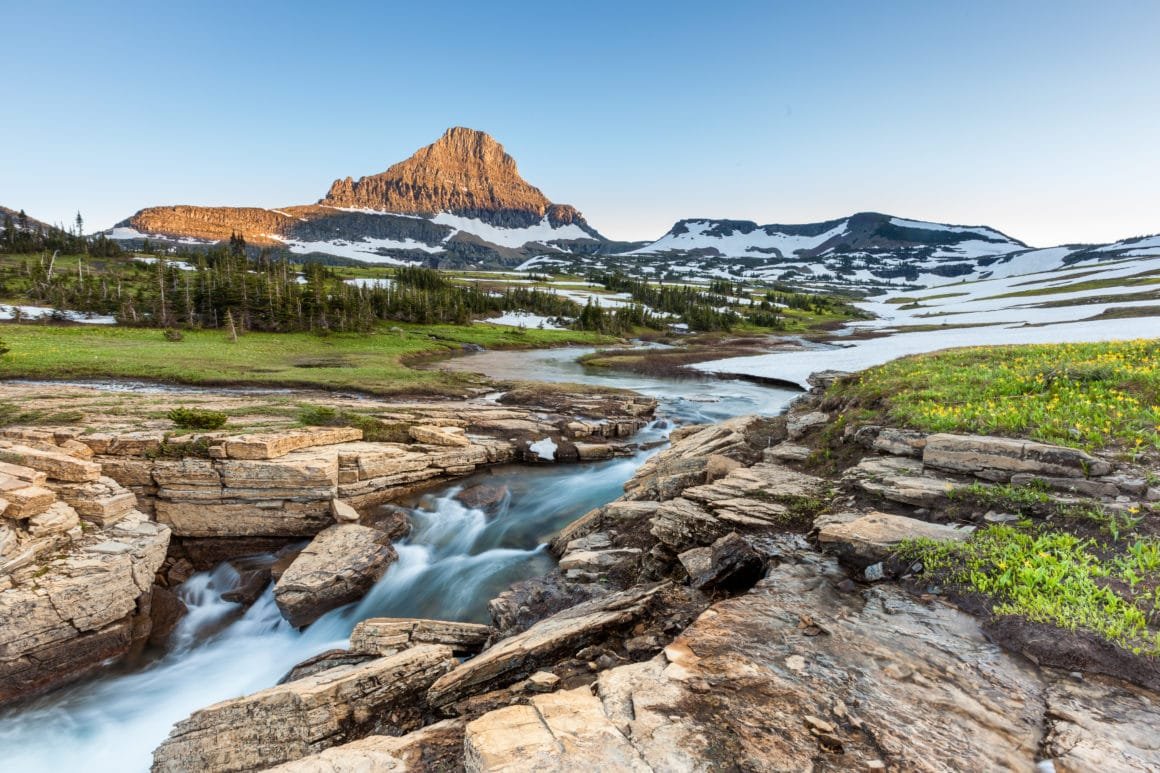
The Highline Trail near Logan Pass catches golden light on the Garden Wall. Lake McDonald’s western shore catches the last light. Bowman Lake in the North Fork is spectacular at sunset and almost empty of people.
Wildflowers
Peak wildflower bloom hits Logan Pass and the Highline Trail in late July through early August. Beargrass, Indian paintbrush, and fireweed dominate the meadows. A 24-70mm lens handles most compositions. Bring a polarizing filter for glacial lake reflections.
What Practical Tips Make or Break a Glacier Trip?
Cell Service and Offline Maps
Assume zero cell service beyond gateway towns. Download the free NPS Glacier app and offline Google Maps for the entire region before you leave Whitefish or Kalispell. Gaia GPS and AllTrails offer downloadable trail maps with topo layers. Do this the night before, not at the entrance gate.
Packing for Alpine Weather
A July afternoon at Logan Pass can swing from 70 degrees Fahrenheit and sunny to 40 degrees with sleet in under an hour. Carry a rain shell, an insulating layer, gloves, and a hat even on bluebird mornings. Hiking poles reduce knee strain on steep descents like the Grinnell Glacier switchbacks.
Family and Kids
Trail of the Cedars and the Lake McDonald shoreline are stroller-friendly. The Hidden Lake boardwalk works for young children with close supervision; mountain goats frequent the trail and are unpredictable. Boat tours on Lake McDonald and Swiftcurrent Lake are excellent for all ages and offer a rest day between hikes. Check GetYourGuide for guided family tours and boat tour bookings.
What Are the Biggest Mistakes People Make on a Glacier National Park Trip?
- Arriving without a vehicle reservation for GTTS Road. You will be turned around at the West Glacier or St. Mary entrance. This is the number one trip-killer.
- Booking lodging in Whitefish and underestimating the drive. Whitefish to Logan Pass is roughly 1.5 hours without traffic or construction. Add 30 minutes minimum in summer. Stay on the park’s east side if your itinerary is Many Glacier-heavy.
- Hiking alone in grizzly country at dawn or dusk. Bears are most active during these hours. Solo hikers are statistically more likely to have negative encounters. Team up.
- Carrying bear spray in a backpack pocket. If you cannot deploy it in three seconds, you are carrying it wrong. Belt holster, always.
- Ignoring altitude. Logan Pass sits at 6,646 feet. If you are flying in from sea level and hiking the same day, hydrate aggressively and consider an easier first trail.
- Skipping Many Glacier because it requires a separate reservation. Many Glacier is the best region for wildlife and hiking. It is worth every planning headache.
- Not checking trail status at the ranger station the morning of your hike. Bear closures, snow conditions, and bridge washouts change daily. The ranger station has the most current intel.
Frequently asked questions
Do I need a reservation to enter Glacier National Park?
Yes, during peak season a vehicle reservation is required for Going-to-the-Sun Road, Many Glacier, and North Fork areas. These are separate from your park entrance fee and are secured on recreation.gov. Without one, you can only enter these zones before 6 AM or after 3 PM.
When does Going-to-the-Sun Road fully open?
The road typically opens fully between mid-June and early July, depending on snowpack and plowing progress. It closes when snow accumulates, usually by mid-October. Some portions may open earlier. Check the NPS road status page for daily updates.
How do I get to Logan Pass if I do not have a vehicle reservation?
Use the park shuttle system. Park at Apgar or St. Mary and board the shuttle to Logan Pass. Shuttles run roughly July through Labor Day. A vehicle reservation is not required to access the park if you arrive by shuttle, bicycle, or on foot.
Is Glacier National Park suitable for young children?
Yes, with planning. Trail of the Cedars and the Lake McDonald shoreline are stroller-friendly. The Hidden Lake boardwalk is manageable for kids with close supervision. Boat tours provide excellent wildlife viewing without hiking. Bear safety discipline is essential with children: keep them close and make noise on trails.
What is the closest airport to Glacier National Park?
Glacier Park International Airport (FCA) in Kalispell is the closest, approximately 30 minutes from the West Glacier entrance. Missoula (MSO) is roughly 2.5 hours south. Great Falls (GTF) is about 3 hours east. Car rentals from FCA book out months ahead in summer.
Can I visit Waterton Lakes National Park from Glacier?
Yes, Waterton Lakes in Alberta, Canada, is accessible via the Chief Mountain border crossing, open seasonally from late May through September. A valid passport is required. Budget a full day for the trip. Your U.S. national park pass does not cover Waterton entry fees.
Plan your trip: booking platforms we trust
The WakaAbuja team uses these platforms for Glacier planning because they offer flexible cancellation options and verified guest reviews. Flexibility matters here; weather and bear activity can upend an itinerary overnight.
Gateway town motels and inns with free cancellation filters.
Cabins and houses near Whitefish, Columbia Falls, and St. Mary.
Flight and rental car bundles into Kalispell (FCA).
Guided hikes, boat tours, and photography excursions.
Restaurant reviews in Whitefish and recent trail condition reports.