
advertisement
Travel to Nice France: Everything You Need to Know Before You Go
To travel to Nice, France, you fly into Nice Côte d’Azur Airport (NCE), which is just 15 minutes from the city center via tram line 2. The city is a year-round destination where you can lounge on pebble beaches, explore a car-free Old Town, and eat Provençal food like socca.
Most international visitors, including Nigerians, need a valid Schengen visa to enter, and as of this year, the new ETIAS authorization is being phased in for visa-exempt nationalities.
I still remember stepping out of the Nice-Ville train station for the first time. The smell of salt water and pissaladière hit me simultaneously. After years of flying from Lagos to Paris and immediately escaping south, our team has learned that Nice isn’t just a pretty backdrop; it’s a city with very specific rhythms, strict social codes around beach clubs, and a transport system that rewards those who know that Bolt works better here than Uber.
Chidi, our lead logistics planner in Abuja, once tried to wing it on a Sunday in August without a restaurant reservation. He ended up eating a supermarket baguette on the Promenade des Anglais, which he now calls his most expensive mistake given the lost opportunity cost of a real Niçoise lunch.
Jump to: Visa and Entry Rules | When to Visit | Where to Stay | Real Travel Costs | Getting Around | First-Timer Mistakes | FAQs
Key takeaways
- Nice Côte d’Azur Airport (NCE) is a 15-minute tram ride from the city center; never take a taxi from the illegal touts inside the terminal.
- The beaches are made of smooth pebbles, not sand. Bring water shoes or risk a very awkward entry into the sea.
- A standard daily budget is 150 to 200 EUR per person, excluding accommodation.
- Bolt is significantly more reliable and cheaper than Uber for getting around the French Riviera.
- You must validate paper bus and tram tickets or face a 40 EUR on-the-spot fine.
- The Old Town (Vieux Nice) is mostly pedestrianized, but many Airbnb rentals have no elevators and five flights of stairs.
- Many restaurants close between 2:30 PM and 7:00 PM; planning meals around French eating hours is non-negotiable.
Do I need a visa to travel to Nice, France?

If you hold a Nigerian passport, you absolutely need a short-stay Schengen visa to enter France. The application goes through VFS Global in Abuja or Lagos, and I always recommend applying at least 8 weeks before your flight. French consulates have gotten stricter about bank statements recently; Fatima, our Lagos correspondent, had her first application rejected because she didn’t highlight her salary inflows. She reapplied with a cover letter explicitly linking every large deposit to her payroll schedule and got approved in 10 days.
@dasstak.ltd Replying to @Ksingh France Visit Visa #francevisa #visitfrance #visitparis #schengenvisa #uktofrance #uktoschengenvisa #ukstudent #internationalstudent #visarequirements
advertisement
As of this year, travelers from the US, UK, and Canada do not need a traditional visa but will need an ETIAS authorization once the system is fully operational. This is an online pre-screening, not a visa, costing 7 EUR. The rules are shifting, so check the official France Visas website before booking anything. Your passport must be valid for at least three months beyond your intended departure date from the Schengen area, and you need proof of accommodation and travel health insurance covering at least 30,000 EUR.
Chidi’s honest take: “Do not book non-refundable flights before your visa is stamped. I’ve seen it go wrong too many times. Pay the extra 40,000 Naira for a refundable dummy ticket from a registered travel agent, then swap it for the real one after approval.”
When is the best time to travel to Nice?
Late May to early July is the sweet spot. The weather sits at a pleasant 24 degrees Celsius, the Nice Jazz Festival hasn’t started yet so crowds are manageable, and the sea is warm enough to swim in. I made the mistake of visiting during the Cannes Film Festival in late May once without realizing hotel prices spike across the whole Riviera. Even budget hotels in Nice double their rates because the overflow from Cannes fills every bed within a 40-kilometer radius.
August is crowded, hot, and expensive. Almost all of France takes vacation in August, so domestic tourists flood the coast. November through February is very quiet. Many restaurants in the port area close entirely, and the famous Cours Saleya market shrinks to half its size. But if you want to be Nice to yourself and prefer crisp 12-degree weather for hiking the Colline du Château, winter is a genuine bargain. The Carnival of Nice in February is a major exception that fills the city with parades and flower battles.
Best for swimming
- June to September: Beach clubs are fully operational with sun loungers and restaurant service.
- July: Water temperatures peak at 24 degrees Celsius.
Best for budget
- November to March: Hotel prices drop by 40 to 60 percent compared to August.
- February: Carnival season offers a cultural spectacle without summer flight costs.
Where should I stay in Nice?
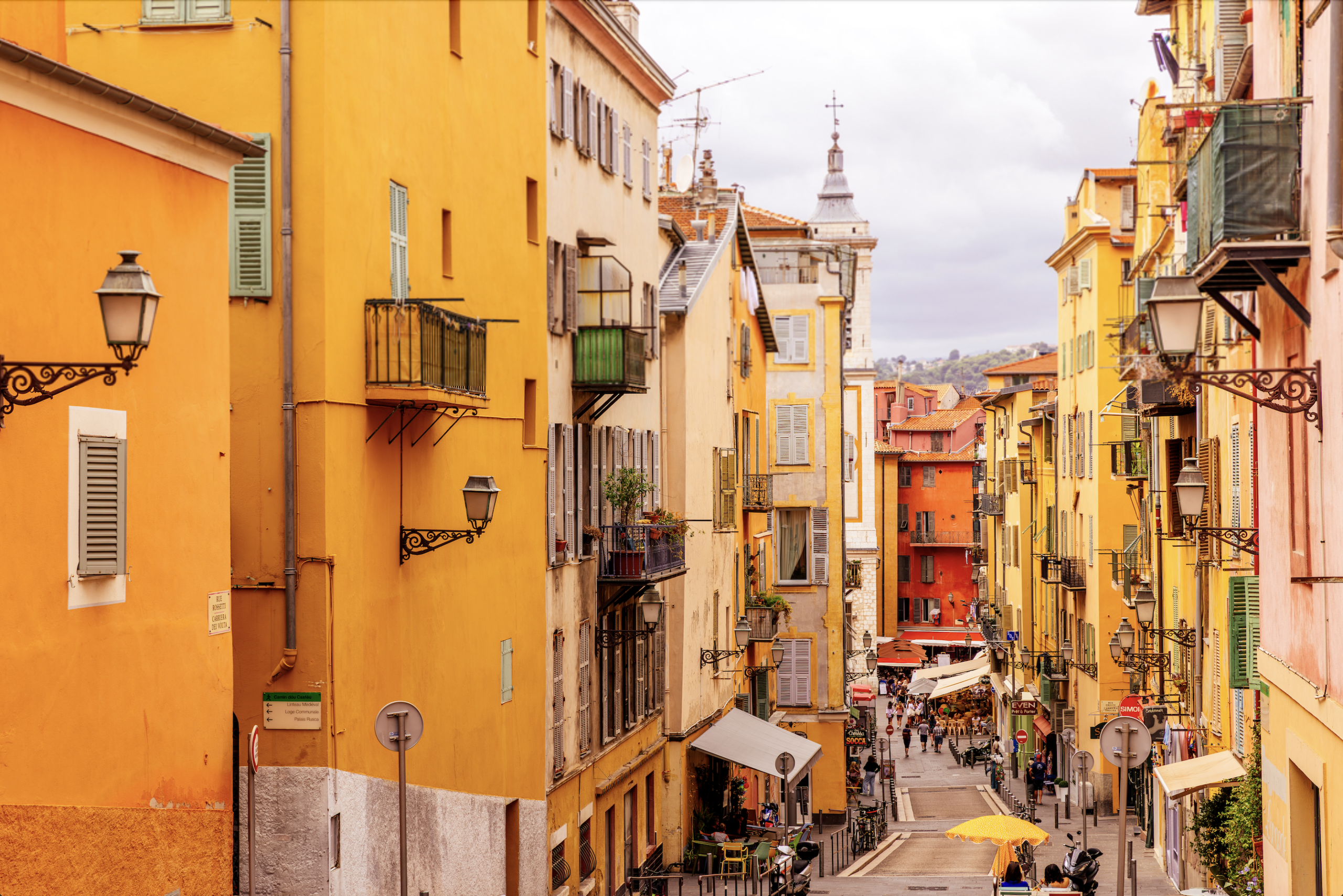
Choose your neighborhood based on your tolerance for noise and stairs. Vieux Nice is the postcard image: ochre buildings, narrow lanes, and the Cours Saleya market. But it’s loud until 3 AM, and most buildings lack elevators. I hauled a 23-kilogram suitcase up five flights of a 17th-century stairwell on my first trip. Never again. Jean-Médecin and the Quartier des Musiciens are the practical choice. You’re on the tram line, a 10-minute walk from the sea, and in a real residential area where boulangeries aren’t tourist traps.
The Port district is our team’s preference now. You get local seafood restaurants, the ferry terminal for Corsica, and a more authentic rhythm. Le Carré d’Or is the most central option, sandwiched between the pedestrian zone and the Promenade des Anglais, but it comes with a premium price. Cimiez, up on the hill, is where the Matisse Museum and Roman ruins are. It’s quiet and residential, but you will need a bus or a strong pair of calves to get up there.

Best for first-timers
- Jean-Médecin / Musiciens: Central, flat, affordable, excellent tram access.
Best for atmosphere
- Vieux Nice: Beautiful chaos. Stairs, noise, and the best socca in the city.
For accommodation, we search across platforms depending on the trip type. We use Booking.com for hotel flexibility with free cancellation and Vrbo when we need an apartment with a washing machine for a longer stay.
How much does a trip to Nice really cost?
Nice is the most affordable base on the French Riviera, but affordable is relative. A coffee at a café on the Cours Saleya costs 4.50 EUR if you sit down, and 1.50 EUR if you stand at the bar. That two-speed pricing structure is the key to unlocking Nice on a budget. A slice of socca, the chickpea flatbread that defines Niçoise street food, runs about 3 EUR at Chez Thérésa in the market. A proper three-course lunch with wine at a bistro will run 25 to 35 EUR.
Hotel prices swing dramatically. A basic double room at an Ibis in the city center averages 90 EUR in winter and 220 EUR in August. Boutique hotels on the Promenade des Anglais with a sea view start at 350 EUR per night during peak season. A 10-ride tram and bus ticket, the “carte de 10 voyages,” costs 17 EUR and can be shared among multiple people. Entry to the Chagall Museum is 10 EUR. We typically compare flight and hotel bundles on Expedia because the package discount can shave 15 percent off the total.
For a comfortable trip with one sit-down meal, a museum entry, and a few drinks per day, budget 150 to 200 EUR per person, plus accommodation. Check the official tourism office website for updated attraction prices, as museum rates tend to increase slightly each year.
@.findingjules How much it costs to vacation in the south of france #frenchriviera #cotedazur #southoffrance #southoffrancetiktok #southoffrancetravel #southoffrancevibes #frenchrivieralife #francetravel #francesummer
What’s the best way to get around Nice and the French Riviera?
Tram line 2 is the spine of the city. It runs directly from the airport through the city center to the port. Buy a ticket from the blue machines at every stop before boarding. This is critical: a paper ticket must be validated on the platform using the beige box near the stairs. Tap it until you hear a beep. Inspectors board in plain clothes and issue a 40 EUR fine on the spot. I have watched a fine three people in a single tram ride.
For cars, download Bolt. The wait times are shorter and the prices are consistently 10 to 15 percent lower than Uber’s. Both operate legally in Nice, but Bolt has stronger local driver density. Do not hail a taxi on the street; they rarely stop, and the meter starts from a dispatch location that inflates the fare.
The local bus network, Lignes d’Azur, reaches hilltop villages like Èze and Saint-Paul-de-Vence for 1.70 EUR per ride. For a day trip comparison, use Kayak to check rental car prices against train fares. The TER train zips you to Antibes in 20 minutes for 6 EUR, which is often faster than driving once you factor in parking.

Fatima’s honest take: “The train from Nice to Monaco is 22 minutes and costs 4.50 EUR. Do not drive it. Parking in Monaco costs more than your lunch.”
How do I plan a smart two-day itinerary?
A day-by-day plan saves you from the classic Nice error of spending half your trip on transport. On day one, tackle Vieux Nice, the Cours Saleya market, and the Colline du Château. The market starts packing up by 1:30 PM, so go before noon. The climb up to the Colline du Château is free and gives you the postcard view of the Baie des Anges without the cost of a helicopter tour. Lunch at a back-alley socca spot, not in the main square.
Spend the late afternoon on a pebbled beach; rent a lounge chair for 20 EUR at Castel Plage or do it local style with a beach mat.
Day two, pick one direction. The train west to Antibes and Cannes is efficient. Antibes has a morning Provençal market that rivals Nice’s for authenticity. The Picasso Museum in the old Grimaldi Castle is worth two hours. Eastbound, go to Villefranche-sur-Mer and Èze. The Nietzsche Path hike from Èze-sur-Mer to the medieval village of Èze is strenuous but unforgettable.
Book a shared tour on GetYourGuide if you want to hit three villages in a day without renting a car. The guides know which roads avoid the coastal traffic jams that clog the Basse Corniche in summer.
What are the biggest mistakes people make when traveling to Nice?
I’ve made most of these myself, and our WakaAbuja community has confirmed the rest. The first one is expecting sand. Nice beaches are smooth, gray pebbles called galets. They look beautiful but make walking into the water genuinely uncomfortable. Bring plastic water shoes; every pharmacy near the beach sells them for 10 EUR.
The second mistake is timing meals wrong. Restaurants serve lunch from noon to 2:00 PM and dinner from 7:00 PM. A 4:00 PM attempt to eat a sit-down meal will fail; you are in sandwich-and-kebab territory at that hour.
- Skipping ticket validation: The 40 EUR tram fine is not a joke. Validate every single time.
- Staying only on the Promenade des Anglais: First-time visitors often never leave the seafront. Walk three blocks inland and prices drop, quality rises, and French replaces English.
- Ignoring Sunday closures: Many independent shops and some restaurants close on Sunday. The Cours Saleya becomes an antiques market, not a food market. Plan accordingly.
- Ordering a “latte” at a café: Order “café crème.” A latte is Italian and will get you a look from the waiter. A café noisette is an espresso with a dash of milk.
- Renting a car for city exploration: Parking in central Nice is a nightmare of tiny garages and 30 EUR daily fees. Only rent a car for the hilltop villages.
Frequently asked questions
Is it safe to travel to Nice right now?
Nice is a generally safe city with a strong police presence, particularly around the Promenade des Anglais and the Old Town. Pickpocketing is the primary concern on crowded trams and in tourist-heavy areas, so keep bags zipped and avoid flashing valuables. Check your home country’s travel advisory for the most current safety assessment before departure.
How many days do I need in Nice?
Three full days is the ideal minimum to experience the city and take one day trip. Spend day one in Vieux Nice and on the Promenade, day two exploring a coastal town like Antibes or Villefranche, and day three in the hills or at a museum. With five days, you can add a trip to Monaco and a beach day with genuine relaxation time.
Can I drink tap water in Nice?
Yes, tap water in Nice is perfectly safe to drink and is treated to high standards. Restaurants will serve a carafe d’eau for free if you request it, and it is culturally normal to do so. Buying bottled water constantly is unnecessary and adds up fast.
What is the currency in Nice and can I use cards?
The currency is the Euro. Visa and Mastercard are accepted in all hotels, most restaurants, and shops. However, some small market vendors on Cours Saleya and older bakeries operate cash-only, so keep 20 to 30 EUR in small notes on you. American Express is frequently not accepted outside of major hotel chains.
What should I pack for a trip to Nice?
Water shoes are the most practical item for the pebble beaches. Pack a reusable water bottle, high-SPF sunscreen, and one moderately smart outfit for evening dinners; the French dress well at night even in casual coastal towns. A light jacket is essential even in summer because the Mistral wind can pick up suddenly after sunset.
Do people in Nice speak English?
In hotels, tourist-facing restaurants, and central shops, English is widely spoken. Once you venture into residential neighborhoods, the port area, or the tram, French becomes the norm. Learn “bonjour,” “merci,” and “parlez-vous anglais” before you go. Greeting anyone with “bonjour” before launching into English is a required courtesy here.
Plan your trip: booking platforms we trust
The WakaAbuja team cross-references several platforms for every trip to Nice because no single site offers the best price on every booking. We lean on these services depending on what type of travel we are booking.
Best for hotels with free cancellation and clear price breakdowns.
Good for comparing private apartment rates alongside hotels.
Our go-to for flight price comparisons across multiple airlines.
Reliable for day tours, boat trips, and skip-the-line museum tickets.
Unmatched for recent restaurant reviews and traveller photos.
Worth using if you are collecting loyalty rewards stamps toward a free night.
advertisement