advertisement
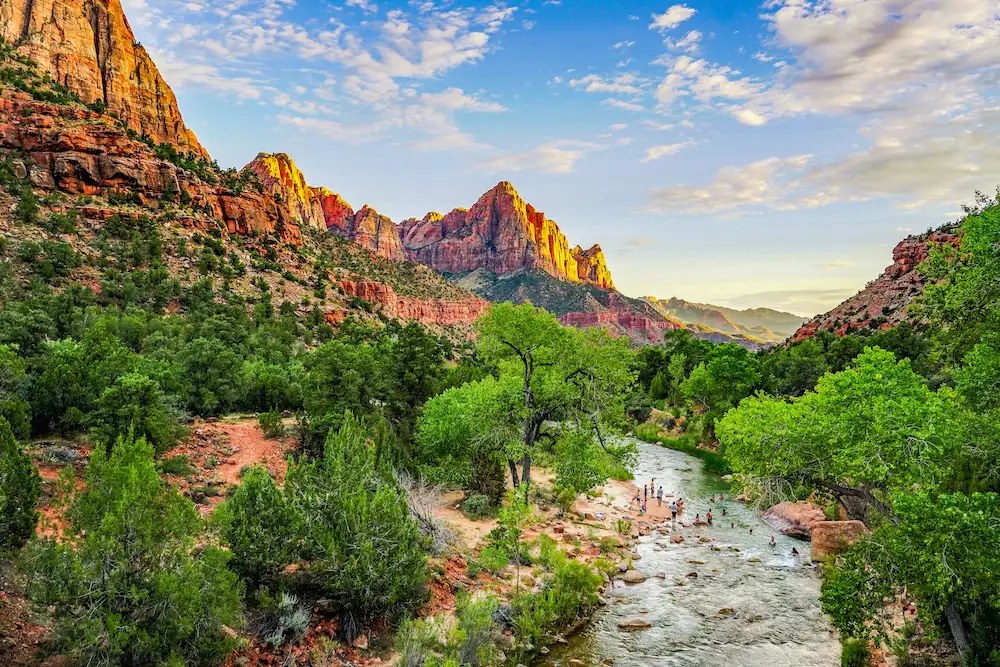
A trip to Zion National Park requires planning around the mandatory shuttle system in Zion Canyon, securing permits for Angels Landing and top-down Narrows hikes months in advance, and arriving at trailheads before 7 AM to beat both crowds and desert heat. The park is open year-round, but what you can access and how you experience it changes dramatically by season.
I remember Fatima, our Lagos-based itinerary lead, calling me from the Springdale visitor center parking lot at 6:45 AM on a Tuesday in September. She was already too late. Every spot was taken, the shuttle line stretched 40 minutes deep, and the temperature was climbing past 90 degrees Fahrenheit before breakfast. That morning reshaped how we plan every Zion trip.
This guide is built on that kind of ground-level, sometimes frustrating, always honest experience. It covers itineraries, permits, trails, and the logistics that official sites assume you already understand.
Jump to: Itineraries | Angels Landing Permits | The Narrows Guide | Trail Difficulty Matrix | Month-by-Month Guide | Where to Stay | Budget Breakdown | FAQ
Key takeaways
- The Zion Canyon Scenic Drive is closed to private vehicles from March through late November. You must use the free park shuttle or bike the road.
- Angels Landing now requires a permit obtained through a seasonal or day-before lottery. Thousands of hikers are denied annually.
- The Narrows closes when the Virgin River flow exceeds 150 cubic feet per second. Check conditions with the park before gearing up.
- A major restriction took effect June 7 of this year: large vehicles are banned from the Zion-Mt. Carmel Highway and Tunnel.
- Parking at the Zion Canyon Visitor Center fills by 7 AM in summer. Stay in Springdale and walk or take the free town shuttle instead.
- Flash floods are a real, sometimes fatal risk in slot canyons from July through September. Check the forecast and heed ranger warnings.
What Are the Best Zion National Park Itineraries for 1, 3, and 5 Days?
Chidi from our Abuja team has now run three different Zion trips, each with a different duration. Here are the blueprints that worked, with the fat trimmed off.
1-Day Blitz
Morning: First shuttle to The Grotto stop. Hike Angels Landing if you have a permit, or continue to Scout Lookout for the same views without the chains section. Back down by late morning.
Afternoon: Riverside Walk to the Temple of Sinawava. Wade into the Narrows for the first mile (no permit needed for bottom-up).
Evening: Dinner in Springdale, watch sunset from the Canyon Junction Bridge.
3-Day Classic
Day 1: Angels Landing or Scout Lookout in the morning. Pa’rus Trail bike ride or walk in the afternoon.
Day 2: Full day dedicated to The Narrows bottom-up hike. Rent gear in Springdale the evening before. Start by 7:30 AM.
Day 3: Drive the Zion-Mt. Carmel Highway east side. Canyon Overlook Trail. Afternoon visit to Kolob Canyons section (separate entrance, no shuttle needed).
5-Day Deep Dive
Days 1–3: Same as 3-day itinerary above, but at a slower pace.
Day 4: Observation Point via East Mesa Trail (the shorter access route from outside the canyon) or West Rim Trail day hike.
Day 5: Kolob Terrace Road. Northgate Peaks Trail or a shorter walk to the Wildcat Canyon overlook. Evening in Springdale.
How Do Angels Landing Permits Work and How Can You Improve Your Odds?
@florentinadenisa_ How to get a PERMIT for Angels Landing ➡️ I applied for my permit the day before and lucked out. I would recommend doing this hike on a weekday to get a better chance. Here’s how to get an Angels Landing permit: • Seasonal Lottery: Opens a few months in advance if you like to plan ahead. You’ll rank your preferred dates, and if you’re selected, you’ll be charged for the permit. • Day-Before Lottery: If you didn’t get a seasonal permit (or planned your trip last minute like I did), you can enter the day before your hike. Applications open from 12:01 a.m. to 3 p.m. MT, and results are sent out around 4 p.m. MT. 100% worth doing if it’s in your bucket list. Personally didn’t think it was that scary. #zionnationalpark #angelslanding #utah #permithikes #solohikes
The Angels Landing permit system runs on two lotteries. The seasonal lottery opens months ahead and covers a block of dates. The day-before lottery opens at midnight and closes at 3 PM Mountain Time for the following day’s hike. You apply through recreation.gov. Each application costs a small non-refundable fee, and if you win, the permit fee is per person.
Success rates hover low, sometimes under 10% for peak dates. Apply for the seasonal lottery as early as the window allows and list multiple date ranges. For the day-before lottery, set a phone alarm. Apply every single day you are in the area. A group of three people each submitting separate applications for the same date multiplies your odds. If you do not get a permit, do not let it derail your trip. Scout Lookout, reached via the same West Rim Trail, delivers the identical canyon view without the chained spine ridge. The final half-mile of chains is terrifying for many and is not an essential component of a great Zion day.
Chidi’s honest take: “I have been denied an Angels Landing permit twice. The second time, I hiked to Scout Lookout anyway and then drove to the Canyon Overlook Trail instead. That spontaneous pivot became one of my favorite Zion mornings. Do not let the lottery define your trip.”
How Do You Prepare for the Narrows Hike in Zion?
The Narrows is a river hike through a slot canyon with walls rising a thousand feet on either side. There are two ways to do it. The bottom-up approach starts at the Temple of Sinawava shuttle stop, requires no permit, and lets you wade as far upstream as you wish before turning back. The top-down route starts at Chamberlain’s Ranch, requires a wilderness permit, and takes 12 to 16 hours across 16 miles. Most visitors want the bottom-up experience.
Rent proper gear. You will see tourists in sneakers and shorts, shivering and turning back within ten minutes. Zion Outfitter and Zion Guru in Springdale rent neoprene socks, canyoneering boots with grip soles, and a wooden walking stick or trekking pole for roughly $25 to $35 per day. The water is snowmelt and stays cold even in August. A wetsuit or dry pants rental extends your comfort significantly. Pick up your gear the evening before so you can catch the first shuttle without a rental shop delay.
Check the Virgin River flow rate before you commit. When the flow exceeds 150 cubic feet per second, the Narrows closes to all entry. Between 100 and 150 CFS, hiking is difficult and only recommended for strong, experienced hikers. Below 70 CFS is comfortable. The park posts current flow data on its website and at the visitor center. Flash flood danger is highest from July through September during monsoon season. If rain is forecast anywhere in the watershed, even miles upstream, skip the Narrows that day entirely. A flash flood through a slot canyon is unsurvivable.
Which Zion Trail Is Right for You? A Difficulty Comparison
Fatima organized Zion’s most popular trails into a scannable reference so you can match a hike to your fitness level and available time. Distances are round-trip unless noted. Always carry at least one liter of water per two hours of hiking, more in summer.
Pa’rus Trail
3.4 mi | Flat | Easy
Paved, wheelchair- and bike-friendly. Follows the Virgin River. Best for families with strollers and sunset walks.
Canyon Overlook
1 mi RT | 163 ft gain | Easy-Moderate
Short trail with a huge payoff at the end. Views down Pine Creek canyon. Great for small kids who can handle a few rail-guarded sections.
Riverside Walk
2.2 mi RT | Flat | Easy
Paved path to the Narrows entrance. Wheelchair accessible to the viewing area. Packed with visitors by mid-morning.
Scout Lookout (via West Rim)
4 mi RT | 1,100 ft gain | Strenuous
The hike to Angels Landing minus the chains. Walter’s Wiggles switchbacks are relentless. Views identical to the permitted section.
The Narrows (Bottom-Up)
Up to 9.4 mi RT | Variable | Strenuous
Wading against current over slippery river rocks. Turn around when you are tired; you must fight the current both ways.
Observation Point (via East Mesa)
7 mi RT | 700 ft gain | Moderate
Accessible from outside the park. Views looking down on Angels Landing. Less crowded than the main canyon trails.
When Is the Best Time of Year to Visit Zion National Park?
Zion’s character shifts sharply with the seasons. Fatima has now visited in March snow, June heat, and October perfection. Each trip required different gear and a different daily schedule.
Winter (Dec–Feb)
Crowds: Very low
Access: Shuttle not running, drive Scenic Drive yourself
Temp: 30s–50s °F
Best for: Solitude, snow-dusted canyon walls
Spring (Mar–May)
Crowds: Moderate, rising in May
Access: Shuttle begins March
Temp: 40s–70s °F
Best for: Wildflowers, comfortable hiking temperatures
Summer (Jun–Aug)
Crowds: Extreme
Access: Shuttle mandatory
Temp: 70s–100s+°F
Best for: Narrows wading, very early starts for everything else
Fall (Sep–Nov)
Crowds: High in Sep, tapering by Nov
Access: Shuttle through Nov
Temp: 50s–80s °F
Best for: Ideal hiking, autumn cottonwood color
Where Should You Stay for a Zion Trip?
Springdale, the town built right up against the park’s south entrance, is the most convenient base. Its free town shuttle connects to the park’s pedestrian entrance, solving the parking problem entirely. Hotels here range from budget motels to the luxurious Cliffrose. Book through Booking.com for the widest Springdale selection, especially properties with free cancellation.
Inside the park, the Zion Lodge sits on the Scenic Drive and is the only in-park hotel. Its location lets you bypass the shuttle for hikes starting near The Grotto. Rooms book a year out. Watchman Campground and South Campground sit near the visitor center and also fill months in advance via recreation.gov. Reserve the moment your window opens.
If Springdale is sold out, Hurricane and La Verkin are roughly 25 minutes away and significantly cheaper. St. George is 45 minutes and offers the most dining and lodging variety. You can compare vacation rental options across these towns on Vrbo. The trade-off is losing the walk-to-the-shuttle convenience that Springdale provides.
Large Vehicle and RV Restrictions on Zion-Mt. Carmel Highway (This Year’s Rule Change)
A major restriction took effect on June 7 of this year. Vehicles measuring 7 feet 6 inches wide or taller than 11 feet 4 inches are now prohibited from driving the Zion-Mt. Carmel Highway, including the famous tunnel. This applies to many RVs, camper vans, and trucks with rooftop cargo boxes. The park made this change due to severe congestion and safety incidents involving large vehicles scraping tunnel walls or veering into oncoming traffic in the narrow passage.
If your vehicle exceeds these dimensions, you must use the Kolob Terrace Road entrance, the Kolob Canyons entrance off I-15, or park outside and use the shuttle. There is no bypass route through the tunnel. This is not a temporary measure. Plan your route accordingly before you arrive with an RV reservation. The official dimensions and escort rules are posted on the NPS Zion tunnel page.
What Does a Realistic Zion National Park Trip Cost?
Chidi tracked expenses from his most recent three-day Zion trip for two people. Prices are approximate and can shift by season.
- Park entry: $35 per vehicle for 7 days. The America the Beautiful annual pass ($80) covers Zion and every other national park for a year.
- Angels Landing permit: $6 application fee per lottery entry. Winning adds a $3 per-person permit fee.
- Narrows gear rental: $25–$35 per person per day for boots, neoprene socks, and a walking stick.
- Camping in the park: $20–$30 per night at Watchman or South Campground.
- Springdale motel: $180–$350 per night in peak season. Budget in Hurricane starts around $90.
- Meals: $12–$18 per person for a casual dinner in Springdale. Grab-and-go breakfast items from Sol Foods market run $5–$10.
- Daily couple estimate: $200–$450 depending on lodging, meals, and gear rentals.
What Should You Pack for a Zion National Park Trip?
Fatima built this packing list after leaving critical items behind on her first trip. Tailor it to your season.
- Hydration: Minimum 3 liters of water capacity per person in summer. A hydration bladder plus a backup bottle. Electrolyte tablets for long hikes.
- Footwear: Sturdy hiking boots with ankle support for Angels Landing and rocky trails. Closed-toe water shoes or rented canyoneering boots for the Narrows.
- Sun protection: Broad-spectrum sunscreen, a wide-brimmed hat, and sunglasses. The canyon reflects heat and UV from every surface.
- Layers: A lightweight long-sleeve sun shirt for summer. A puffy jacket for shoulder season mornings. Rain shell for monsoon season (July–September).
- Gear: Trekking poles for steep descents. A headlamp if you plan a pre-dawn start. A dry bag for electronics in the Narrows.
- Misc: Cash for the small entry fee if you lack a pass. A physical map. Offline GPS maps downloaded on your phone.
Where Should You Eat Near Zion National Park?
Springdale has a concentrated, surprisingly good food scene. Oscar’s Cafe serves breakfast burritos large enough to fuel a full morning of hiking and opens early. Deep Creek Coffee Co. pulls proper espresso and opens at 6:30 AM for pre-shuttle caffeine. For dinner, the Spotted Dog in the Flanigan’s Inn complex offers a sit-down meal with a patio, and Bit & Spur Restaurant has served Mexican-inspired fare for decades.
If you want to pack your own food, Sol Foods supermarket in Springdale carries everything from fresh produce to deli sandwiches. Prices are higher than a standard grocery store but reasonable for a gateway town. Stock up on trail snacks, sandwich supplies, and water here. For reviews and current ratings of every restaurant in Springdale, check TripAdvisor before your trip.
What Other Parks Can You Visit Near Zion?
Zion anchors a region dense with national parks and monuments. Bryce Canyon National Park sits 1.5 hours northeast and makes a logical next stop. Its hoodoo amphitheaters sit at 8,000 feet of elevation, so temperatures run 20 degrees cooler than Zion, a welcome relief in summer. Grand Canyon’s North Rim is a 2.5-hour drive and receives a fraction of the South Rim’s crowds. It is open roughly mid-May through October. Cedar Breaks National Monument, an hour north, offers a quieter alpine amphitheater experience. For a broader Southwest road trip, you can bundle flights and multi-city itineraries through Expedia or book guided multi-park tours on GetYourGuide that handle the driving logistics.
Is Zion a Good National Park for Families with Kids?
@explore_az Baby Cal’s first National Park and hike! We highly recommend staying at Zion Canyon Cabins and getting a hiking backpack like the Osprey Poco to make your trip easier. #travelwithbaby #hikewithbaby #nationalparks #zionnationalpark #familytravel
Zion works well for families, but it rewards those who match hikes to their children’s ages. The Pa’rus Trail accommodates strollers and gives toddlers room to walk without drop-offs. The Riverside Walk is paved and ends at a shallow riverbank where kids can splash safely on hot days. The Canyon Overlook Trail is short but includes a few sections with railings where small children need a hand to hold. The Junior Ranger program, available at the visitor center, gives kids an activity booklet and a badge upon completion, and it is genuinely well-designed to keep them engaged on trails and shuttles.
Avoid Angels Landing; Observation Point via the main canyon route, and the Narrows beyond the first quarter-mile with children under 10. The combination of heat, exposure, and physical demand leads to meltdowns, and in some cases, dangerous situations. There is no shame in sticking to the valley floor hikes and letting the canyon walls do the impressing.
What Are the Biggest First-Timer Mistakes at Zion National Park?
- Assuming you can drive Scenic Drive in summer. The road is closed to private vehicles from March through November. You must use the shuttle or bike.
- Arriving at 9 AM and expecting to park. The visitor center lot fills before 7 AM in peak months. Stay in Springdale and walk in.
- Hiking Angels Landing in flip-flops or without water. Rangers perform rescues here regularly. Heat exhaustion and poor footwear are the two leading causes.
- Ignoring flash flood warnings. If the Narrows or any slot canyon is under a flash flood watch, do not enter. The threat is real and the outcome is often fatal.
- Waiting until you arrive to book campgrounds. Watchman Campground sells out the day reservations open. Book on recreation.gov months ahead.
- Skipping Kolob Canyons and Kolob Terrace entirely. These separate sections of the park have no shuttle, no crowds, and spectacular trails. If Zion Canyon feels overwhelming, drive here instead.
- Not renting Narrows gear because “the water doesn’t look that cold.” It is snowmelt. It is that cold. Rent the boots and neoprene socks.
Frequently asked questions
Do I need a reservation to enter Zion National Park?
No general entry reservation is required to drive into Zion or use the shuttle. You pay the entrance fee at the gate. However, you do need a permit for Angels Landing and for top-down Narrows backpacking trips. Campgrounds require separate reservations.
How does the Zion Canyon shuttle work?
The shuttle runs from the Zion Canyon Visitor Center to the Temple of Sinawava, making nine stops. It is free with park entry and operates roughly 6 AM to 8 PM in summer, with shorter hours in shoulder seasons. You board at the visitor center and can hop on and off at any stop.
Can I drive my RV through the Zion-Mt. Carmel Tunnel?
As of June 7 this year, vehicles wider than 7 feet 6 inches or taller than 11 feet 4 inches are banned from the Zion-Mt. Carmel Highway. This includes many RVs and high-roof camper vans. Check your vehicle dimensions against the posted limits before planning this route.
What is the best Zion hike if I have a fear of heights?
The Pa’rus Trail, Riverside Walk, and lower section of the Narrows have no exposure or drop-offs. Emerald Pools via the lower trail is also a good moderate option. Avoid Angels Landing, the Canyon Overlook’s unfenced sections, and Observation Point via the main canyon route.
Is Zion open in the winter?
Yes, Zion Canyon is open 24 hours a day, every day of the year. The shuttle stops running in winter, so you can drive your private vehicle on Scenic Drive. Some trails like Angels Landing may close temporarily for ice. Kolob Canyons Road may close after heavy snow.
How far is Zion from Las Vegas?
Zion National Park is approximately 160 miles from Las Vegas, a 2.5 to 3 hour drive via I-15 north. It is the closest national park to the Las Vegas Strip and makes a feasible, though long, day trip. Staying overnight in Springdale is a far better experience.
Plan your trip: booking platforms we use
The WakaAbuja team books Zion trips with a short list of platforms we have tested repeatedly. Each serves a specific purpose in the planning chain.
Springdale motels and hotels with free cancellation filters.
Vacation rentals in Hurricane and La Verkin for families.
Las Vegas flights and rental car packages for the drive to Zion.
Guided Narrows hikes, canyoneering trips, and multi-park tours.
Springdale restaurant reviews and gear rental shop comparisons.