advertisement
Lake Atitlan Guatemala: The Complete Travel Guide for US & UK Travelers
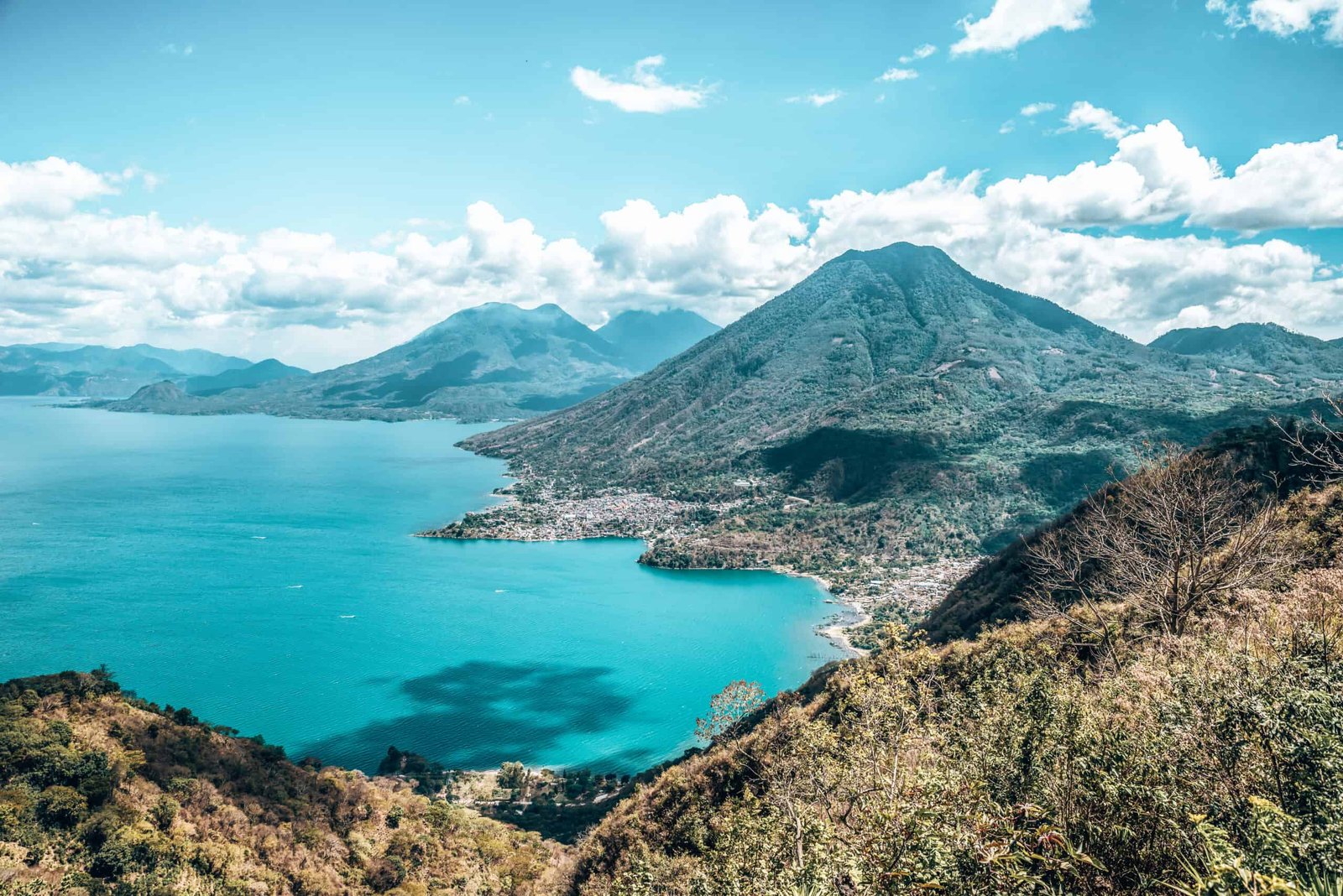
Lake Atitlán is a volcanic crater lake in the Guatemalan highlands, ringed by Mayan villages and three volcanoes. For US and UK travelers, the most direct route is flying into Guatemala City (GUA) and taking a 3-hour shuttle.
US and UK passport holders both get a 90-day visa-free entry stamp on arrival, making it one of the most logistically straightforward long-haul eco-destinations in the Americas right now.
I remember sitting on the dock at San Pedro La Laguna early one morning, watching the volcanoes sharp against a pink sky, thinking two things. First, that this was the closest thing to Lake Como I had ever seen outside of Italy, and second, that the 14 hours of travel from London felt genuinely worth it. Fatima, who joined me from our Edinburgh base, put it better: “It’s like someone dropped an Italian lake into a Mayan highland village and cut the price by two-thirds.” She wasn’t wrong.
This guide covers every logistical step a US or UK traveler needs, from flight routes out of JFK or Heathrow to the daily budget in both dollars and pounds. No vague inspiration. Just the practical roadmap we wish we’d had before we booked.
Jump to: Flights From the US | Flights From the UK | Visa & Entry | Town Guide | Safety | Budget in $ and £ | 7-Day Itinerary | FAQs
Key takeaways
- US and UK passport holders both receive a 90-day visa-free stamp on arrival, no advance paperwork or fees required.
- The most common flight route from the UK connects through Miami, Houston, or Mexico City, with total journey times averaging 14 to 16 hours.
- A comfortable mid-range daily budget runs $60 to $90 USD, roughly 48 to 72 GBP, including accommodation, meals, and a boat ride or activity.
- Safety concerns are heavily concentrated in Guatemala City, not around the lake. We detail the specific neighborhoods to avoid for your transit stop.
- Guatemala uses US-style 110V outlets and Type A/B plugs, a convenient detail for Americans but one that means UK travelers must pack a simple adapter.
- The dry season from November to April offers the clearest volcano views, but the rainy-season afternoons from May to October clear quickly and bring fewer crowds.
- Book your Guatemala City to Panajachel shuttle online before you land to avoid the chaotic airport taxi scrum.
Is Lake Atitlán Really the “Lake Como of Central America”?
Travel magazines have been running this comparison for years, and for once the cliché holds up. Both lakes sit in deep alpine basins ringed by steep mountains. Both have ferries connecting small, character-distinct villages. The critical difference is cost and cultural texture. A lakeside room with a volcano view at Lake Atitlán runs $40 to $80 USD per night. A comparable room on Lake Como runs $250 to $400 USD. You also swap Italian villas for Mayan villages where Kaqchikel and Tz’utujil are still the first languages. For US and UK travelers weighing a long-haul trip, the value proposition is stark. You are getting a world-class lake landscape, excellent coffee, and a genuinely different cultural immersion for roughly the price of a modest weekend break in Cornwall or the Catskills.
Fatima’s honest take: “I’ve done Lake Como in July. It was beautiful, packed, and eye-wateringly expensive. Atitlán in November was quieter and warmer, and the view from my $45-a-night balcony was genuinely better. I’d pick Atitlán for a two-week trip and Como for a long weekend.”
Getting to Lake Atitlán From the US: Routes, Hubs, and Typical Fares

Guatemala City’s La Aurora International Airport (GUA) is your only practical entry point. From the US, direct flights are concentrated in a handful of hubs, and the route map shifts seasonally. We track prices monthly on Kayak, and the pattern is consistent. Miami, Houston, and Dallas offer the most reliable direct options. New York, Los Angeles, and Chicago typically require one stop. A round-trip fare in economy during shoulder season, April to May and October to early November, runs $350 to $550 USD.
Peak dry-season fares, December through February, can jump to $700 to $900 USD. We recommend setting a price alert three months out and booking when you see a dip below $450 from any major East Coast hub.
Direct Routes (no plane change)
- Miami (MIA) to GUA: 2 hrs 45 min. Multiple daily flights on American Airlines and Avianca.
- Houston (IAH) to GUA: 3 hrs. United runs this route, often the cheapest direct option.
- Dallas (DFW) to GUA: 3 hrs 20 min. American Airlines is good for connecting from the West Coast.
One-Stop Routes (common connections)
- New York (JFK) to GUA: 6 to 7 hrs total via Miami or Houston.
- Los Angeles (LAX) to GUA: 7 to 8 hrs total via Houston, Dallas, or Mexico City.
- Chicago (ORD) to GUA: 7 hrs total via Houston or Miami.
Once you land, you will need a 3-hour shuttle van to Panajachel, the main gateway town on the lake. Pre-book this. We use and recommend checking current shuttle schedules on GetYourGuide or with your hotel. An airport taxi to Antigua first, then a shuttle the next morning, is also a popular and lower-stress option if you land late.
Getting to Lake Atitlán from the UK: The Heathrow and Manchester Routes

There are no direct flights from the UK to Guatemala City. Your realistic routing connects through a US hub, Mexico City, or occasionally Madrid. The most common and usually cheapest path is London Heathrow to Miami or Houston, then onward to GUA. Total journey time, including the layover, averages 14 to 16 hours. An alternative route through Mexico City on Aeromexico can be faster on paper but frequently incurs long immigration queues during the connection. We have found the Houston (IAH) connection on United to be the most reliable for a single booking and protected connection.
Economy round-trip fares from the UK sit in a predictable band. Off-peak, April to May and late September to November, expect to pay 450 to 650 GBP. Peak winter dates, particularly Christmas and February half-term, push fares to 800 to 1,100 GBP. Booking roughly 10 to 12 weeks out is our sweet spot. Use Kayak or Expedia for multi-city searches and set alerts early. Fatima booked her Edinburgh to GUA via Amsterdam and Mexico City routing for 520 GBP in late April and considered it a solid deal. Always check whether your fare includes checked luggage, as several US-carrier basic economy tickets do not, and you will want a bag for a trip of this length.
Visa & Entry Rules for US and UK Passport Holders
This is the easiest part of planning the whole trip. Guatemala grants a 90-day visa-free entry stamp to both US and UK citizens on arrival. There is no fee, no online pre-registration, and no reciprocity charge. The immigration officer will ask for your passport, which must be valid for at least six months beyond your entry date, and may ask to see proof of onward travel. A flight reservation email on your phone is almost always sufficient. The 90-day allowance covers Guatemala, Honduras, El Salvador, and Nicaragua as part of the CA-4 Border Control Agreement, meaning you can cross borders within this bloc without resetting the clock.
The UK Foreign Office travel advice page and the US State Department Guatemala advisory page both confirm this, but always check those directly before you fly, as rules can change with short notice.
Border crossing note: There are no routine vaccination requirements for entry from the US or UK. However, some travelers choose hepatitis A and typhoid vaccinations. Consult a travel clinic, not this page, for medical advice specific to your health history.
Which Town Should You Stay In? All Six Lake Atitlán Villages Compared
Choosing your base is the single decision that shapes your entire trip. Each village has a distinct personality, and getting it wrong means a lot of time wasted on lanchas, the public ferries that are scenic but slow. We stayed in four of the six across two trips and interviewed other travelers for the rest. Here is the breakdown, in order from most accessible to most remote.
Panajachel (Pana)
Vibe: Transport hub and commercial gateway. Loud, convenient, not charming.
Best for: A one-night transit stop on arrival or departure night before a flight.
Avoid if you want a quiet, village feel. Pana is a working town with heavy traffic.
Our pick: The Selina hostel for a clean, social bed near the dock, $15 to $25 USD per night.
San Pedro La Laguna
Vibe: Backpacker central. Spanish schools, cheap eats, vibrant nightlife.
Best for: Solo travelers and budget-focused visitors wanting a social scene.
Avoid if you want quiet. The main street can get loud until late.
Our pick: Mr. Mullet’s hostel for a social atmosphere, around $10 to $15 USD per night.
San Marcos La Laguna
Vibe: New-age wellness hub. Yoga studios, vegan cafes, cacao ceremonies.
Best for: A retreat-style stay focused on meditation, massage, and holistic workshops.
Avoid if you are skeptical of crystal healing or find the wellness scene grating.
Our pick: Lush Atitlán for mid-range eco-cabins, $60 to $90 USD per night.
Santa Cruz La Laguna
Vibe: Quiet, spread-out, and scenic. Dotted with mid-range to upscale eco-lodges.
Best for: Couples and anyone wanting a balance of tranquility and kayak access.
Avoid if you need walkable access to a town center. Properties are spread along a steep path.
Our pick: La Iguana Perdida for a social-but-relaxed lakeside stay, $25 to $50 USD per night.
San Juan La Laguna
Vibe: Artisan cooperative town. Textile and painting collectives, quiet and culturally rich.
Best for: A half-day trip from San Pedro to see weaving cooperatives and buy directly from artists.
Avoid if you want nightlife or a wide range of dining options.
Santiago Atitlán
Vibe: Largest indigenous town, strong Tz’utujil Maya identity, famous for the Maximón shrine.
Best for: A culturally focused day trip with a guide to understand the local spiritual traditions.
Avoid if you want a base for hiking. Santiago is better as an excursion than a multi-day stay.
Chidi’s honest take: “I split my week between San Pedro for the social energy and Santa Cruz to decompress. Two towns in seven days felt right. Trying to see all six in one trip is a mistake; you will spend half your time on a ferry.”
Is Lake Atitlán safe? US and UK Government Advisories Explained

This is the question every first-time traveler to Guatemala asks, and the answer requires separating Guatemala City from the highlands. The US State Department currently assigns Guatemala a “Level 3: Reconsider Travel” advisory, but this is driven almost entirely by crime in specific zones of the capital. The UK Foreign Office similarly warns against non-essential travel to certain Guatemala City neighborhoods while noting that tourist areas, including Antigua and Lake Atitlán, see far fewer incidents.
We read both advisories in full before our trip and concluded the lake region felt comparable to other highland tourist zones in Latin America. Petty theft is the most common risk. Violent incidents targeting tourists at the lake are rare.
In practical terms, do not walk alone on secluded lakeside paths after dark. Use registered lanchas or pre-booked shuttles rather than walking between villages at night. Keep your passport in your accommodation safe and carry a photocopy. Avoid flashing expensive gear on crowded public boats. If you are transiting through Guatemala City, take a pre-booked shuttle directly from the airport to Antigua or Panajachel without detouring into the capital.
These are the same precautions you would take in any unfamiliar destination, and they are sufficient. Always check the current advisory on the US State Department or UK Foreign Office site right before you travel.
Lake Atitlán Budget: Daily Costs in USD and GBP
We tracked every quetzal we spent for a week and converted it into numbers that make sense for a US or UK reader. Guatemala remains one of the best-value destinations in Latin America for the quality of experience delivered. Below are real, mid-range, per-person daily figures. Budget travelers can shave roughly 30% off these numbers. Luxury eco-lodge stays double that.
Backpacker Budget
- Dorm bed: $10 to $15 USD / 8 to 12 GBP
- Street food meal: $3 to $5 USD / 2.50 to 4 GBP
- Daily lancha pass: $3 to $5 USD / 2.50 to 4 GBP
- Total daily: $25 to $35 USD / 20 to 28 GBP
Mid-Range Comfort
- Private room with lake view: $40 to $80 USD / 32 to 64 GBP
- Restaurant dinner with drinks: $12 to $18 USD / 10 to 14 GBP
- Guided hike (Indian Nose): $15 to $25 USD / 12 to 20 GBP
- Total daily: $60 to $90 USD / 48 to 72 GBP
ATMs are available in Panajachel, San Pedro, and San Marcos, but they can run out of cash on weekends. Bring at least 1,500 Quetzales, roughly $190 USD or 150 GBP, in cash as a buffer. US dollars are widely accepted in tourist-facing businesses at a slightly worse exchange rate than Quetzales. UK pounds are not; convert before you arrive or withdraw quetzales directly from an ATM. Check current accommodation prices on Booking.com before locking in your budget.
Best Things to Do at Lake Atitlán: Adventure, Culture, and Wellness
The lake’s activity roster splits neatly into three categories. Most travelers we met mixed at least two. Hardcore hikers tend to base in San Pedro for the early-morning summit access. Wellness-focused travelers cluster in San Marcos. Culture seekers gravitate toward the Santiago and San Juan day trips.
Adventure
- Indian Nose sunrise hike: 4 a.m. start, 45-minute climb, and the iconic volcano-and-lake photo. Book a guide in San Pedro for $15 to $25 USD.
- Kayaking to Cerro Tzankujil: Rent a kayak in San Marcos, paddle 30 minutes to the nature reserve, and jump off the 10-meter cliff platform.
- Volcán San Pedro: A strenuous 6-hour round trip. Hire a guide, required by the local community, for $30 to $40 USD.
Culture
- San Juan weaving cooperatives: Watch women dye cotton with native plants and buy a scarf directly from the weaver, not a middleman.
- Maximón shrine, Santiago: Visit the wandering folk saint with a local guide who can explain the syncretic Maya-Catholic tradition.
- Chichicastenango market: Thursday and Sunday, a 1.5-hour shuttle from Panajachel. The largest indigenous market in Central America.
Wellness
- Yoga at The Yoga Forest, San Marcos: Open-air studio overlooking the lake. Drop-in classes are $10 to $15 USD.
- Temazcal ceremony: A traditional Mayan sweat lodge. Book through a reputable San Marcos center, not a beach tout.
- Spanish immersion: San Pedro has a dozen schools. A week of 4-hour daily one-on-one classes runs $150 to $200 USD, including a homestay.
Book tours through your accommodation or established operators with recent reviews on TripAdvisor. Avoid booking through touts at the Panajachel dock. We watched a traveler pay double for an Indian Nose hike from a stranger with no guide license. The sunrise was the same, but the experience, she told us later, was a disorganized mess.
Sample 7-Day Lake Atitlán Itinerary for First-Time Visitors
This is the exact week-long plan we recommend to friends flying in from the US or UK. It assumes you arrive in Guatemala City on Day 1 and balances activity with genuine downtime. The lake’s altitude, 1,562 meters, hits harder than you expect on the first hike.
- Day 1: Land at GUA, pre-booked shuttle to Panajachel. Overnight at Selina Pana. Do not plan anything except dinner and an early night.
- Day 2: Morning lancha to San Pedro. Drop bags at your hostel. Afternoon orientation walk and coffee at a lakeside cafe.
- Day 3: Indian Nose sunrise hike, 4 a.m. pickup. Afternoon kayaking or paddleboarding rental directly from the San Pedro dock.
- Day 4: Day trip to San Juan. Visit the weaving cooperatives and the Mayan textile museum. Lunch at a family-run comedor.
- Day 5: Shift base to Santa Cruz or San Marcos. Check into a mid-range lodge with a lake view. Afternoon swimming and reading.
- Day 6: San Marcos wellness day. Morning yoga, afternoon temazcal ceremony or massage, and sunset dinner at a plant-based cafe.
- Day 7: Leisurely breakfast, lancha back to Panajachel, and shuttle to GUA or Antigua for your next segment.
Print or screenshot this list before you go. Cell service is patchy in several villages, and you do not want to be loading a webpage on a swaying lancha.
Packing List for US and UK Travelers: What You Actually Need
Guatemala’s electrical outlets are US-style Type A and B, 110V. Americans, you are already set. UK travelers, pack a simple US-to-UK adapter, not a voltage converter, as modern phone and laptop chargers handle both voltages. The lake’s climate is spring-like year-round, but mornings and evenings at altitude feel cool. Pack layers, not a heavy coat. A fleece and a light waterproof shell cover 90% of situations. Bring solid-soled sandals for rocky lake entries and hiking shoes with grip for the muddy San Pedro volcano trail. Sunscreen and insect repellent are available locally but cost more than at home; bring your own supply.
A reusable water bottle with a filter is worth its weight given the single-use plastic problem visible on some lake shores. Finally, a small headlamp is essential for the pre-dawn Indian Nose hike and for navigating unlit village paths after dinner.
Frequently asked questions
How long is the flight from London to Guatemala City?
There are no direct flights. The total journey, including a layover, averages 14 to 16 hours from London Heathrow. A common routing connects through Miami or Houston. An alternative through Mexico City can be slightly faster but involves a more complicated terminal transfer.
Do I need a visa to visit Guatemala from the US or the UK?
No. Both US and UK citizens receive a 90-day visa-free stamp on arrival. Your passport must be valid for six months beyond your entry date. An onward travel ticket may be requested by immigration; a flight confirmation on your phone is sufficient.
What currency should I bring to Lake Atitlán?
Guatemalan Quetzales are the local currency and get you the best prices. US dollars are accepted at many tourist businesses but at a slightly worse exchange rate. UK pounds are not widely accepted; exchange them at the airport or withdraw Quetzales from an ATM in Panajachel.
Is Lake Atitlán safe for solo female travelers?
Fatima traveled solo for part of our research trip and reports feeling safe in the main villages during daylight and early evening. The standard precautions apply: avoid isolated lakeside paths after dark, use registered boat operators, and keep valuables out of sight. The lake’s backpacker scene means solo travelers are common and easy to meet.
Can I drink the tap water at Lake Atitlán?
No. Tap water is not safe to drink anywhere around the lake. Most accommodations provide filtered water refills. Bring a reusable bottle with a built-in filter or purification tablets. Avoid drinks with ice from street vendors unless you are certain the ice is made from purified water.
When is the best time to visit Lake Atitlán for clear volcano views?
The dry season, November through April, offers the most reliably clear skies and the iconic volcano panoramas. Early mornings are consistently clearer than afternoons, even during the rainy season from May to October, when afternoons often cloud over but the mornings can still be crisp.
Plan your Lake Atitlán trip: platforms we use
Our team books all Guatemala travel through a small set of platforms we trust for accurate availability and responsive support. We have used each of these for Atitlán bookings personally.
Best for tracking Guatemala City flight prices from multiple departure cities.
Best for filtering lake-view rooms with free cancellation in Panajachel and San Pedro.
Best for booking verified Indian Nose sunrise hikes and Chichicastenango market tours.
Best for reading recent reviews of hostels and tour operators before you commit.