advertisement
Lake Tahoe: The Complete Guide to Visiting, Facts & Best Times to Go
Fact-Checked By Maya Whitfield, Senior Travel Editor at WakaAbuja
Lake Tahoe is the second-deepest lake in the United States, reaching 1,645 feet, and sits at 6,225 feet of elevation, straddling the California-Nevada border. It is a natural alpine lake formed by faulting and glaciation, not a reservoir, and it is famous for water so clear you can see depths of over 70 feet. The best time to visit depends entirely on whether you want ski slopes or beaches, because Tahoe delivers both in completely different seasons.
The official tourism website will welcome you with talk of a “Tahoe state of mind” and a weather widget. What it skips is the actual substance: how deep the lake really is, which shoreline matches your travel style, what a weekend actually costs, and the specific months when crowds or smoke make the trip miserable. I have driven up from San Francisco more times than I can count, in every month except May, and I have made the classic mistakes so you do not have to.
Here is the factual, practical layer the marketing pages leave out.
Jump to: Quick Facts | Where Is It? | North vs. South Shore | Best Time to Go | What It Costs | Things to Do | Mistakes to Avoid | FAQs
Key takeaways
- Lake Tahoe is 22 miles long, 11 miles wide, and holds about 39 trillion gallons of water, roughly enough to cover the entire state of California in 14 inches of water.
- The lake is divided between the busier, casino-backed South Shore and the quieter, wealthier, more residential North Shore.
- Summer brings warm days and cool nights, with daytime highs averaging 75 to 80 degrees Fahrenheit at lake level from June through August.
- Winter is ski season, with resorts like Heavenly, Palisades Tahoe, and Northstar operating roughly from mid-November through late April.
- A mid-range weekend trip for two people typically costs between $700 and $1,200, with lodging as the largest variable.
- Wildfire smoke from California fires can blanket the basin unpredictably between July and October, which is the single biggest weather risk nobody plans for.
- Lake Tahoe never freezes over completely, despite winter temperatures that regularly drop below freezing at night.
Lake Tahoe quick facts: depth, size, and what it actually is
Lake Tahoe sits in the Sierra Nevada mountain range, with the California-Nevada state line running north to south through the lake. Roughly two-thirds of the lake lies in California. The surface elevation is 6,225 feet, making it the highest lake of its size in the United States. At its deepest point, near Crystal Bay on the north end, the lake plunges 1,645 feet, making it the second-deepest lake in the country after Oregon’s Crater Lake.
The lake formed over roughly two million years through a combination of fault-block geology and glacial scouring. It is not man-made and not a reservoir. The water clarity is legendary, though it has fluctuated over time. In recent years, average annual clarity has hovered around 60 to 70 feet, down from over 100 feet when measurements began in the 1960s. The water is also remarkably cold, staying between 40 and 50 degrees Fahrenheit below the surface layer even in late summer. Surface temperatures near shore warm to the mid-60s by August, which is why swimming feels bracing even on hot days.
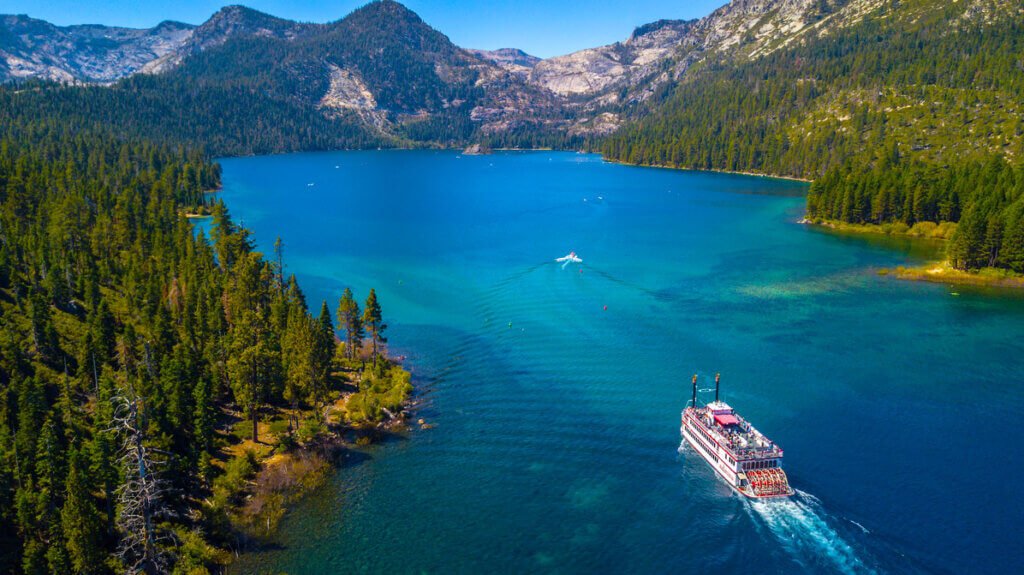
Maya’s honest take: “The first time I saw Lake Tahoe, I assumed the color was photoshopped. It is not. On a clear day the water is an almost unreal cobalt that shifts to turquoise near the shallows. It is the kind of blue that makes you understand why people buy property here.”
Where is Lake Tahoe, and how do you get there?
Lake Tahoe sits about 200 miles northeast of San Francisco and 100 miles east of Sacramento, up in the Sierra Nevada at the California-Nevada border. The nearest commercial airport with year-round scheduled service is Reno-Tahoe International Airport in Nevada, about 45 minutes from the North Shore and an hour from the South Shore. Sacramento International Airport is another option, roughly a two-hour drive from the lake.
From San Francisco, the drive takes between three and a half and five hours depending on traffic and which pass you take. Interstate 80 over Donner Summit is the most reliable winter route, but it can close during heavy snow. Highway 50 over Echo Summit is shorter for South Shore access but steeper and more prone to chain controls. The single most useful tool before driving up in winter is the CalTrans road conditions page, which lists live chain requirements and closures. From Reno, the drive is straightforward, though the Mount Rose Highway closes during severe winter storms.
Drive time cheat sheet: San Francisco to South Lake Tahoe, roughly 4 hours via Highway 50. Sacramento to South Lake Tahoe, roughly 2 hours. Reno to Incline Village, roughly 45 minutes. Los Angeles to South Lake Tahoe, roughly 7.5 to 8 hours, usually with an overnight stop in the Central Valley or Eastern Sierra.
North Shore versus South Shore: Which side should you visit?
Lake Tahoe is one lake with two very different personalities. The South Shore, anchored by the city of South Lake Tahoe and Stateline, Nevada, is the busier, more tourist-oriented side. It has the casino strip, the Heavenly gondola base, the densest concentration of hotels, and the most nightlife. The North Shore, running from Crystal Bay through Incline Village to Tahoe City, is quieter, wealthier, and more residential, with a stronger focus on outdoor recreation and a slower pace.
South Shore
- Best for: first-timers, nightlife, casino gaming, easy lodging
- Vibe: busy, lively, commercial
- Accommodation: large hotels and casinos, wider budget range
- Access: closer to Highway 50 from Sacramento and the Bay Area
- Drawbacks: traffic, crowds, less pristine shoreline in town
North Shore
- Best for: families, outdoor purists, quiet retreats
- Vibe: relaxed, residential, understated
- Accommodation: vacation rentals, boutique inns, fewer large hotels
- Access: closer to Reno and I-80, but spread out
- Drawbacks: higher prices, fewer restaurants, less nightlife
My honest recommendation for a first visit is to split the difference. Stay one night in South Lake Tahoe to experience the energy and the gondola, then move to the North or West Shore for a second night to see the quieter side. If you can only choose one, pick based on whether your trip is more about activities and entertainment, in which case South Shore wins, or scenery and solitude, in which case North Shore wins.
Best time to visit Lake Tahoe by month
There is no single best month. The right answer depends entirely on what you want to do. July and August deliver the warmest swimming weather and the fullest activity calendar. January and February deliver the best skiing and the most reliable snowpack. September delivers warm days, cool nights, and a fraction of the summer crowds. Here is the month-by-month reality check.
Summer (Jun–Aug)
- Daytime highs 75 to 80 degrees at lake level
- All hiking trails, beaches, and water sports open
- Peak lodging prices, especially July and August weekends
- Wildfire smoke risk increases by August
Fall (Sep–Nov)
- September is the sweet spot, warm but uncrowded
- October brings crisp air and fall colors.
- November is a quiet shoulder month; many businesses closed
- Lodging prices drop sharply after Labor Day
Winter (Dec–Mar)
- Ski resorts open roughly mid-November through April
- Snow chains often required on mountain passes
- Holiday weekends and ski weeks book out months ahead
- Lake views are stunning, but most hiking trails are snow-covered
What a Lake Tahoe trip actually costs
Lake Tahoe is not a budget destination, but the cost range is wide enough that planning makes a real difference. The single largest variable is lodging. A standard hotel room in South Lake Tahoe in July can run $200 to $350 per night midweek and $300 to $500 on weekends. The same room in November or April might cost $100 to $150. Vacation rentals on the North Shore are generally more expensive, with entire cabins frequently exceeding $400 per night during ski season and summer holidays.
Lift tickets at major resorts during peak winter season typically range from $120 to $180 per day when bought at the window, with advance online purchase and multi-day passes reducing the cost meaningfully. Summer activities cost less. Kayak rentals run about $30 to $50 per hour. The Heavenly Gondola scenic ride is around $80 to $100 per adult. Food prices match a mid-range city restaurant, with casual meals at $15 to $25 per person and nicer dinners at $40 to $70 per person. A realistic daily budget for a mid-range trip, with two people sharing lodging and a car, lands between $300 and $500 per day in summer and $400 to $700 per day during ski season when lift tickets enter the picture.
Sample weekend cost (two people, summer): Two nights’ lodging is roughly $500. Gas and parking are roughly $80. Meals for two days are roughly $250. Kayak rental and one scenic gondola are roughly $300. Total: approximately $1,130 for a two-night summer weekend.
Top things to do at Lake Tahoe by season
The lake is the attraction, but the activities rotate sharply with the seasons. In summer, the priorities are beaches, boating, and high-elevation hiking. Sand Harbor on the Nevada side has the most photogenic boulder-strewn shoreline and crystal-clear shallows. Emerald Bay on the West Shore offers the classic overlook shot and kayak access to Fannette Island. In winter, skiing dominates. Heavenly sits right above the South Shore casinos, while Palisades Tahoe and Northstar anchor the North Shore. For non-skiers in winter, snowshoeing at Donner Memorial State Park or a sleigh ride at Sand Harbor provides the same white-snow Tahoe fix without a provided ticket.
Fall is the underrated season. The crowds vanish after Labor Day, the lake water is still warm enough for a quick swim through early October, and the aspen groves on the eastern side of the basin turn gold. Spring, roughly April through early June, is the least predictable window. Ski resorts wind down, hiking trails turn muddy, and many local businesses take a break. It is the cheapest time to visit and the most likely to leave you with limited options.
Mistakes to avoid at Lake Tahoe
These are the errors I have made or watched others make consistently. Most are easy to prevent with a bit of forethought.
- Not checking wildfire smoke forecasts before booking a summer trip. Smoke from California fires can blanket the basin for days. Check air quality maps before you commit to a weekend in July, August, or September.
- Underestimating the altitude. At over 6,200 feet, the first day can bring headaches and fatigue if you push too hard. Drink extra water and skip the long hike on day one.
- Driving up from the Bay Area on a Friday afternoon. The I-80 and Highway 50 corridors turn into parking lots. Leave before 10 a.m. or after 7 p.m., or prepare for a five-hour crawl.
- Ignoring chain controls in winter. Mountain passes require chains during storms, and the CHP does check. Carry chains in your vehicle from November through April, even if the forecast looks clear.
- Assuming the lake is warm enough for a comfortable swim. Surface water only reaches the mid-60s by late summer. That is refreshing for ten minutes, not comfortable for an hour.
- Booking a hotel without checking its exact location. Tahoe is spread out and the lakeside versus “near the lake” distinction matters. A motel on the wrong side of the highway can leave you walking nowhere pleasant.
- Visiting in May and expecting the full Tahoe experience. May is a limbo month. Trails are muddy, ski resorts are closed, and many restaurants are on break. Unless you want silence, pick a different month.
Frequently asked questions
How deep is Lake Tahoe?
Lake Tahoe is 1,645 feet deep at its deepest point near Crystal Bay on the north end. That makes it the second-deepest lake in the United States, behind only Crater Lake in Oregon at 1,949 feet. The average depth is about 1,000 feet, meaning most of the lake is very deep water.
Is Lake Tahoe man-made?
No. Lake Tahoe is a natural alpine lake formed over the last two million years through fault-block geology and glacial scouring. It is not a reservoir and not artificially created. The only human influence on the lake level is a small dam at the outlet in Tahoe City that regulates the top few inches of water.
Does Lake Tahoe ever freeze over?
No, not in recorded history. The lake contains roughly 39 trillion gallons of water, and that massive volume retains enough heat to prevent full freezing even during the coldest winters. Emerald Bay, a shallow inlet on the West Shore, has partially frozen in very cold winters, but the main body of the lake stays liquid year-round.
What is the best month to visit Lake Tahoe?
September is the best overall month. The summer crowds disappear after Labor Day, daytime temperatures stay warm in the 70s, the lake water is at its warmest for swimming, and the wildfire smoke risk is lower than in July and August. For skiers, February offers the most reliable snowpack and the fullest resort operations.
Which side of Lake Tahoe is better?
Neither side is objectively better, but they suit different trip styles. The South Shore offers more hotels, casinos, restaurants, and nightlife, making it better for first-timers and groups who want activity density. The North Shore is quieter, wealthier, and more residential, with a stronger focus on outdoors and vacation rentals, making it better for families and travelers seeking solitude.
Can you swim in Lake Tahoe?
Yes, but the water is cold. Surface temperatures near shore warm to the mid-60s Fahrenheit by August, which feels bracing but swimmable on a hot day. Below the surface layer, the water stays in the 40s. Most visitors swim briefly from beaches like Sand Harbor and Pope Beach, while only the most cold-tolerant stay in for extended periods.
How far is Lake Tahoe from San Francisco?
Lake Tahoe is roughly 200 miles from San Francisco, and the drive takes about four hours in clear traffic via Highway 50 to the South Shore. The route via Interstate 80 to the North Shore is slightly longer but more reliable in winter. On Friday afternoons and Sunday evenings, the drive can stretch to five hours or more due to heavy traffic.
Is Lake Tahoe in California or Nevada?
Both. The California-Nevada state line runs through the lake, with roughly two-thirds of the water surface in California. The South Shore around Stateline, including the major casinos, sits in Nevada. The rest of the shoreline, including Emerald Bay, Tahoe City, and most of the West Shore, sits in California. This split creates the unique situation of casino gaming existing directly beside California’s stricter regulatory environment.
Plan your trip: booking platforms we trust
For Lake Tahoe, I prioritize platforms with strong vacation rental coverage on the North Shore and flexible cancellation, because the weather and wildfire smoke risk make last-minute changes common. The right booking platform depends on whether you want a casino hotel, a lakeside cabin, or a simple motel room.
Best for whole cabins and lakeside vacation rentals, especially on the quieter North and West Shore.
Best for South Shore casino hotels and standard rooms with flexible cancellation and guest reviews.
Best for bundling flights into Reno or Sacramento with a rental car and Tahoe lodging in one booking.
Best for comparing recent reviews of specific hotels, restaurants, and activity operators around the lake.