Great Barrier Reef, Australia: Is It Still Worth Visiting This Year?
Fact-Checked By: Maya Whitfield — Senior Travel Editor at WakaAbuja
The Great Barrier Reef is not dead, despite what some headlines suggest. Large sections, particularly in the central and southern regions, remain vibrant and are absolutely worth visiting this year. You need to choose your location carefully, as reef health varies significantly by zone.
I have spent more hours than I can count bobbing around in the Coral Sea, and I have watched the narrative around the reef shift from “paradise” to “tragedy” in real time. The truth is messier and more hopeful than either extreme. You can still have a world-class snorkel or dive trip, but you have to be smarter about where you go than travelers were twenty years ago.
Jump to: Is the Reef Dead? | Best Regions to Visit | Best Time to Go | What It Costs | What You Will See | Mistakes to Avoid | FAQs
Key takeaways
- The Great Barrier Reef is a 2,300-kilometer ecosystem with over 600 individual reefs, not a single solid wall of coral.
- Coral bleaching is a serious issue, but bleaching does not always mean dead coral. Many areas have recovered significantly in recent years.
- The outer reef and the far northern sections generally have the healthiest coral cover right now.
- A day trip from Cairns or Port Douglas is the most practical way to see the reef for most travelers.
- Stinger season runs roughly November to May, so wearing a protective suit during that window is non-negotiable.
- Liveaboard trips are the single best way to escape the crowds and see the healthiest, most remote reefs.
- Scenic helicopter flights give you the only true sense of the reef’s scale, and they are worth the splurge.
Is the Great Barrier Reef Dead? The Real Answer
No, it is not dead. Not even close. What it is is stress. The reef has suffered through several mass bleaching events over the last decade, and some sections have seen coral cover decline sharply. But the system is 344,400 square kilometers, roughly the size of Japan. You cannot paint it with a single brush.
The Australian Institute of Marine Science (AIMS) publishes long-term monitoring reports, and their data shows that much of the northern and central reef has seen record levels of coral regrowth in the last few years. The southern section has had a harder time recently due to crown-of-thorns starfish outbreaks and heat stress. So the truth depends entirely on which coordinates you plug into your dive computer.
From my own trips, I have seen stretches that look like a garden and a few that look like a graveyard. The difference is striking, and it is exactly why choosing the right departure point matters more than ever.

Maya Whitfield’s honest take: “If you want a guaranteed pristine reef with zero signs of change, you are about thirty years too late. If you want a spectacular marine ecosystem with a lot of life left in it, the reef will deliver.”
Best for healthy coral right now
- Outer ribbon reefs east of Cairns
- Far northern sector near Lizard Island
- Swains Reefs in the far south
Worth considering
- Inner reefs near Port Douglas, but check recent survey data
- Whitsunday fringing reefs, which are resilient but patchy
Which Part of the Reef Should You Actually Visit?
Your choice of port will define your experience more than almost any other decision. Cairns and Port Douglas are the heavyweights, with the most infrastructure and the fastest access to the outer reef. The Whitsundays offer a different vibe, mixing reef time with white silica sand and sailing. Then there is the southern gateway near Gladstone or Lady Elliot Island, which is a coral cay with exceptional snorkeling right off the beach.
I always tell first-timers to fly into Cairns. It is not the cheapest base, but it gives you the widest range of operators and the shortest travel time to the good stuff. You can be on a pontoon at a quality outer reef site in under two hours by fast catamaran.

Cairns / Port Douglas
- Fastest access to outer ribbon reefs
- Huge range of day trips and liveaboards
- Best for families and first-time divers
- Easy international airport access
The Whitsundays
- Best for combining sailing and snorkeling
- Whitehaven Beach is a major draw
- Reef sites are softer but very accessible
- More about the overall scenery than pure coral density
Southern Reef / Lady Elliot
- Exceptional water clarity in winter
- Manta ray encounters are common
- Fringing reef right off the beach
- Smaller, more eco-focused visitor numbers
When Is the Best Time to Visit the Great Barrier Reef?
The dry season, roughly May through October, is the sweet spot. You get mild air temperatures, low humidity, and southeast trade winds that keep the water clear. Visibility during these months is consistently the best of the year, often exceeding 20 meters on the outer reef.
Stinger season runs from November through May, and while the outer reef is generally safer than the coastline, you will still want a full-body lycra suit. Many operators provide them free of charge. I have never understood people who skip the suit to get a tan, only to spend the next three days in agony because a tiny, invisible jellyfish grazes their ankle.
Coral spawning usually happens a few nights after the full moon in November. It is a spectacular biological event, though it can temporarily reduce visibility. For photographers and marine nerds, it is a bucket-list moment. For first-timers who just want clear water, stick to June through September.
Maya Whitfield’s honest take: “August is the month I would choose if I could only dive the reef once. Cold mornings on the boat, sure, but the underwater visibility is worth every goosebump.”
How Much Does a Great Barrier Reef Trip Really Cost?
A standard day trip from Cairns to a pontoon or reef platform will run between AUD 200 and AUD 300 per adult, depending on the operator and what is included. That price typically covers snorkel gear, lunch, and sometimes a glass-bottom boat tour. Introductory scuba dives are usually an add-on of AUD 100 to AUD 150. For current pricing, check the official operator websites directly, as rates shift with fuel costs and seasonal demand.
Liveaboard trips, where you sleep on a dive boat for two to seven nights, start around AUD 800 for a budget two-night trip and climb quickly from there. These are the best value for serious divers because you get up to four or five dives a day and access to reefs that day-trippers never reach.
Then there is the scenic flight option. A 30-minute helicopter ride from Cairns will cost you roughly AUD 300 to AUD 400. It sounds extravagant, but it is the only way to grasp the sheer scale of the reef system. I have done it once, and the image of the ribbon reefs from the air is burned into my memory more clearly than most of my dives.

Best for budget travelers
- Day trip from Cairns on a large catamaran
- Bring your own snorkel gear if you have it
- Travel during the shoulder months of May or October
Best for value
- Two-night liveaboard instead of multiple day trips
- Packages that combine a reef day with a rainforest day
- Lady Elliot Island day trips from the Gold Coast
What Marine Life Will You Actually See?
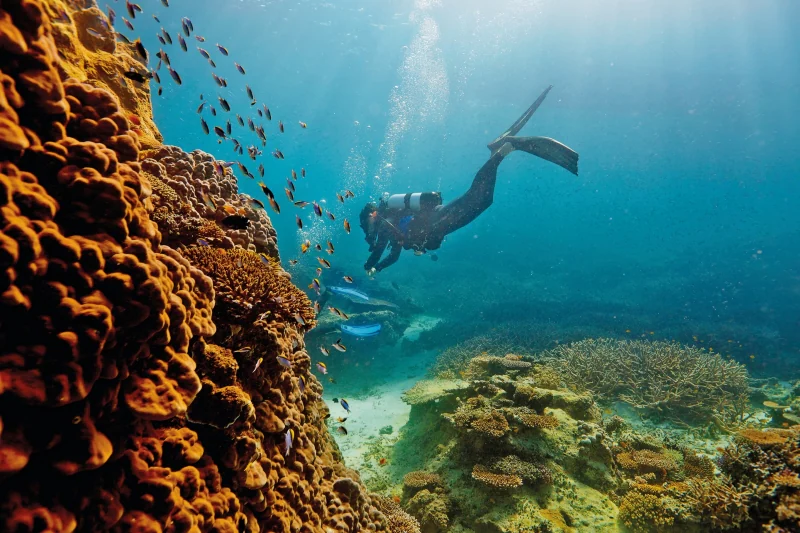
Expect a lot of color and constant movement. The reef supports over 1,500 species of fish, from tiny clownfish peeking out of anemones to massive Maori wrasse that will swim right up to your mask. Giant clams sit on the reef flats with electric blue mantles, and green sea turtles are so common on some sites that you will stop taking photos after the first hour.
Sharks are present, but the ones you will see are mostly reef sharks, which are shy and utterly uninterested in you. I have spent years trying to get a decent photo of a whitetip reef shark, and they always turn and glide away the second I make eye contact. Manta rays are less predictable, but your odds improve dramatically at southern sites like Lady Elliot Island during winter.
You will not see the reef of a nature documentary in one afternoon. The truly wild stuff, like dwarf minke whales or epic trevally hunting schools, requires time and specific locations. But for a first-time visitor, a single good dive on the outer reef will deliver more species in one hour than you could identify in a week.
How Do You Choose a Responsible Reef Tour Operator?
Not all operators are created equal, and your choice has a real impact on the reef. Look for companies certified by Ecotourism Australia or those that employ marine biologists on their staff. The Great Barrier Reef Marine Park Authority (GBRMPA) licenses all commercial operators, and the certified ones will display their permit number prominently. If an operator cannot tell you which reef site they are visiting and why, that is a red flag.
Check the vessel and the site plan
Ask whether they rotate sites to reduce pressure on any single reef. The best operators use moorings rather than dropping anchor on coral. A fast catamaran to a dedicated pontoon is fine for families, but smaller, slower boats often get you to less crowded sites. I have had reefs to myself on small-group trips, which is a completely different experience from sharing a pontoon with 300 other people.
Look for education, not just entertainment
A good brief before you enter the water should cover more than just how to use your gear. It should explain the rules on touching coral, how to avoid stirring up sediment, and what the reef is currently facing. The Australian Institute of Marine Science has excellent resources if you want to read up on reef health data before you book. An operator that talks about conservation in the briefing is one that actually cares about the product they are selling you.
What Are the Biggest Mistakes People Make on a Reef Trip?
I have watched people ruin their own trips in more ways than I can count. Most of these are easy to avoid if you know what you are doing.
Booking the cheapest possible day trip. The cheapest boats are often the oldest, slowest, and most crowded. You spend more time in transit and less time in the water. A slightly pricier operator with a fast boat and a capped passenger number is worth the extra money.
Ignoring the stinger suit rule. Even outside peak stinger season, a Lycra suit protects you from sunburn and minor scrapes. Operators provide them. Wear it.
Not bringing a dry bag. You will be on a boat, and things get wet. Your phone, your passport, your change of clothes—all of it needs a waterproof home. I learned this the expensive way on a Whitsundays sailing trip.
Trying to see the reef on a zero-fitness day. Snorkeling is easier than diving, but swimming against even a mild current for an hour is tiring. If you are not a strong swimmer, ask for a flotation aid instead of pretending you are fine. There is no shame in using a noodle.
Flying in and diving the same day. If you plan to scuba dive, you need to respect the no-fly time after your last dive, usually 18 to 24 hours. Do not book a morning dive and an afternoon flight. The dive shops will tell you the same thing, but every year someone argues with them and loses.
Expecting the reef to look like a screensaver. The reef is a living system, not a theme park. Some days are murkier than others. Some coral is brown, not neon. If you arrive with rigid expectations, you will miss the real magic.
Frequently asked questions
Can you still snorkel the Great Barrier Reef?
Yes. Snorkeling is possible year-round, and most day-trip operators include it in their base price. The outer reef sites have the clearest water and the most abundant marine life for snorkelers.
How much of the Great Barrier Reef is actually dead?
That depends on how you measure it. While some sections have lost significant coral cover, recent surveys by AIMS show strong recovery in many northern and central regions. The entire reef system is not dead, but specific sites have been badly affected.
Is it safe to swim in the Great Barrier Reef?
For the most part, yes. The main risks are sunburn, jellyfish during stinger season, and your own physical limitations. Wearing a stinger suit and staying within your swimming ability makes it very safe.
What is the best month to visit the Great Barrier Reef?
August is my top pick. Visibility is at its peak, the air is dry, and the water is cool enough to keep you comfortable in a wetsuit. Any month from June through October is a solid choice.
Do I need to be a certified diver to see the reef?
No. You can see most of the reef’s highlights with a mask, snorkel, and fins. If you want to try scuba diving, many operators offer introductory dives with no certification required, accompanied by an instructor.
Is the Great Barrier Reef worth the money?
Yes, if you choose your location and operator carefully. A well-run day trip to a healthy outer reef site is one of the most extraordinary natural experiences on the planet. A poorly chosen trip to a degraded inner reef can feel underwhelming.
Plan your trip: booking platforms we trust
I have booked reef trips through several platforms over the years, and these are the ones I keep coming back to. For accommodation in Cairns or the Whitsundays, you want flexibility and clear cancellation policies. For reef tours and dives, you want verified reviews and easy booking changes.
GetYourGuideBest for booking reef day trips, glass-bottom boat tours, and scenic flights with instant confirmation.
Booking.com is best for Cairns and Port Douglas hotels with flexible cancellation and real guest reviews.
TripAdvisor is best for reading honest reviews of specific reef operators before you commit.
Expedia is best for bundling flights into Cairns with your hotel for a lower package rate.
Kayak is best for comparing flight prices into Cairns, Brisbane, or Hamilton Island.
Vrbo is best for family-sized apartments in Port Douglas if you are staying more than a few nights.