advertisement
With 12 of the best islands to visit in Greece, this guide breaks down what each destination offers so you can choose the right Greek island for your travel style, budget, and itinerary.
Fact-Checked By: Maya Whitfield—Senior Travel Editor at WakaAbuja
The best islands to visit in Greece depend on your trip type. Santorini is best for views and romance, Naxos for families and beaches, Mykonos for nightlife, Crete for food and history, Milos for quiet scenery, and Corfu for something completely different from the Cyclades. Budget around 80 to 200 euros per person per day for a mid-range trip including accommodation, food, and ferries (confirm the latest price directly with the operator).
If you are trying to pick one Greek island out of a hundred contenders, the honest answer is this: it depends less on which island is “best” and more on your budget, how many days you actually have, and what kind of trip you want. I learned this the hard way on my first Greece trip, when I booked Santorini and Mykonos back-to-back and spent most of my time in crowds, then met a family in Naxos who had just spent a week on empty beaches for half the price.
This guide fixes that. It gives you a direct answer for your situation, plus the trade-offs nobody puts in the brochure.
Jump to: At a Glance | Comparison | Ranked Islands | By Travel Style | Islands to Skip | Budget Breakdown | Island Groups | FAQ
Key takeaways
- Pick your island group before you pick your island. You cannot combine Corfu in the Ionian with Santorini in the Cyclades without losing a full travel day.
- Santorini and Mykonos are the most expensive islands at 200 to 400 euros per person per day in peak season (confirm the latest price directly with the operator).
- Naxos, Milos, and Crete offer the best value for money while still delivering the Greek island experience.
- Book ferries 4 to 6 weeks ahead in July and August. They sell out, and prices rise closer to the date.
- Two islands in 7 days is the realistic maximum. Three islands in a week means you will spend most of it on ferries.
- Go in May, June, or September. July and August are the hottest, busiest, and most expensive months.
Best Greek Islands at a Glance
If you only have a minute, this is the short version. Read the full entries below for the trade-offs.
Best for first-timers: Naxos or Paros, which combine classic Cycladic scenery with manageable crowds and prices.
Best for romance: Santorini, especially Oia and Imerovigli for caldera views.
Best for families: Naxos, with shallow beaches and calm water, or Crete for its beaches and food.
Best for nightlife: Mykonos, though it comes at a price.
Best for food: Crete, followed by Naxos and Paros.
Best for history: Crete for Knossos and the Minoan palaces, Delos for the archaeological site.
Best for beaches: Milos, Naxos, and Crete. Milos has the most unusual geology.
Best for quiet and low crowds: Milos, Folegandros, and Amorgos.
Best for solo travelers: Paros, which is easy to navigate and has a strong hostel scene.
Best for budget travelers: Naxos, Paros, and Crete, all of which offer low-cost accommodation and cheap local food.
Greek Islands Compared: Cost, Trip Length, and Travel Style
Use this table to narrow down before you read the full island entries. Cost tiers are for a mid-range traveler in shoulder season (confirm the latest price directly with the operator).
Santorini
Group: Cyclades
Best for: Couples, honeymooners, first-time visitors
Cost: High, 200 to 400 euros per day (confirm the latest price directly with the operator)
Trip length: 3 to 4 days
Best months: May, June, September
Mykonos
Group: Cyclades
Best for: Nightlife, party travelers, LGBTQ+ scene
Cost: High, 200 to 400 euros per day (confirm the latest price directly with the operator)
Trip length: 2 to 3 days
Best months: June, September
Naxos
Group: Cyclades
Best for: Families, first-timers, budget travelers
Cost: Mid, 80 to 150 euros per day (confirm the latest price directly with the operator)
Trip length: 4 to 5 days
Best months: May, June, September, October
Paros
Group: Cyclades
Best for: Solo travelers, couples, low-key trips
Cost: Mid, 80 to 150 euros per day (confirm the latest price directly with the operator)
Trip length: 3 to 4 days
Best months: May, June, September
Milos
Group: Cyclades
Best for: Beaches, quiet trips, photography
Cost: Mid, 90 to 160 euros per day (confirm the latest price directly with the operator)
Trip length: 3 to 4 days
Best months: May, June, September
Crete
Group: Crete
Best for: Food, history, families, road trips
Cost: Mid to low, 70 to 140 euros per day (confirm the latest price directly with the operator)
Trip length: 5 to 7 days
Best months: May, June, September, October
Corfu
Group: Ionian
Best for: Families, green scenery, Venetian history
Cost: Mid, 80 to 150 euros per day (confirm the latest price directly with the operator)
Trip length: 4 to 5 days
Best months: May, June, September
Rhodes
Group: Dodecanese
Best for: History, families, resort-style stays
Cost: Mid, 80 to 160 euros per day (confirm the latest price directly with the operator)
Trip length: 4 to 5 days
Best months: May, June, September
The Best Greek Islands, Ranked
Here is my honest ranking of the 12 islands worth considering, with the trade-offs spelled out.
1. Naxos
Naxos is the best all-around Greek island for a first trip. It has the classic white-washed villages, the best beaches in the Cyclades, and prices that are 40 to 60 percent lower than Santorini (confirm the latest price directly with the operator). Stay in Naxos Town (Chora) for convenience or Agios Prokopios for the beach. It is a large island, so renting a car makes sense if you want to explore beyond the main town.
2. Crete
Crete is practically its own country. It has the best food in Greece, the most important archaeological sites, including Knossos, and enough beaches to fill a two-week trip. Chania and Rethymno are the two best bases. It is a 5- to 7-day island minimum, and more if you want to see both the east and west coasts.
3. Santorini
Santorini is as beautiful as everyone says, and as crowded. The caldera view from Oia or Imerovigli is genuinely one of the most dramatic in the world. The trade-offs: prices are the highest in Greece, the beaches are mostly volcanic and not great, and the cruise ship crowds hit hard between 10 a.m. and 4 p.m. Go for the views, not for a beach holiday.
4. Milos
Milos is the best island for beaches and quiet. It has over 70 beaches, many accessible only by boat, and the lunar landscape at Sarakiniko is unlike anywhere else in Greece. It is much quieter than Santorini or Mykonos. Stay in Plaka or Pollonia. Rent a car to reach the more remote beaches.
5. Paros
Paros is the best island for solo travelers and for anyone who wants a low-key trip. It has great beaches, a charming main town (Parikia), and a strong hostel scene in Naoussa. It is also a major ferry hub, which makes it easy to combine with Naxos or Mykonos on a hopping route.
6. Mykonos
Mykonos is the party island, and it delivers on that. The old town is beautiful, the beaches have excellent beach clubs, and the nightlife runs until dawn. The trade-offs: prices are as high as Santorini, the beaches are crowded, and the island draws a very specific crowd. Skip it if you want a quiet or cultural trip.
7. Rhodes
Rhodes is the best Dodecanese option. It has the best-preserved medieval old town in Greece, excellent beaches, and a mix of resort and independent accommodation. It is a large island with an international airport, which makes it easy to reach directly from many European cities.
8. Corfu
Corfu is completely different from the Cyclades. It is green, with Venetian architecture, Italian-influenced food, and a milder climate. The old town is a UNESCO World Heritage Site. It is the best Greek island for a family trip if you want variety beyond beaches.
9. Folegandros
Folegandros is the quiet alternative to Santorini. It has a cliffside Chora that looks like the postcards but a fraction of the crowds. There is not much to do beyond eat, swim, and walk, which is the point.
10. Amorgos
Amorgos is for hikers and anyone who wants to feel off the main tourist circuit. The monastery of Panagia Hozoviotissa carved into the cliff is the main sight. The island has excellent walking trails and very few hotels.
11. Zakynthos
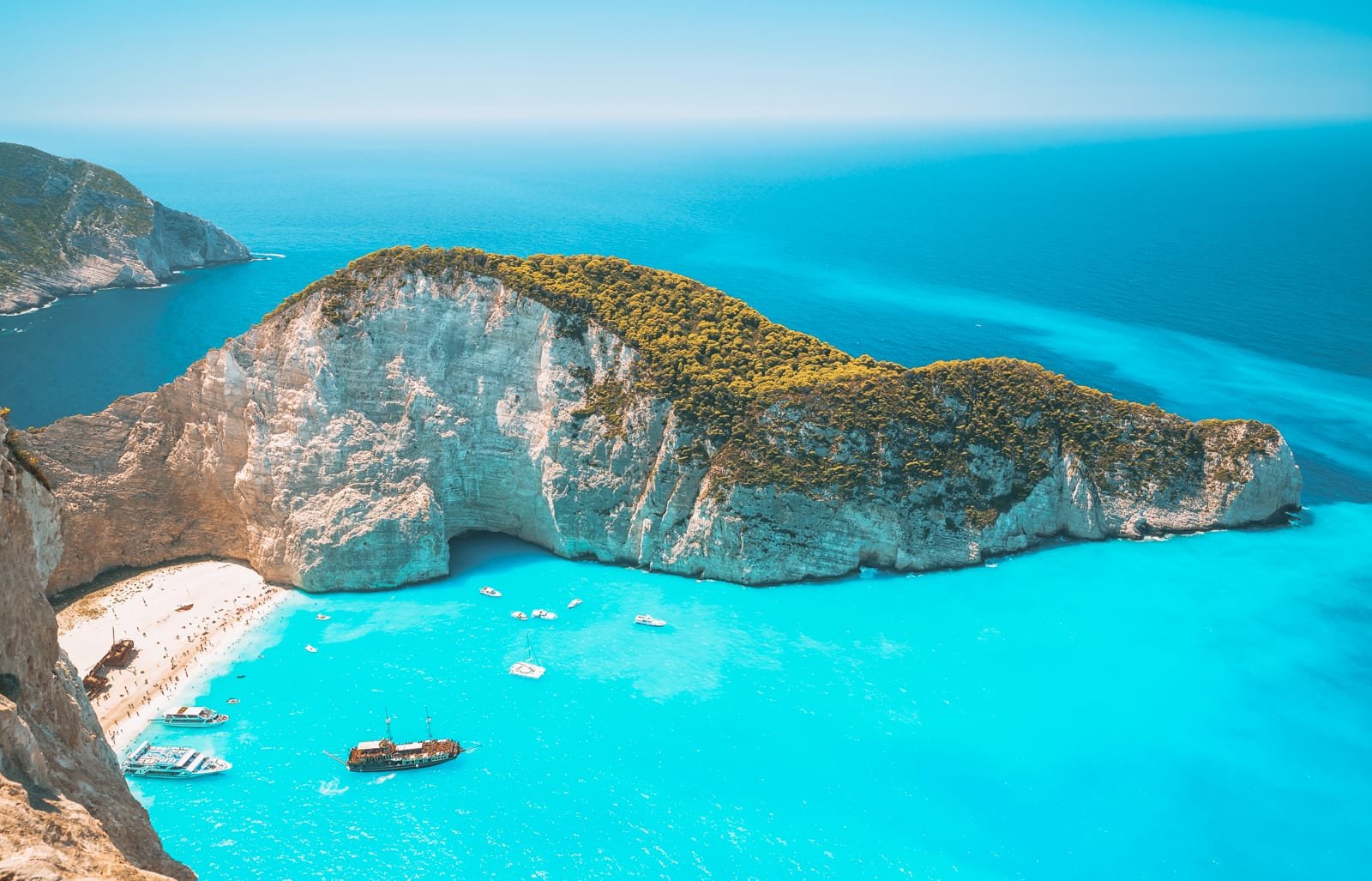
Zakynthos (Zante) is in the Ionian and is famous for Navagio Beach, the shipwreck beach. It is a party island in the south and a nature destination in the north. The turtle nesting beaches at Laganas are protected but under pressure from tourism.
12. Delos
Delos is not a place to stay, but it is worth a day trip from Mykonos. The entire island is an archaeological site and a UNESCO World Heritage Site. It was the mythological birthplace of Apollo and Artemis, and the ruins include an entire ancient city.
Best Greek Island by Travel Style
Families
Naxos: Shallow beaches, calm water, plenty of family-run hotels.
Crete: Beaches, food, and easy day trips for all ages.
Corfu: Green scenery and shorter flights from northern Europe.
Couples and honeymooners
Santorini: The classic choice, with caldera views from Oia and Imerovigli.
Milos: Quieter, with dramatic geology and excellent sunsets.
Folegandros: The understated honeymoon island.
Solo travelers
Paros: Easy to navigate, strong hostel scene, easy to meet people.
Naxos: Large enough to feel safe, small enough to feel manageable.
Athens: Not an island, but a good first stop before you hop.
Budget travelers
Naxos: The best value in the Cyclades for food and accommodation.
Crete: Cheap tavernas and plenty of independent guesthouses.
Paros: Hostels and mid-range studios everywhere.
Food and history
Crete: Best food in Greece and the most important archaeological sites.
Rhodes: Medieval old town and a mix of Greek, Ottoman, and Italian heritage.
Delos: The most important archaeological island in the Aegean.
Which Greek Islands Should You Skip (and For Whom)?
Every island has someone it is wrong for. Here is the honest list of islands to skip depending on your trip.
- Skip Santorini if you want a beach holiday. The beaches are volcanic, crowded, and not as good as Naxos or Milos. Go for the views, not the swimming.
- Skip Mykonos if you want quiet. It is loud, expensive, and packed in July and August. Go in June or September if you must, or pick Paros instead.
- Skip Ios and Kavos (Corfu) if you are over 30 and not on a party trip. Both are dominated by young crowds and cheap bars.
- Skip Santorini and Mykonos, both in one trip. They are the two most expensive islands, and combining them eats your budget fast.
- Skip Hydra and Spetses if you want classic Cycladic white-washed scenery. They are beautiful but different, with a more Saronic Gulf character.
- Skip Zakynthos if you want culture. It is mostly a beach and nightlife destination.
- Skip any island in the Dodecanese if you only have one week. They are too far from Athens to combine with the Cyclades in a short trip.
What Do Greek Islands Actually Cost?
Here is a realistic daily budget per person for a mid-range trip, including accommodation, food, ferries, and one activity. Prices vary by island and season (confirm the latest price directly with the operator).
Budget traveler
Hostel or basic studio, local tavernas, and ferries in the economy. Around 50 to 80 euros per day. Best islands for this: Naxos, Paros, and Crete outside peak season.
Mid-range traveler
Three-star hotel or guesthouse, mix of tavernas and one nicer meal, ferries in economy or business. Around 100 to 180 euros per day. Best islands for this: Naxos, Paros, Milos, Crete, and Rhodes.
Luxury traveler
Four- or five-star hotel, caldera or sea view, private transfers, fine dining. Around 250 to 500 euros per day. Best islands for this: Santorini, Mykonos, and parts of Crete.
The biggest cost differences come from accommodation and the timing of your trip. July and August prices are 30 to 50 percent higher than May or September on the same island (confirm the latest price directly with the operator).
Greek Island Groups Explained: What Combines With What
Greece has six major island groups. You cannot easily combine islands from different groups on a short trip because the ferries do not always connect them directly.
Cyclades
The most popular group, with Santorini, Mykonos, Naxos, Paros, Milos, Ios, Folegandros, and Amorgos. Easy to combine with each other by ferry. Two to four hours between most islands.
Dodecanese
Southeast Aegean, near Turkey. Includes Rhodes, Kos, Symi, and Patmos. Far from Athens, but well connected to each other. Best reached by flight to Rhodes or Kos.
Ionian
West coast, near Italy. Includes Corfu, Zakynthos, Kefalonia, and Lefkada. Greener and wetter than the Cyclades, with a different cuisine and architecture. Flights from Athens or direct from many European cities.
Saronic Gulf
Closest to Athens. Includes Hydra, Spetses, Aegina, and Poros. Good for a short trip or a day trip from Athens.
Sporades
Northeast Aegean. Includes Skiathos, Skopelos, and Alonissos. Skiathos has an international airport. Popular with a low-key crowd.
Crete
Technically its own group. Large enough that it operates like a small country. Two international airports and direct ferries to Santorini, Mykonos, and Rhodes.
Frequently asked questions about Greek islands
What is the best Greek island for a first trip?
Naxos is the best first-timer island. It has classic Cycladic scenery, the best beaches in the group, and prices that are far lower than Santorini or Mykonos. Paros is the second-best option and has a similar vibe.
Santorini or Mykonos, which is better?
They serve different purposes. Santorini is for views, romance, and photos. Mykonos is for nightlife, beaches with clubs, and a party crowd. If you have to pick one for a first trip, Santorini is the more unique experience.
How many Greek islands can I visit in one week?
Two islands is the realistic maximum in seven days. Three means you spend more time on ferries and in ports than on the islands themselves. If you have 10 to 14 days, three islands become manageable.
How much does a Greek island trip cost?
A mid-range traveler should budget 100 to 180 euros per person per day for accommodation, food, ferries, and one activity (confirm the latest price directly with the operator). Budget travelers can do it for 50 to 80 euros per day on Naxos, Paros, or Crete. Santorini and Mykonos push costs to 200 to 400 euros per day.
What is the best time to visit the Greek islands?
May, June, September, and early October are the best months. The weather is warm, the crowds are smaller, and prices are 20 to 40 percent lower than July and August (confirm the latest price directly with the operator). July and August are the hottest and busiest.
Do I need to book Greek ferries in advance?
Yes. Book ferries 4 to 6 weeks ahead in July and August. They sell out, and prices rise closer to the date. In shoulder season, 1 to 2 weeks is usually enough. Book direct with the ferry operator or through a booking platform.
Do I need a car on Greek islands?
It depends on the island. Naxos, Milos, and Crete benefit hugely from a rental car because the best beaches are spread out. Santorini, Mykonos, and Paros have good bus networks and are manageable without a car. Rent in advance in peak season.
Are the Greek islands safe for solo travelers?
Yes. Greece is one of the safest countries in Europe for solo travel. Petty theft is rare. The main concerns are the same as anywhere: do not leave bags unattended on beaches, and be aware of your surroundings late at night in busy nightlife areas.
Do US, UK, and Canadian citizens need a visa for Greece?
No. Greece is part of the Schengen Area, and US, UK, Canadian, and Australian citizens can stay visa-free for up to 90 days in any 180-day period. Check the latest rules on the US State Department Greece page before booking.
Plan your trip: booking platforms we trust
These are the platforms I use to plan Greek island trips. Book ferries and hotels as far ahead as possible for peak summer dates.
Booking.com
Best for finding hotels and guesthouses on every Greek island.
Kayak
Useful for comparing flights to Athens and direct island flights.
GetYourGuide
Good for booking ferry tickets, island tours, and sunset cruises.
Expedia
Useful for bundling flights and hotels into a Greece package.
Vrbo
Best for renting a villa for a family or group trip to Naxos or Crete.
TripAdvisor
Essential for reading reviews of hotels and tavernas on specific islands.
For more planning help, see our travel planning guides, our hotel reviews, our attractions section, and our visa category. When you are ready to book flights, start with our discounted flights page.
WakaAbuja does its best to keep all information accurate at the time of publishing. Prices, policies, and availability change regularly. Always verify with official sources before you travel. We are not liable for errors caused by outdated information. Travel insurance is strongly recommended.