
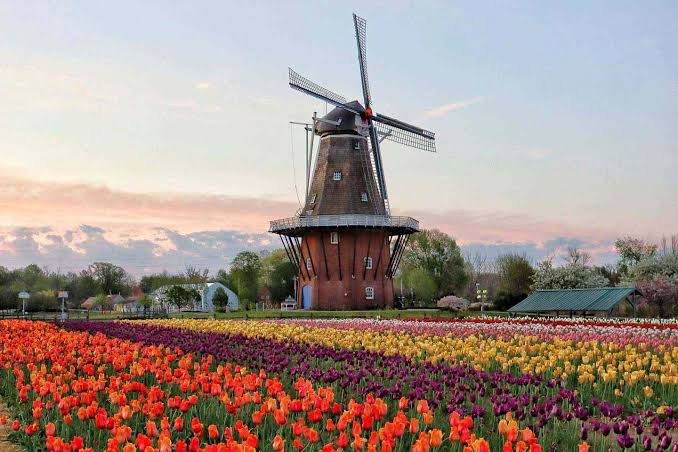
advertisement
From free flower fields to celebrated festivals, discover the best places to see tulips in the USA this spring.
Fact-Checked By: Maya Whitfield, Senior Travel Editor at WakaAbuja—read my full travel bio here
The best places to see tulips in the USA are the Skagit Valley fields around Mount Vernon, Washington; the Wooden Shoe Tulip Farm in Woodburn, Oregon; Holland, Michigan; Pella, Iowa; and the Texas Tulips farms near Dallas and San Antonio. Peak bloom across most US regions runs from late March through mid-May, and entry fees range from free at some farms to about $15 to $25 per adult at ticketed festivals (confirm current rates on each farm’s official site before you drive out).
I have chased tulip bloom across four states and two continents, and I can tell you the single biggest mistake people make is treating this like a normal day trip. Tulip season is short. A field that is a carpet of red and yellow on a Tuesday can be stripped of rows and mud by the following Monday. If you show up on the wrong week, you drive home with gas station coffee and regret.
So this is not just a list of pretty farms. It is a plannable guide. Every entry below has a real location, a realistic bloom window, a price range, and the one thing that makes it worth your specific trip. I have grouped them by region so you can find the best places to see tulips without crossing three time zones.
Jump to: Bloom timing by region | Pacific Northwest | Midwest | South | Northeast and Mid-Atlantic | Mistakes to avoid | FAQ
Key takeaways
- The Pacific Northwest blooms first, usually late March into mid-April, because the Skagit Valley and Willamette Valley have cooler, wetter winters that push early growth.
- The Midwest and Northeast peak later, generally late April through mid-May, so you can genuinely stretch tulip season across six weeks by driving north.
- Several major fields are free to enter, including parts of the Skagit Valley display gardens, while ticketed festivals typically run about $15 to $25 per adult (check current rates on the official site).
- U-pick tulips usually cost per stem, often around $1 to $3 each (confirm the latest price directly with the operator), and most farms charge separately for the vase.
- Weekday mornings are dramatically less crowded than weekends at every festival I have visited, and the light is better for photos before 10 a.m.
- Always check the farm’s bloom report the morning you leave. Most post daily updates on social media during peak weeks.
- If you are flying in, book cheap flights into the nearest hub at least six weeks out, because bloom-season weekends sell out fast.
When do tulips bloom in the USA?
Tulips bloom in the USA in a rolling wave that starts in the Pacific Northwest in late March, moves through the South and lower Midwest in early April, and finishes in the upper Midwest and Northeast by mid- to late May. The exact week shifts every year based on winter chill and spring heat, so no honest guide can give you a fixed date. What I can give you is the regional order, which is reliable enough to plan a trip around.
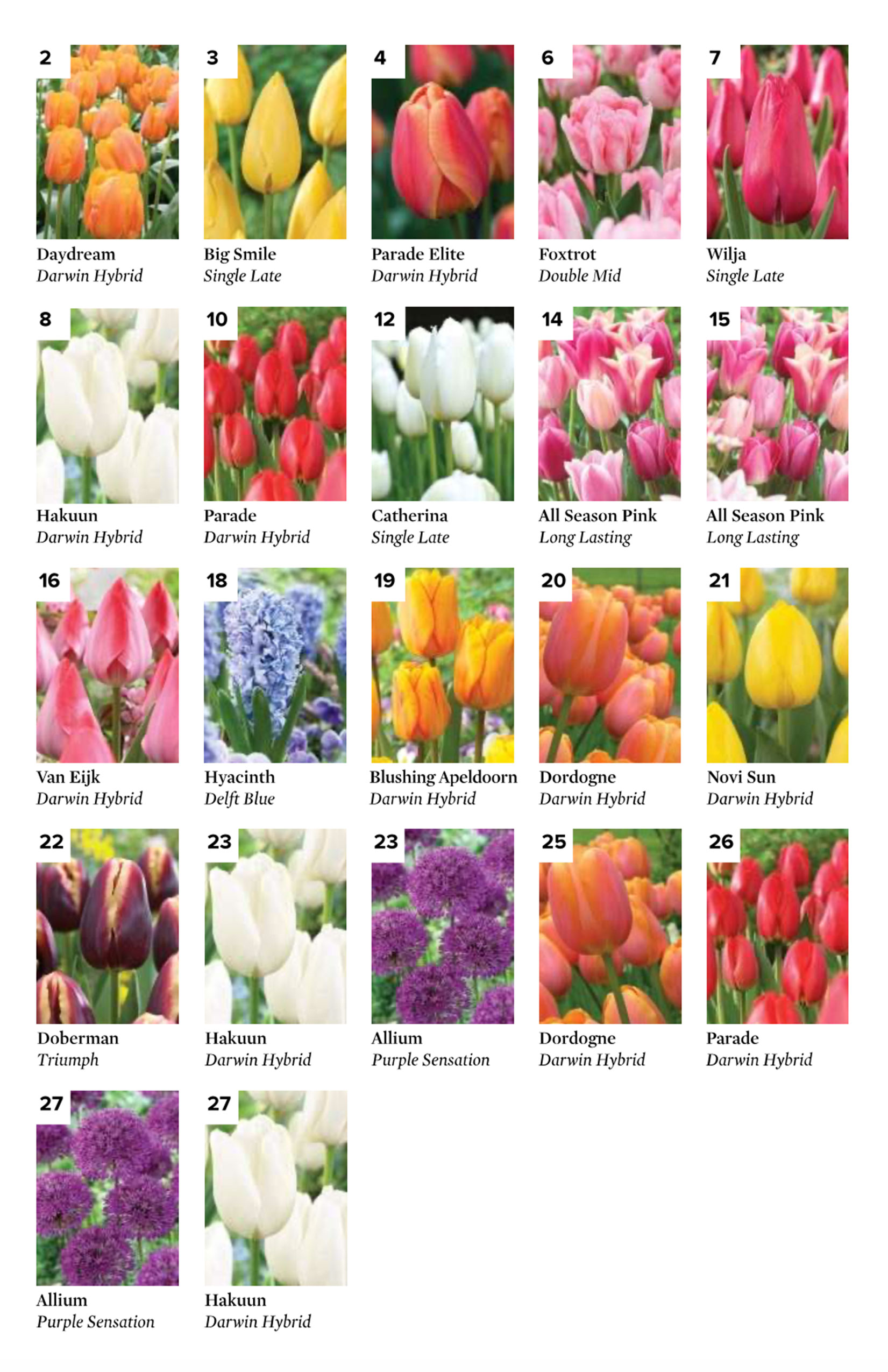
Pacific Northwest
- Late March to mid-April
- Earliest reliable bloom in the country
- Cool, wet winters drive early growth
South and lower Midwest
- Early to mid-April
- Warmer soil pushes faster opening
- Bloom can end abruptly in a heat spike
Upper Midwest and Northeast
- Late April to late May
- Latest window, best for a late-May trip
- Cooler springs extend the display
One hard data point worth knowing: the Netherlands produces roughly 4 billion tulip bulbs a year, according to the Dutch bulb industry association, and many US farms grow Dutch-bred varieties. That matters because Dutch cultivars are bred for staggered bloom times, which is why a well-managed US farm can keep color on display for three to four weeks instead of ten days. If you want the full science behind that, the Royal Bulb Flowers grower network publishes variety-by-variety bloom timing.
Maya Whitfield’s honest take: “I once drove two hours to a field in early April because a website said ‘peak bloom’ and found nothing but green stems. Call the farm. Ask what percentage of the field is actually open. That one phone call saves entire trips.”
What are the best tulip fields in the Pacific Northwest?
The Pacific Northwest is the best region in the country for tulips, and it is not close. The Skagit Valley in Washington grows more tulip and daffodil bulbs than any other region in the United States, according to the Skagit Valley Tulip Festival, which runs the entire month of April. If you only ever visit one tulip region, make it this one.
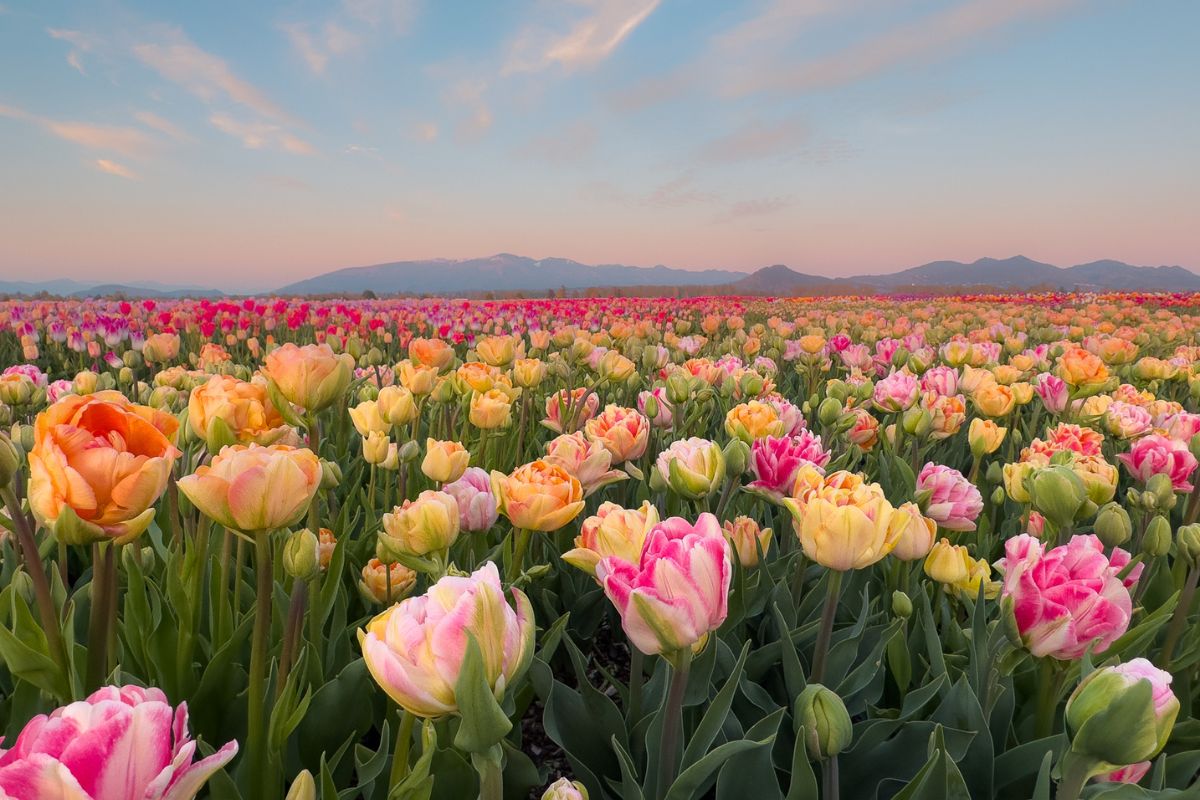
RoozenGaarde, Mount Vernon, Washington
This is the flagship. RoozenGaarde is the display garden arm of the Roozen family, who have been growing bulbs in the Skagit Valley for generations. The show garden is manicured, densely planted, and designed for photography, with a windmill and a formal layout. Entry is ticketed during the festival, typically around $15 to $20 per adult on weekends (confirm the latest price directly with the operator). My advice: go on a weekday at opening. I have stood in a 40-minute entry line on a Saturday and walked straight in on a Wednesday.
Tulip Town, Mount Vernon, Washington
Tulip Town sits a few miles from RoozenGaarde and leans harder into the festival atmosphere, with an indoor display barn, local vendors, and a small train ride for kids. It is the better pick if you are traveling with young children or someone who cannot walk far on uneven ground. Tickets are usually in the same $15 to $20 range per adult (check current rates on the official site). The trade-off is that the outdoor fields are slightly smaller than RoozenGaarde’s.
Wooden Shoe Tulip Farm, Woodburn, Oregon
About 45 minutes south of Portland, Wooden Shoe runs the Wooden Shoe Tulip Festival and offers something the Washington farms mostly do not: U-pick. You can walk the fields and cut your own stems, usually priced per stem at roughly $1 to $2 each (confirm the latest price directly with the operator). They also run hot air balloon rides over the fields during the festival, which is the single most photogenic thing I have done in Oregon. Entry is ticketed, generally around $15 to $25 per vehicle depending on the day (check current rates on the official site).
VanderZanden Farms, Woodburn, Oregon
A smaller, quieter alternative near Wooden Shoe. VanderZanden is a working bulb farm that opens to the public during bloom, and it feels far less commercial. If crowds drain you, this is the one. Entry is typically lower than the big festivals, often under $10 per person (confirm the latest price directly with the operator).
Maya Whitfield’s honest take: “Skagit Valley traffic on a festival Saturday is genuinely brutal. I now base myself in La Conner, a tiny town ten minutes from the fields, and drive in before 8 a.m. It changes the entire experience.”
Best for
- Photographers: RoozenGaarde’s manicured beds
- Families with small kids: Tulip Town
- U-pick and balloon rides: Wooden Shoe
- Crowd avoidance: VanderZanden Farms
Worth considering
- RoozenGaarde season pass if you visit twice
- La Conner as a base for two nights
- Booking a guided tulip festival tour to skip parking stress
Which Midwest tulip festivals are worth the trip?
The Midwest has two genuinely famous tulip towns, and they are very different experiences. If you want a full festival with parades and street food, go to Holland, Michigan. If you want a smaller, heritage-heavy Dutch celebration, go to Pella, Iowa.

Holland, Michigan (Tulip Time Festival)
Holland plants roughly 5 to 6 million tulips across the city each year, according to the Tulip Time Festival organizers, and many of the downtown beds are free to walk past. The festival runs for about a week in early to mid-May and includes parades, Dutch dancing, and a carnival. Ticketed events cost extra, generally $10 to $30 depending on the show (confirm the latest price directly with the operator). My honest note: the downtown beds are lovely, but the real show is at the dedicated display gardens, which are ticketed.
Pella, Iowa (Pella Tulip Time)
Pella is smaller and more heritage-focused. The town plants around 250,000 to 300,000 tulips, per the Pella Tulip Time committee, and the festival runs three days in early May. What I love here is the authenticity: Dutch letter pastries, traditional costumes, and a parade that feels community-run rather than corporate. Most street-level viewing is free. There are ticketed shows, usually in the $10 to $20 range (check current rates on the official site).
Dutch Hollow Farms, Modesto, California
Technically not the Midwest, but worth grouping here for West Coast travelers who cannot reach Washington or Oregon. Dutch Hollow is a smaller U-pick operation in California’s Central Valley, with a bloom window that runs earlier than the northern farms, often February into March. Entry and per-stem pricing are modest, typically under $10 entry and around $1 to $2 per stem (confirm the latest price directly with the operator).
Maya Whitfield’s honest take: “Pella is the sleeper pick. It is a fifth the size of Holland, but the locals actually talk to you, and the food is better. I would take a quiet Pella morning over a packed Holland afternoon every time.”
Best for
- Big festival energy: Holland, Michigan
- Heritage and smaller crowds: Pella, Iowa
- Early bloom and U-pick: Dutch Hollow Farms
Worth considering
- Booking a hotel in downtown Holland months ahead
- Combining Pella with a Des Moines weekend
- Checking TripAdvisor reviews for current festival logistics
Are there tulip fields in the South?
Yes, and they bloom earlier than almost anywhere else in the country. The South’s tulip season is short because heat arrives fast, but if you time it right, you can see tulips in February and March while the rest of the country is still in winter coats.
Texas Tulips, Pilot Point, Texas
About an hour north of Dallas, Texas Tulips is a U-pick farm that opens when the fields are ready, usually late February into March. Entry is modest, generally around $5 to $10 per person, and you pay per stem for what you pick, typically a few dollars each (confirm the latest price directly with the operator). The fields are smaller than the Northwest farms, but the experience is more hands-on. I picked a dozen stems here in under twenty minutes and the staff wrapped them for the drive home.
Texas Tulips, San Antonio area
The same operator runs a second location near San Antonio with a similar U-pick model and a slightly later window, often March into early April. Pricing is comparable to the Pilot Point farm (check current rates on the official site). If you are in Central or South Texas, this is your closest real tulip field.
Holland America Flower Gardens, Woodland, Washington
I am listing this here deliberately because a lot of Southern travelers fly to the Pacific Northwest anyway. Woodland is south of the main Skagit fields, closer to Portland, and the gardens here offer a slightly later bloom and a quieter visit. Entry is generally under $15 per person (confirm the latest price directly with the operator).
Maya Whitfield’s honest take: “Texas tulip season is a sprint, not a marathon. I have seen a field go from perfect to petal-drop in five days when a warm front rolled through. If the farm says peak, go that week. Do not wait for the weekend.”
Best for
- Early-season tulips: Texas Tulips Pilot Point
- San Antonio day trips: Texas Tulips second location
- Quieter Northwest visit: Holland America Flower Gardens
Worth considering
- Booking a family vacation rental near Pilot Point for a weekend
- Checking flight prices into Dallas or San Antonio early
- Packing sun protection, because Texas fields have zero shade
Where can I see tulips in the Northeast and Mid-Atlantic?
This is the region most tulip listicles skip, and it is a real gap. The Northeast and Mid-Atlantic have excellent tulip displays, they just peak later, which actually works in your favor if you missed the Northwest season.
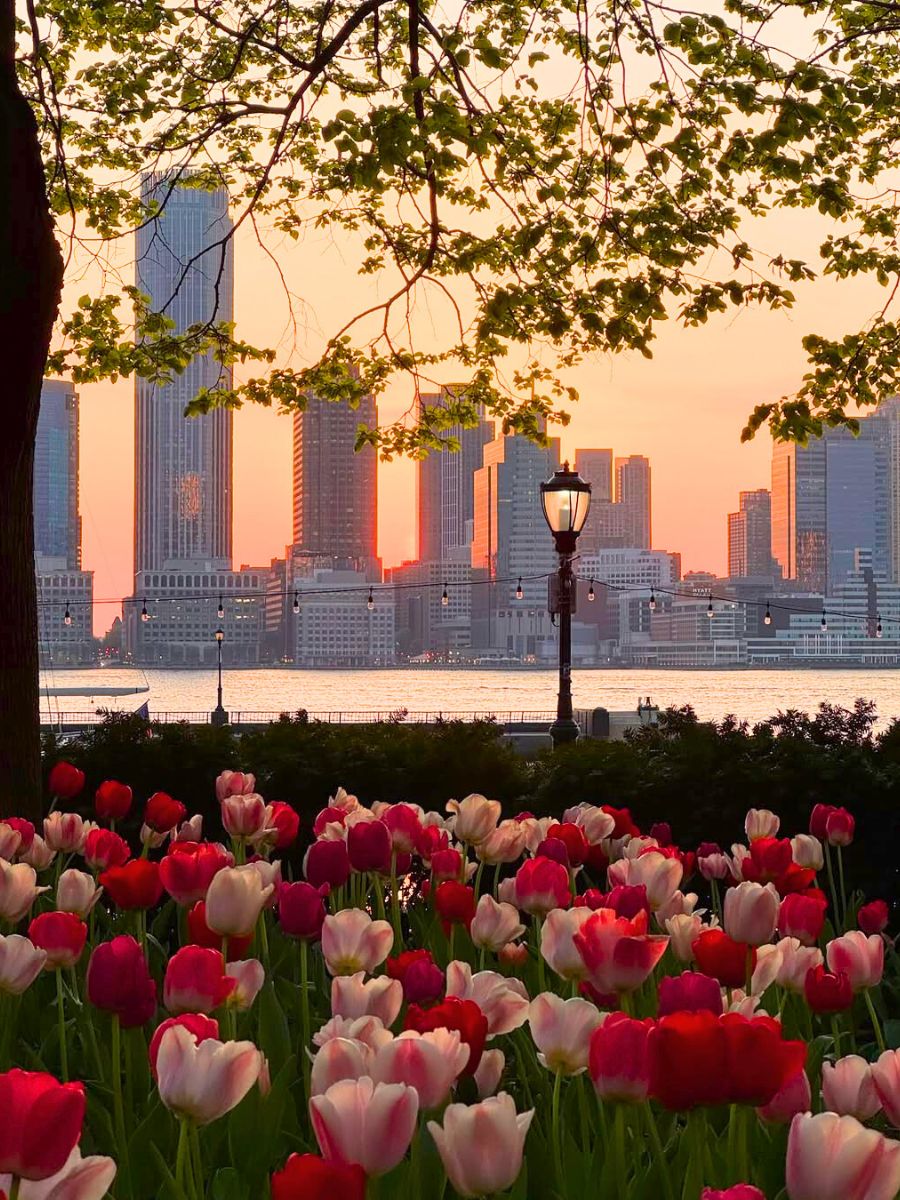
Hudson Valley display gardens, New York
Several estates and botanical gardens in the Hudson Valley plant substantial tulip displays that peak in late April and early May. Entry varies by site, generally $10 to $20 per adult (confirm the latest price directly with the operator). The advantage here is that you can pair tulips with a weekend of things to do in the region, from wineries to historic homes.
Longwood Gardens, Kennett Square, Pennsylvania
Longwood is one of the great botanical gardens in the United States, and its spring bulb display is enormous. The tulip peak usually lands in mid to late April, and the garden publishes detailed bloom updates. Timed-entry tickets are required and typically run about $25 to $30 per adult (check current rates on the official site). This is the most reliable tulip experience in the Mid-Atlantic because the garden manages indoor and outdoor displays, so weather is less of a gamble.
New England bulb displays, Connecticut and Massachusetts
Smaller towns across Connecticut and Massachusetts plant municipal tulip beds that peak in early to mid-May. These are usually free to walk through. The trade-off is scale: you will not find a 50-acre field, but you will find charming town commons with dense color and no ticket line.
Maya Whitfield’s honest take: “Longwood Gardens is the most organized tulip experience in America. They tell you exactly what is blooming before you buy a ticket. After years of guessing at farm bloom reports, that transparency is worth the ticket price alone.”
Best for
- Reliable bloom and timed entry: Longwood Gardens
- Weekend pairing with wine and history: Hudson Valley
- Free, low-key viewing: New England town commons
Worth considering
- Booking a flight and hotel package into Philadelphia or New York
- Checking loyalty reward stays near Kennett Square
- Reserving Longwood tickets the moment your dates are firm
What mistakes should you avoid when visiting tulip fields?
I have made most of these myself, so this list is earned rather than theoretical.
Booking around a fixed date instead of a bloom report
Bloom moves. A farm that peaked on April 10 last year might peak on April 17 this year. Never book a nonrefundable trip around a historical date. Book flexible lodging and check the farm’s daily report before you commit. Most farms post updates on Instagram and Facebook every morning during season.
Showing up in the afternoon
Two problems. First, crowds peak between 11 a.m. and 2 p.m. Second, tulips close slightly in heat and direct sun, so the flowers look less open. Go at opening. I have photographed the same field at 8 a.m. and 1 p.m. and the morning shots are not close.
Wearing the wrong shoes
Tulip fields are farm fields. After rain, they are mud. I have watched people in white sneakers sink to the ankle and spend the rest of the visit miserable. Wear boots or shoes you do not care about.
Assuming every field is free
Some are free. Many are not. Ticketed festivals generally charge about $15 to $25 per adult (confirm the latest price directly with the operator), and U-pick stems are almost always extra, often $1 to $3 per stem (check current rates on the official site). Budget for parking fees too at the larger festivals.
Picking without permission
This sounds obvious, but every year people get escorted out of display fields for snapping stems. If a farm is not a U-pick operation, do not pick. The bulbs are the crop. The flowers are a byproduct, and the farm still needs them intact for their own harvest schedule.
Ignoring the weather plan
Tulip festivals run rain or shine. There is rarely a refund for bad weather. Bring a rain shell and check the forecast the night before. If a storm is coming, consider shifting your visit a day.
Forgetting that pets usually are not allowed
Most tulip farms prohibit dogs, even leashed ones, because the fields are food-production adjacent. Check before you bring a pet. I have seen families turned away at the gate.
For broader trip planning around these visits, including how to structure a multi-city itinerary, see our travel planning guides.
Frequently asked questions
When is the best time to see tulips in the USA?
The best time is late March through mid-May, depending on region. The Pacific Northwest peaks first, usually late March to mid-April. The South and lower Midwest follow in early to mid-April. The upper Midwest and Northeast peak last, generally late April through late May. Check each farm’s daily bloom report before you travel.
Are tulip fields free to visit?
Some are free, many are not. Municipal displays and some town plantings cost nothing. Ticketed festivals typically charge about $15 to $25 per adult, and U-pick stems usually cost extra at around $1 to $3 per stem (confirm the latest price directly with the operator). Always check the farm’s official site before you go.
Can you pick your own tulips?
At U-pick farms, yes. Texas Tulips, Wooden Shoe Tulip Farm, and Dutch Hollow Farms all offer U-pick during their seasons. You pay per stem, usually a few dollars each (check current rates on the official site). At display-only farms like RoozenGaarde and Longwood Gardens, picking is prohibited because the flowers are part of the managed display.
What is the largest tulip festival in the United States?
The Skagit Valley Tulip Festival in Washington is generally considered the largest, running the entire month of April across multiple farms and drawing hundreds of thousands of visitors. Holland, Michigan’s Tulip Time Festival is the largest single-town festival, with roughly 5 to 6 million tulips planted each year, according to festival organizers.
How do I find a tulip field near me?
Search for your state plus “tulip farm” or “tulip festival” and check the results against local garden club listings. Botanical gardens and arboretums are a reliable fallback because they publish bloom schedules. Social media is surprisingly useful: search Instagram for your city name plus “tulips” and filter by recent posts to see what is actually blooming nearby right now.
Do tulip fields allow dogs?
Most do not. Tulip farms are working agricultural operations, and food-safety rules plus crowd control mean pets are usually banned even on a leash. A few smaller farms allow dogs on specific quiet days, so call ahead. Never assume your dog can join you at a ticketed festival.
What should I wear to a tulip field?
Wear waterproof boots or shoes you do not mind ruining, because fields hold mud after rain. Bring a light rain shell, since festivals run rain or shine. Dress in layers because spring mornings in the Northwest and Midwest can be cold even when the afternoon is warm. Avoid white sneakers.
Plan your trip: booking platforms we trust
I book almost all of my tulip-season travel through these platforms because they consistently have the best availability near festival towns, and their cancellation policies have saved me more than once when bloom dates shifted. Start with hotel research first, then lock in transit.
Agoda
Best for Asian hotel deals, though I have found solid US festival-town rates here too.
Booking.com
My default for general hotel search near Skagit Valley, Holland, and Pella.
Expedia
Best for flight and hotel packages if you are flying into a tulip region.
Kayak
Flight price comparison, useful when bloom dates are still flexible.
Vrbo
Family villas and vacation rentals, ideal for a Skagit Valley or Texas field weekend.
GetYourGuide
Tours and activities, including guided tulip festival day trips.
Hotels.com
Loyalty rewards bookings, good if you are stacking nights across a multi-field road trip.
TripAdvisor
Reviews and restaurant finds, especially helpful for small festival towns.
WakaAbuja does its best to keep all information accurate at the time of publishing. Prices, policies, and availability change regularly. Always verify with official sources before you travel. We are not liable for errors caused by outdated information. Travel insurance is strongly recommended.