advertisement
Trip to Koror, Palau: Costs, Permits & a 5-Day Plan
A trip to Koror, Palau costs roughly US$200 to US$400 per person per day, excluding international flights, and requires two mandatory permits: the US$100 Pristine Paradise Environmental Fee paid with your airline ticket, and a Koror State Rock Islands permit starting at US$50 per person (or US$100 if you plan to visit Jellyfish Lake), valid for five days. Five days is the sweet spot for most visitors: enough time for two full Rock Islands boat days, one Babeldaob land day, and one Peleliu history day without rushing. The cheapest round-trip flights from the US West Coast start around US$1,100, though prices vary by season (confirm current fares on a comparison site like Kayak).
Palau is not a destination you stumble into. It sits in the western Pacific, roughly 800 kilometers east of the Philippines, and the only way in is through Roman Tmetuchl International Airport (ROR) on Babeldaob Island, about a 15-minute drive from Koror. I have made this trip twice: once on a dive-focused itinerary, once with a non-diving partner. Both times, the same thing tripped me up: the permits. Not the flights, not the hotels. The permits.
This guide exists because every other Koror article I found either buries the permit information in a footnote or skips it entirely. Tripadvisor ranks first for this query with a thin aggregator page, and the itinerary sites offer generic day plans with no costs attached. I am going to give you the numbers, the permit names, and a five-day sequence that actually works on the ground.
Jump to: Key Takeaways | Flights and Visa | Permits You Must Buy | Cost Breakdown | 5-Day Itinerary | Where to Stay | What to Avoid | FAQ
Key takeaways
- Palau requires a US$100 Pristine Paradise Environmental Fee, usually added to your airline ticket at booking.
- A separate Koror State permit costs US$50 for Rock Islands access or US$100 if you include Jellyfish Lake, valid for five days.
- Direct flights reach Koror (ROR) from Guam, Manila, Taipei, Hong Kong, Macao, and Brisbane, with United, China Airlines, and Qantas among the carriers.
- US citizens enter visa-free for up to 90 days; most other nationalities receive a 30-day visa on arrival, extendable twice for a fee.
- Budget travelers can find guesthouses around US$100 to US$150 per night (check current rates on Booking.com), while mid-range hotels like Palau Pacific Resort run higher.
- Jellyfish Lake access depends on daily conditions and conservation closures, so confirm it is open before you buy the US$100 permit.
- A five-day trip covers the essentials: two Rock Islands days, one Babeldaob land day, and one Peleliu history day.
How do you actually get to Koror, Palau?
Koror has one airport: Roman Tmetuchl International Airport, also called Palau International Airport, code ROR. It sits on Babeldaob Island about 7 kilometers from Koror town center, roughly a 15-minute drive. There are no direct flights from North America, Europe, or Australia beyond Brisbane.
The most common routes come through Guam and Manila. United operates direct flights from both, with Guam taking about 2 hours 5 minutes and Manila about 3 hours. China Airlines flies from Taipei in roughly 3 hours 50 minutes. Greater Bay Airlines connects Hong Kong in about 4 hours 20 minutes, and Qantas runs a weekly Brisbane service at roughly 6 hours. Cambodia Airways covers Macao.
From the US mainland, you are looking at a connection through Guam, Honolulu, or Tokyo. A recent fare analysis put the cheapest US-origin round-trip at around US$1,119 (check current fares on Kayak), but that varies widely by season and how far ahead you book.
Visa rules are straightforward for most travelers. US citizens enter visa-free for 90 days. Citizens of most other countries, except Bangladesh and Myanmar, can get a visa on arrival valid for 30 days, extendable twice for a fee. You need a passport valid for at least six months, proof of onward travel, and proof of sufficient funds at US$200 per week.
Maya Whitfield’s honest take: “The Guam connection is the easiest for most North American travelers, but it adds a full day of travel each way. I built an extra night in Guam on my first trip and was glad I did. Trying to do the red-eye into Koror and start a dive day the same morning is a recipe for a ruined first day.”
What permits do you need for a trip to Koror, Palau?
This is the section that no other guide gives you clearly, and it is the one that matters most. Palau charges two separate fees that function as permits. Miss either one and you cannot get on a boat to the Rock Islands.
The first is the Pristine Paradise Environmental Fee, US$100 per person. This is added to your airline ticket when you book or collected at check-in by your carrier. You do not pay it separately on arrival. It funds environmental conservation and heritage preservation across Palau.
The second is the Koror State Rock Islands permit. This is separate from the environmental fee and is sold by tour operators or at the Koror State office. It comes in two tiers: US$50 per person for general Rock Islands access or US$100 per person if you want to include Jellyfish Lake. Both are valid for five days. If you plan to fish during your boat trips, there is an additional fishing tax of US$20 per person, valid for 30 days.
Some boat tours include the permit cost in their listed price; many do not. Read the fine print carefully. On my first trip, I assumed the US$115 tour price covered everything and ended up paying an extra US$100 at the dock for the Jellyfish Lake permit. That was on me for not checking, but the listing did not make it obvious either.
Permits you will pay
- Pristine Paradise Environmental Fee: US$100, on your airline ticket
- Rock Islands permit (no Jellyfish Lake): US$50, valid 5 days
- Rock Islands permit (with Jellyfish Lake): US$100, valid 5 days
- Fishing tax (if applicable): US$20, valid 30 days
What to know
- Some tours bundle permits into the price; many do not.
- Jellyfish Lake can close without notice for conservation or weather reasons.
- Keep your permit receipt; rangers check at popular sites.
How much does a trip to Koror actually cost?
I am going to give you real ranges based on what I paid and what I have verified with current listings. Palau is not cheap. The country made a deliberate policy shift years ago to target fewer, higher-spending visitors rather than mass tourism, and the pricing reflects that.
Flights
From the US West Coast, expect US$1,100 to US$1,800 round-trip depending on season and how far ahead you book (check current fares on Kayak). From Australia via Brisbane, Qantas runs a weekly direct service. From Asia, fares from Manila or Taipei are often significantly cheaper.
Accommodation
Budget guesthouses in Koror start around US$100 to US$150 per night. A mid-range property like Shell Villa Apartel Resort averages around US$188 per night (check current rates on Booking.com). Palau Pacific Resort, the main higher-end option in Koror, sits around S$344 to S$363 per night, roughly US$250 to US$270 depending on exchange rates.
Food and daily expenses
Breakfast at a Koror cafe runs US$5 to US$15. Lunch is US$10 to US$25, and dinner ranges from US$15 for local spots to US$60 or more at waterfront restaurants like Elilai Seaside. Alcohol is taxed heavily and adds up fast.
Boat tours and activities
A standard Rock Islands group snorkeling day tour runs around US$115 per person, not including the permit. Private charter boats start around HK$7,845 for a 1-6 person boat, which translates to roughly US$1,000 (confirm current pricing directly with the operator). Dive shops charge separately for two-tank dive days, typically US$150 to US$200.
Maya Whitfield’s honest take: “The number people underestimate most is the daily tip for boat crews. It is not mandatory, but it is expected, and US$10 per person per day is the standard. On a five-day trip with two boat days and two dive days, that is US$40 per person before you have bought a single meal.”
Daily budget tiers (per person, excluding flights)
- Budget: US$150 to US$200 per day (guesthouse, local food, group tours)
- Mid-range: US$250 to US$350 per day (mid hotel, one tour daily, mix of dining)
- Luxury: US$500 and up (Palau Pacific, private charters, fine dining)
One-time costs
- Environmental fee: US$100
- Rock Islands permit: US$50 or US$100
- Fishing tax (if applicable): US$20
What does a realistic 5-day Koror itinerary look like?
Five days is enough to see the highlights without burning out. Four days feels rushed. Seven days lets you add a dedicated diving certification or a second Babeldaob day. Here is the sequence I would use again.
@travelwithzo_ Bucket list country 🇵🇼 Palau itinerary – accommodation Ocean Star Hotel Palau #palau #koror #micronesia #travel #femaletravel
Day 1: Arrive, orient, and buy your permits.
Flights into Koror mostly arrive in the evening or late afternoon. Clear immigration, grab a taxi to your hotel in Koror (about 15 minutes), and check in. If you arrive early enough, walk the main street, visit the Etpison Museum for context on Palauan history and culture, and have dinner at a waterfront spot. Before you sleep, sort out your Rock Islands permit with your tour operator for the next day. Do not wait until morning.
Day 2: Rock Islands, Southern Lagoon, and Jellyfish Lake
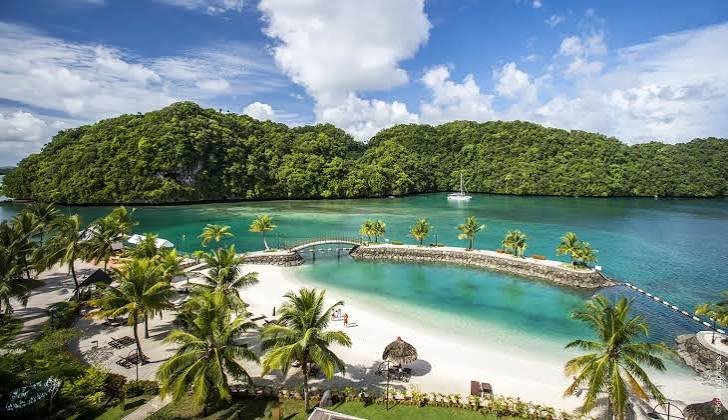
This is the classic Palau day. Board a boat in Koror around 8:30 AM for a full-day Rock Islands tour. The standard route hits the Milky Way for a volcanic mud “spa,” the Big Drop-Off for wall snorkeling, and either Jellyfish Lake or an alternate site depending on conditions. Lunch is usually on an uninhabited beach. You are back in Koror by mid-afternoon, tired in the best way.
If Jellyfish Lake is open, this is the day to do it. The walk from the dock to the lake is about 10 minutes uphill on a rough path, then a wooden boardwalk. You snorkel among millions of golden jellyfish that have evolved to be essentially harmless. No sting.
Day 3: Babeldaob Land Day and Ngardmau Waterfall
Take a break from the water. Rent a car in Koror (about US$60 to US$90 per day, check current rates with local agencies) and cross the Japan-Palau Friendship Bridge onto Babeldaob, Palau’s largest island . Drive north to Ngardmau Waterfall, the country’s tallest, and hike down for a swim. On the way back, stop at the Badrulchau stone monoliths, a mysterious archaeological site with 37 basalt pillars, and the Capitol building in Melekeok, a white domed structure that looks oddly like a small Washington DC in the jungle .
Fuel up before you leave Koror. Gas stations on Babeldaob are sparse, and services are limited. Carry water and snacks.
Day 4: Peleliu Island World War II history
A speedboat to Peleliu takes about 1.5 hours each way. This island was the site of one of the Pacific War’s bloodiest battles in late 1944, and it is now a designated U.S. National Historic Landmark . A local guide walks you through Bloody Nose Ridge, the 1,000-Man Cave, rusting tanks, and the memorial sites. The abandoned airstrip is now a field of wildflowers. It is heavy and worth it.
If World War II history is not your priority, swap this day for a second Rock Islands boat trip on the western route, which covers Japanese shipwrecks and different coral sites .
Day 5: Kayaking Nikko Bay and departure
Morning kayaking through Nikko Bay’s mangrove channels and mushroom-shaped rock islands is the quietest way to experience the Rock Islands . You can do a half-day guided paddle and still make an afternoon flight. If your flight leaves late evening, add a final snorkel stop before you head to the airport.
Where should you stay in Koror?
Koror is the commercial center and the base for almost every tour departure. Staying anywhere else on Babeldaob adds driving time to your mornings. I have stayed in two places in Koror and visited most of the others.
Palau Pacific Resort is the flagship, with its own beach and pool, and it is where I would put someone who wants a resort experience between boat days. Rates run around S$344 to S$363 per night (check current rates on Booking.com) . Shell Villa Apartel Resort offers good value at around US$188 per night and is a five-minute drive from the museum and Nikko Bay . Garden Palace Downtown Koror puts you in the middle of town, which matters if you want to walk to dinner.
Budget options exist. Antelope Guesthouse was recently listed at around S$102 per night, the lowest in Koror at the time of that data pull . These are basic rooms, but if you are spending all day on boats, they get the job done.
Best for resort amenities
- Palau Pacific Resort: own beach, pool, full service
- Palau Royal Resort: central, reliable mid-range
Best value and location
- Shell Villa Apartel Resort: good value, near town
- Garden Palace Downtown Koror: walkable to restaurants
- Antelope Guesthouse: lowest nightly rate in town
What should you avoid on a trip to Koror?
These are the mistakes I have made or watched others make. Each one costs money or time.
Assuming your tour price includes permits
Most group tours list a base price that does not include the Koror State permit. A US$115 tour can become US$215 once you add the US$100 Jellyfish Lake permit . Ask explicitly before you book: “Does this price include the Rock Islands permit and Jellyfish Lake fee?”
Buying the Jellyfish Lake permit without checking if the lake is open
Jellyfish Lake closes periodically for conservation reasons and after heavy rain. It can also be closed on the day you visit due to conditions . If you pay the US$100 permit and the lake is closed, you have paid US$50 more than necessary. Check with your operator that morning before committing.
Booking a red-eye arrival and a boat tour the same day
The Guam red-eye lands early morning. You will be exhausted. Booking a full-day Rock Islands tour for that same morning is a waste. You will fall asleep on the boat and remember nothing. Build in a half-day on arrival.
Forgetting that Palau uses US dollars
Palau uses the U.S. dollar as its currency . Credit cards are accepted at hotels and larger restaurants, but you need cash for permits, tips, small cafes, and local markets. Bring more cash than you think you need.
Underestimating the physical demands of the Rock Islands
Jellyfish Lake requires a 10-minute uphill hike on a rough path each way. Some snorkel sites have strong currents. The Big Drop-Off is a wall dive that is not suitable for weak swimmers. If you have mobility issues or are not a confident swimmer, tell your operator in advance so they can suggest gentler sites.
Packing too much and buying too little sunscreen
Reef-safe sunscreen is required at many sites and sold at a premium in Koror. Bring it from home. Also bring a long-sleeved rash guard for snorkeling days; the equatorial sun is relentless, and you will burn through a t-shirt in the water.
Frequently asked questions
How many days do you need in Koror, Palau?
Five days is the minimum for a satisfying trip. That gives you two Rock Islands boat days, one Babeldaob land day, and one Peleliu history day without rushing. Four days works if you skip Peleliu. Seven days lets you add a diving certification or a second land day .
What is the Pristine Paradise Environmental Fee?
It is a US$100 fee charged to every visitor entering Palau, usually added to your airline ticket at booking or collected at check-in. It funds environmental conservation and heritage preservation. You do not pay it separately on arrival .
Do I need a visa for Palau?
US citizens enter visa-free for up to 90 days. Citizens of most other countries receive a 30-day visa on arrival, extendable twice for a fee. Citizens of Bangladesh and Myanmar must apply for a visa in advance . You need a passport valid for six months and proof of onward travel.
Is Jellyfish Lake worth the extra US$50 permit cost?
Yes, if it is open and you are comfortable hiking 10 minutes uphill to reach it. Swimming among millions of harmless golden jellyfish is genuinely unlike anything else. If you are not a strong swimmer or the lake is closed, save the US$50 and do a second snorkel site instead .
How much does a Rock Islands boat tour cost?
A standard group snorkeling day tour runs around US$115 per person, not including the Koror State permit (US$50 or US$100) or tips. Private charters start around US$1,000 for a 1-6 person boat (confirm current pricing directly with the operator) .
What is the best time of year to visit Koror?
The dry season runs roughly December through April, with calmer seas and better visibility for diving and snorkeling. The wet season from July through October brings rain showers and occasional closures, but also lower prices and fewer crowds. Jellyfish Lake access can be affected by rainfall runoff.
Plan your trip: booking platforms we trust
I use these platforms for different parts of the trip. None of them pay me to say that.
WakaAbuja does its best to keep all information accurate at the time of publishing. Prices, policies, and availability change regularly. Always verify with official sources before you travel. We are not liable for errors caused by outdated information. Travel insurance is strongly recommended.