
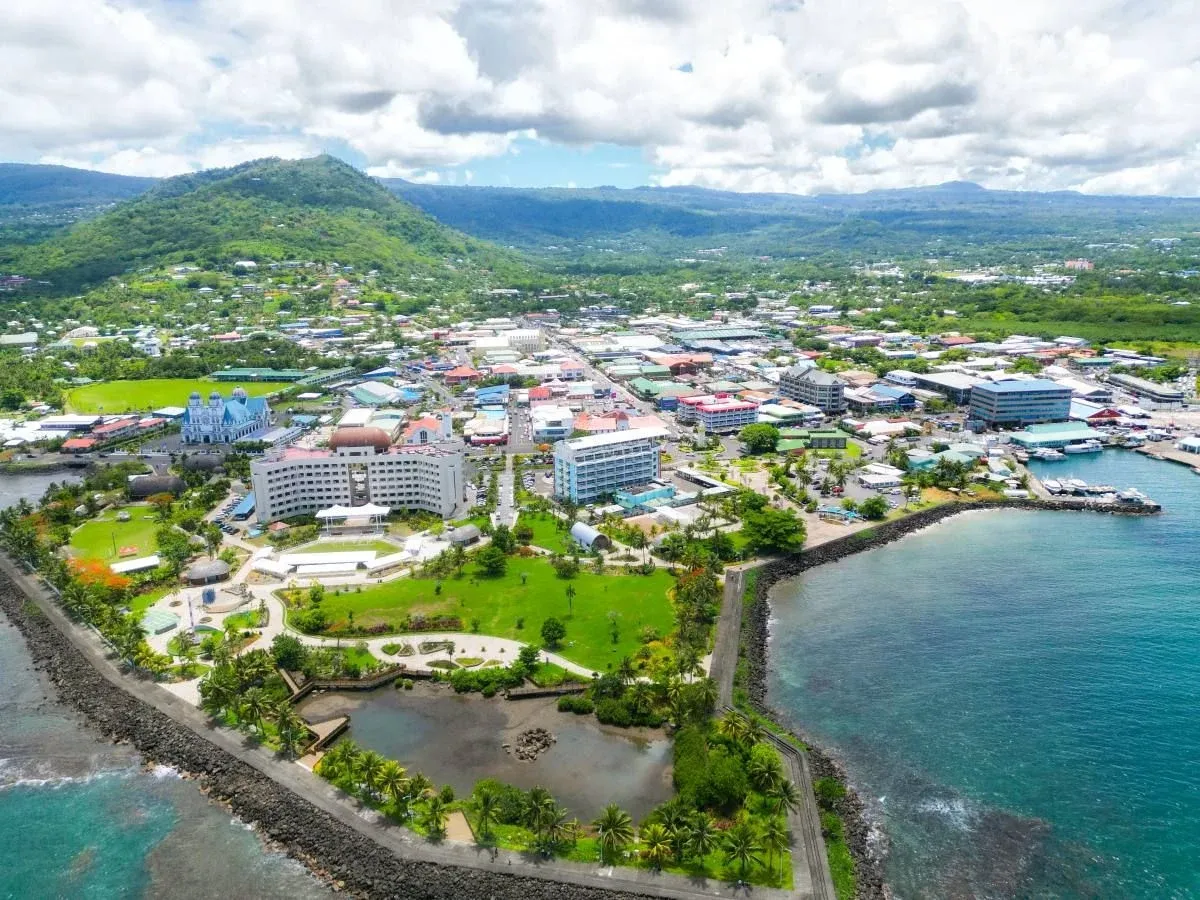
Travel to Apia, Samoa: Visas, Costs, Weather & What to Do
Travel to Apia, Samoa, is straightforward for most Western passport holders: US, UK, EU, Australian, and New Zealand citizens get a 60-day visitor permit on arrival, with a passport valid for at least six months beyond departure (confirm your specific nationality on the official Samoa Immigration site). A realistic mid-range trip for two costs roughly US$3,500 to US$5,500 for seven days, including flights from Australia or New Zealand, beach fare or hotel accommodation, food, and activities (confirm current rates on Booking.com). The best time to visit is May through October, the dry season, when temperatures sit between 24 and 30 degrees Celsius and humidity is lower.
Apia gets undersold. Most travelers treat it as the airport they fly into before heading to a beach resort on Upolu, and that is a mistake. The capital has the best food in Samoa, the most concentrated set of cultural sights, and the liveliest market in the country. Give it two full days before you head to the coast, and you will understand Samoa better than travelers who go straight to the resorts.
I spent five days in Apia in 2022, split between a hotel near the harbor and a beach fale on the outskirts, and the practical stuff that Samoa Pocket Guide’s otherwise excellent page does not cover is what I ended up researching the hard way: visa rules, real daily costs, which months to avoid, and how to get around without a rental car. This guide covers all of it, with real numbers and current rules.
Jump to: Key Takeaways | Is Apia Worth Visiting | Visa & Entry | What It Costs | Best Time to Visit | Getting There | What to Do | Where to Stay | Safety & Health | 3-Day Itinerary | FAQ
Key takeaways
- US, UK, EU, Australian, and New Zealand passport holders get a 60-day visitor permit on arrival in Samoa, free of charge, with a passport valid for at least six months beyond departure (confirm your specific nationality on the official Samoa Immigration site).
- A realistic mid-range 7-day trip for two costs US$3,500 to US$5,500, including flights, accommodation, food, and activities (confirm current rates with your booking platform).
- May through October is the dry season and the best time to visit, with lower humidity and daytime temperatures of 24 to 30 degrees Celsius.
- Faleolo International Airport (APW) is 40 km west of Apia and 45 to 60 minutes by road. A taxi to the city should cost 40 to 60 Samoan tala, roughly US$15 to US$22 (confirm current fares with the official airport taxi line).
- Samoa observes Sunday as a day of rest. Most businesses, tours, and many restaurants close, and village rules restrict activity. Plan around it.
- Palolo Deep Marine Reserve is the best snorkeling spot reachable from Apia, with an entry fee of 5 tala, roughly US$2 (confirm current fees at the entrance).
- Dengue fever is present in Samoa, and the CDC recommends standard travel vaccinations plus hepatitis A and typhoid before you go (check the CDC’s Samoa page for current guidance).
Is Apia worth visiting, or should you head straight to the resorts?
Apia is worth visiting, and skipping it is the single most common regret travelers have about Samoa. The capital is where you see the everyday life of the country rather than the resort version of it. The Maketi Fou market, the Palolo Deep snorkeling reserve, and the Vailima estate where Robert Louis Stevenson lived are all within a short drive of the center.
Apia is a working Pacific capital, not a beach town. Do not arrive expecting white sand and turquoise water in the city itself. The beaches are on the coast outside town. What you get in Apia is culture, food, and the best base for day trips to Papase’ea Sliding Rocks, the Piula Cave Pool, and the cross-island road to the south coast.
Two full days in Apia is the right amount. One day for the town and the market, one day for the nearby sights. If you are planning a week in Samoa, spend the first two nights in Apia and the rest at a beach fale on the south or east coast.
Maya Whitfield’s honest take: “I almost skipped Apia because every guide framed it as a transit city. Two nights there turned out to be the best part of the trip. The market alone is worth the stop. Go early on Saturday, before the heat and the crowds.”
Best for
- First-time visitors: the best base for day trips to Upolu’s sights.
- Food lovers: the widest restaurant variety in Samoa.
- Culture-focused travelers: markets, museums, and Vailima estate.
- Families: easy access to Palolo Deep and the Papase’ea Sliding Rocks.
Worth considering
- Beach-focused travelers: spend only one night in Apia, then move to the coast.
- Return visitors: Apia’s sights repeat quickly, so prioritize the coast.
Do you need a visa to travel to Apia, Samoa?
Most Western passport holders do not need a visa for Samoa. US, UK, EU, Australian, and New Zealand citizens receive a 60-day visitor permit on arrival, free of charge, provided their passport is valid for at least six months beyond departure and they have a return or onward ticket. Confirm your specific nationality on the official Samoa Ministry of Foreign Affairs and Trade site before booking.
Citizens of some countries in Asia, Africa, and the Middle East may need to apply for a visa in advance. The application requires a passport photo, proof of accommodation, and a return ticket. Processing usually takes one to two weeks but can run longer during peak periods. Apply at least a month before departure to be safe.
Samoa has no departure tax for most travelers and no mandatory vaccinations for entry. If you are arriving from a yellow fever-endemic country, proof of yellow fever vaccination is required. Check the CDC travel page for current vaccination recommendations.
For destination-specific visa rules and entry requirements beyond Samoa, see the WakaAbuja visa guide.
How much does a trip to Apia, Samoa, cost?
Samoa is not a cheap destination, mostly because flights from Australia, New Zealand, or the US are limited and expensive. On the ground, costs are moderate. A budget traveler can manage on US$60 to US$90 per person per day, mid-range US$140 to US$220, and comfort travelers US$300 or more (confirm current rates with your hotel and tour operators).
These figures exclude international airfare, which runs US$400 to US$900 round trip from Auckland or Sydney and US$900 to US$1,600 from the US West Coast, depending on season and how far ahead you book (check current fares on Kayak).
Budget tier (beach fare, local food)
- Daily: US$60 to US$90 per person (confirm current rates on Booking.com).
- Lodging: Beach flat or simple guesthouse, US$25 to US$50 per night.
- Food: Local restaurants and market stalls, US$15 to US$25 per day.
- Transport: Local buses and shared taxis, US$5 to US$10 per day.
Mid-range tier (hotels, mix of dining)
- Daily: US$140 to US$220 per person (confirm current rates on Booking.com).
- Lodging: Mid-range hotels and resort rooms, US$90 to US$180 per night.
- Food: Mix of local and hotel restaurants, US$35 to US$60 per day.
- Activities: One paid tour or excursion per day, US$25 to US$60.
Comfort tier (resorts, fine dining)
- Daily: US$300 to US$500 per person (confirm current rates with the resort directly).
- Lodging: Beachfront resorts, US$200 to US$400 per night.
- Food: Resort dining primarily, US$70 to US$120 per day.
- Transport: Private transfers and rental cars, US$60 to US$120 per day.
Two cost traps catch first-timers. First, taxis from Faleolo airport often quote prices well above the standard 40 to 60 tala, roughly US$15 to US$22 (confirm current fares with the official airport taxi line). Use the airport shuttle or arrange a transfer through your hotel instead. Second, restaurants at resorts charge twice what Apia restaurants do. Eat in town for at least one meal a day and save real money.
When is the best time to travel to Apia, Samoa?
May through October is the best time to visit Apia. This is the dry season, when the trade winds keep humidity lower, rainfall is lighter, and daytime temperatures sit between 24 and 30 degrees Celsius. It is also the peak tourist season, so book accommodation and flights well in advance.
The wet season runs November through April, with heavier rain, higher humidity, and the risk of cyclones. The cyclone season peaks between December and March, and Samoa has been hit by major storms in past years. Prices drop significantly during the wet season, so budget travelers willing to tolerate some rain can save 30 to 40 percent on accommodation.
September is the sweet spot for most travelers. It sits at the tail end of the dry season; the crowds have thinned after the July and August peak, and prices have not yet risen for the December holiday period. October is also excellent, though the rain starts to pick up toward the end of the month.
Best months by priority
- Best weather: June, July, August, September.
- Best for budget: February, March, November.
- Best for diving: September to November, calm water and good visibility.
- Avoid: December to March, cyclone season peak.
Seasonal notes
- Teuila Festival: Usually in September, Samoa’s biggest cultural festival with dance, music, and food.
- White Sunday: Second Sunday of October, a national children’s day with church celebrations.
- Rainy season: Expect heavy afternoon downpours, not all-day rain.
How do you get to Apia, Samoa?
Faleolo International Airport (APW) is 40 km west of Apia, on the western tip of Upolu. It is the main gateway to Samoa and the only airport with regular international flights. The transfer to Apia takes 45 to 60 minutes by road.
Air New Zealand flies from Auckland, usually five to six times per week. Fiji Airways flies from Nadi. Virgin Australia flies from Sydney and Brisbane. Air Samoa operates a short hop from Pago Pago in American Samoa. Flights are limited, so book as far ahead as possible, especially during the June to August peak and the December holiday period.
The airport shuttle runs between Faleolo and the Apia waterfront, but schedules are infrequent. A taxi should cost 40 to 60 tala, roughly US$15 to US$22 (confirm current fares with the official airport taxi line). Arrange a transfer through your hotel if you want a fixed price and a driver waiting at arrivals.
For cheap flight comparisons to Apia, check the WakaAbuja flight finder.
What should you do in Apia and around Upolu?
The sights around Apia split into the town center and the day-trip ring outside it. The town center is walkable. The day-trip sights require a car, a taxi, or a tour.
Maketi Fou (the main market)
The Maketi Fou is the best market in Samoa and the heart of the city. Vendors sell produce, clothing, wood carvings, and local food. Go early on Saturday morning when the market is at its liveliest. Do not expect air conditioning or credit cards. Bring cash and small notes.
Palolo Deep Marine Reserve
Palolo Deep is a coral reserve a short walk from the center of Apia, just past the harbor. Entry costs 5 tala, roughly US$2 (confirm current fees at the entrance). The snorkeling is genuinely good and the reef starts close to shore. Bring your own mask if you can, as rental gear is limited.
Vailima and the Robert Louis Stevenson Museum
Vailima is the estate where Robert Louis Stevenson spent the last five years of his life, now a museum with a well-preserved house, gardens, and views over the jungle. Entry costs 20 tala, roughly US$7 (confirm current prices at the ticket desk). The walk up to the summit of Mount Vaea, where Stevenson is buried, takes about 45 minutes and rewards you with a view over Apia.
Papase’ea Sliding Rocks
Papase’ea is a set of natural rock slides just outside Apia, where you can slide down small waterfalls into a pool. It is a fun, easy stop for families and worth an hour of your day. Entry is a few tala per person (confirm current fees at the entrance). Wear sturdy footwear and be careful on the rocks.
Piula Cave Pool
Piula is a freshwater cave pool on the north coast, about 30 minutes east of Apia, fed by an underground spring. It is a calm, unusual stop and easy to combine with the beaches on the north coast. Entry is a few tala per person (confirm current fees at the entrance).
Must-see
- Maketi Fou: free, best on Saturday morning.
- Palolo Deep: excellent snorkeling near the center.
- Vailima: the Robert Louis Stevenson museum and estate.
- Papase’ea Sliding Rocks: easy fun for families.
Worth adding
- Piula Cave Pool: a calm freshwater cave on the north coast.
- Cross-island road: scenic drive to the south coast beaches.
- Museum of Samoa: small but informative on the country’s history.
Where should you stay in Apia?
Apia accommodations split between the town center, where you get easy access to restaurants and the market, and the coast to the east and west, where you get water views and quieter surroundings. The right choice depends on how much time you plan to spend in town versus at the beach.
Best for first-timers
- Apia town center: walkable to the market, restaurants, and harbor.
- Vailima: quiet, near the museum and the Mount Vaea hike.
- Sogi: a short drive west of town, near Palolo Deep.
Best for beach and resort stays
- Mulinu’u: peninsula just west of town, good for resort-style stays.
- East coast: quieter and closer to Piula and the north coast beaches.
- South coast: the best swimming beaches, 45 minutes to an hour from town.
Hotel prices run from US$50 for a simple guesthouse to US$400 or more for a beachfront resort room (confirm current rates on Booking.com). For families or longer stays, Vrbo has a small but useful set of Apia apartments, and the beach fale stays on the south coast are the most authentic Samoa experience.
Is Apia, Samoa, safe for travelers?
Apia is generally safe for travelers, with low rates of violent crime against visitors. The main risks are petty theft, road safety, and the country’s limited medical infrastructure. Petty theft does happen in Apia, especially around the market and the waterfront at night, so keep your valuables secure and do not leave bags unattended in cars or on beaches.
Road conditions outside Apia are variable. The main roads are paved but often narrow and unlit at night. Watch for dogs, pedestrians, and potholes. If you are driving yourself, do so in daylight outside the city. If you are taking taxis, use licensed operators and agree on a price before you get in.
Samoa has limited medical facilities, particularly outside Apia. The main hospital is in Apia, but serious cases are often evacuated to New Zealand. Travel insurance with medical evacuation coverage is strongly recommended. Dengue fever is present in Samoa, and the CDC recommends standard travel vaccinations plus hepatitis A and typhoid (check the CDC’s Samoa page for current guidance).
Samoa has a strong traditional culture, and village rules matter. Dress modestly outside the resorts, especially in villages and churches. Do not walk through a village during the evening prayer curfew, which lasts about 30 minutes around sunset. Ask before taking photos of people. These rules are taken seriously.
What does a 3-day Apia itinerary look like?
This itinerary covers the city and the nearby sights without rushing. It assumes you have a car or can hire taxis for the day-trip days, which is the most efficient way to see Upolu.
Day 1: Apia town and Palolo Deep
Start at the Maketi Fou market in the morning, then walk along the waterfront and past the government buildings. Have lunch at a local restaurant near the harbor. In the afternoon, snorkel at Palolo Deep Marine Reserve. Dinner at a waterfront restaurant, ideally with a view over the harbor. This is a slow day, and it should be.
Day 2: Vailima and the Papase’ea Sliding Rocks
Morning at Vailima, the Robert Louis Stevenson museum and estate. Climb Mount Vaea if you have the energy; the view over Apia is worth it. Afternoon at Papase’ea Sliding Rocks, which is easy to combine with a stop at the nearby Falefa Falls if you have time. Dinner back in Apia.
Day 3: Cross-island road to the south coast
Take the cross-island road from Apia through the rainforest to the south coast, stopping at the various viewpoints and waterfalls along the way. Spend the afternoon at a south coast beach, such as Salamumu or Matareva, before heading back to Apia or onward to your next base. The drive is scenic and slow. Do not try to fit in too many stops.
Maya Whitfield’s honest take: “The cross-island road is one of the best drives in the Pacific, but it is not a highway. Budget the full day, not half. And plan around Sunday, when most stops along the route are closed.”
What mistakes do first-time visitors make in Apia?
I made several of these myself, so this is not a theoretical list. Here are the ones that cost money, time, or goodwill.
Not planning around Sunday closures
Samoa shuts down on Sunday. Most shops, tours, and many restaurants close, and village rules restrict movement during the evening prayer curfew. If your trip includes a Sunday, plan it as a beach or resort day and stock up on food the day before.
Assuming you can pay by card everywhere
Apia is largely a cash economy outside hotels and the biggest restaurants. Bring enough Samoan tala for markets, small restaurants, and taxis. ATMs exist in Apia but are limited outside the center.
Skipping the market
The Maketi Fou is the best single stop in Apia, and many travelers skip it because it looks busy or they are on their way to a resort. Go early on Saturday and give it an hour. It is the most authentic experience in the city.
Underestimating driving times
Roads outside Apia are narrow and slow. A drive that looks short on the map takes much longer than you expect. Do not over-plan your day. Two or three stops are enough for a full-day loop.
Not learning basic fa’a Samoa etiquette
Samoa has a strong traditional culture. Dress modestly outside resorts, remove your shoes before entering a fale, and ask before taking photos of people. These are not optional courtesies. They are expected, and getting them right will make your trip better.
Skimping on travel insurance
Samoan medical facilities are limited, and serious cases are often evacuated to New Zealand. Travel insurance with medical evacuation coverage is not optional here. Check what your policy covers before you fly.
Frequently asked questions
Do I need a visa to travel to Apia, Samoa?
US, UK, EU, Australian, and New Zealand passport holders receive a 60-day visitor permit on arrival, free of charge, provided their passport is valid for at least six months beyond departure. Citizens of some other countries may need to apply in advance. Confirm your nationality on the official Samoa Ministry of Foreign Affairs and Trade site.
How much does a trip to Apia cost for two people?
A 7-day mid-range trip for two costs roughly US$3,500 to US$5,500, including flights from Australia or New Zealand, mid-range accommodation, food, and activities. Budget travelers can do it for US$2,000 to US$3,000. Comfort travelers should budget US$6,000 to US$9,000 (confirm current rates with your booking platform).
When is the best time to visit Apia, Samoa?
May through October is the dry season and the best time to visit, with lower humidity and daytime temperatures of 24 to 30 degrees Celsius. September and October are the sweet spot, with thinner crowds and calm conditions for diving. Avoid December to March, the cyclone season peak.
Is Apia worth visiting, or should I go straight to a resort?
Apia is worth at least two full days, especially for first-time visitors. It has the best food in Samoa, the liveliest market, and the best base for day trips around Upolu. Beach-focused travelers can shorten this to one night, but skipping it entirely misses the best of the country.
How do you get from Faleolo airport to Apia?
Faleolo International Airport is 40 km west of Apia, a 45 to 60 minute drive. A taxi should cost 40 to 60 tala, roughly US$15 to US$22 (confirm current fares with the official airport taxi line). The airport shuttle is cheaper but infrequent. Arrange a transfer through your hotel for a fixed price.
Is Apia safe for tourists?
Apia is generally safe for tourists, with low rates of violent crime. The main risks are petty theft, road safety, and limited medical facilities outside the capital. Use licensed taxis, keep valuables secure, and carry travel insurance with medical evacuation coverage.
What should you not do in Samoa?
Do not walk through a village during the evening prayer curfew, do not wear revealing clothing outside resorts, and do not take photos of people without asking. Samoa has a strong traditional culture, and these rules are taken seriously. Following them is not just polite; it makes your trip better.
Plan your trip: booking platforms we trust
I use these platforms myself. They are the ones that consistently surface the best rates for Apia hotels, beach fales, and day tours around Upolu, and the ones I recommend to friends planning their first Samoa trip.
Booking.com
Best for Apia hotels, guesthouses, and beach fale stays.
Kayak
Compare international flight prices to Faleolo airport.
GetYourGuide
Book Upolu day tours, snorkeling trips, and cultural experiences.
Agoda
Useful for stopover hotels en route to Samoa.
Expedia
Bundle flights and hotels for package pricing.
TripAdvisor
Reviews and restaurant recommendations across Apia and Upolu.
WakaAbuja does its best to keep all information accurate at the time of publishing. Prices, policies, and availability change regularly. Always verify with official sources before you travel. We are not liable for errors caused by outdated information. Travel insurance is strongly recommended.