advertisement
Where to See Bioluminescence Around the World: 17 Glowing Destinations and the Best Time to Visit
Fact-Checked By: Maya Whitfield, Senior Travel Editor at WakaAbuja — Read more of her work here.
The best places to see bioluminescence include Mosquito Bay in Puerto Rico, Waitomo Glowworm Caves in New Zealand, Toyama Bay in Japan, and Manialtepec Lagoon in Mexico. Peak viewing usually runs between May and January, depending on the destination, with new moon nights offering the darkest skies and brightest glow. Tour prices typically range from $25 to $120 per person (confirm the latest price directly with the operator).
Most bioluminescence guides tell you it’s magical and stop there. This one tells you which month to book, whether you need a boat, and what not to pack for 17 places where the water actually glows. I’ve chased glowing bays across four continents, and I’ve learned the hard way that showing up without checking the moon phase is the fastest way to stare at ordinary dark water.
This guide covers every major bioluminescence destination on Earth, grouped by region, with real logistics: best months, how to book, rough costs, and whether you can see it from shore or need a tour. I’ve also included a comparison card set, a photography section, and a safety and etiquette briefing that most other guides skip entirely.
Jump to: What is bioluminescence | Compare your options | Caribbean | North America | Central and South America | Europe | Africa | Asia | Oceania | Maximize your chances | Photography | Safety and etiquette | FAQ
Key takeaways
- Puerto Rico’s Mosquito Bay is the brightest bioluminescent bay on record, with up to 720,000 dinoflagellates per gallon of water, according to a study published in PLOS ONE.
- New moon nights are almost always better than full moon nights, because moonlight washes out the glow.
- Some bays ban sunscreen, insect repellent, and even touching the water, and fines can run several hundred dollars (check current rules with your tour operator).
- Bioluminescence is not the same as fluorescence, and glowworm caves are a completely different phenomenon from glowing plankton.
- Peak season varies widely: Puerto Rico runs year-round but is best in winter, Japan’s Toyama Bay peaks from March to June, and New Zealand’s glowworm caves are viewable all year.
- Guided kayak and boat tours generally cost between $25 and $120 per person (confirm the latest price directly with the operator).
- Booking two nights instead of one dramatically improves your odds, since cloud cover and wind can cancel a single-night trip.
What is bioluminescence, and why does the water glow?
Bioluminescence is a chemical reaction inside a living organism that produces light. It happens when a light-emitting molecule called luciferin reacts with oxygen, usually triggered by an enzyme called luciferase. The result is cold light, meaning almost no heat is released, which is why it can flash for hours without cooking the creature producing it.
In the ocean, the most common source is single-celled plankton called dinoflagellates. When the water is disturbed by a paddle, a hand, or a breaking wave, they flash blue. On land, the glow comes from fungus gnat larvae, commonly called glowworms, which are found in caves and damp forests. These are two completely different organisms with two completely different light systems, and confusing them is the single most common mistake I see in bioluminescence planning.
The 4 types you’ll actually encounter
Dinoflagellates: Microscopic plankton that flash blue when the water moves. This is what you see in Puerto Rico, Jamaica, and most Caribbean bio bays.
Glowworms: Fungus gnat larvae that live in caves and emit a steady blue-green light. New Zealand’s Waitomo Caves and Australia’s Glowworm Tunnel are the classic examples.
Red tide: A bloom of certain plankton that turns the water reddish-brown by day and can glow blue at night when agitated. It is unpredictable and can be toxic to marine life and people, so check local health advisories before visiting.
Milky seas: A rare phenomenon where vast stretches of ocean glow uniformly, caused by billions of bacteria. It is almost impossible to predict and not a realistic tourist target.
If you want a deeper scientific primer, NOAA’s bioluminescence overview is the most reliable starting point I’ve found.
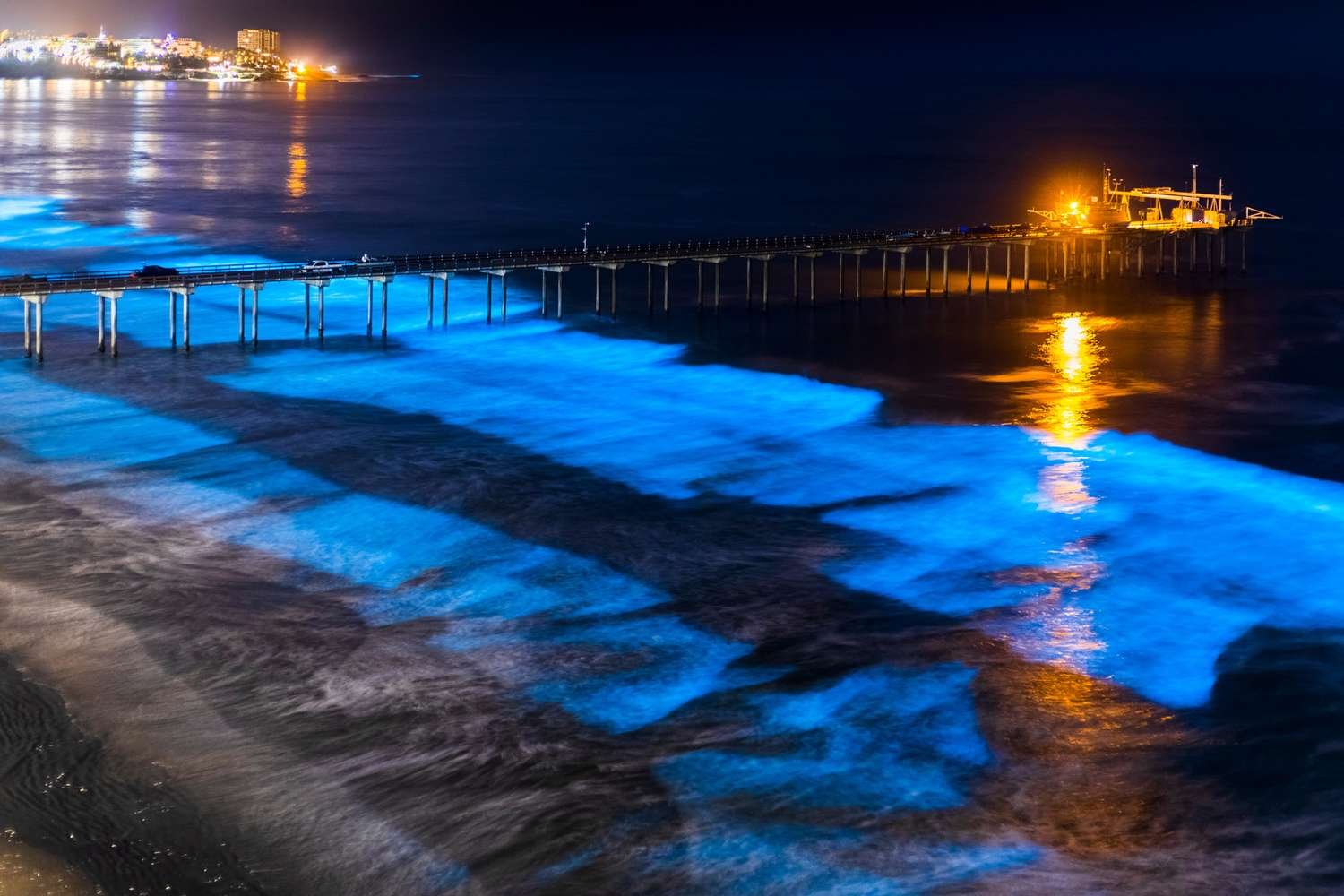
:max_bytes(150000):strip_icc()/TAL-lead-image-san-diego-USBIOLUMIN0626-17b10554b30c432eac28ba9ac09a1aae.jpg "Where to See Bioluminescence: 17 Glowing Spots Around the World (Plus When to Go) 1")
Compare your options at a glance.
Before you book anything, use these cards to narrow down which destination fits your budget, timing, and comfort level. I’ve grouped them by what matters most: whether you can see the glow from shore, whether you need a boat, and roughly what it costs.
From shore, no boat needed.
- Manialtepec Lagoon, Mexico
- Vaadhoo Island, Maldives
- Mission Rocks, South Africa
- North Devon, UK (seasonal)
Boat or kayak required
- Mosquito Bay, Puerto Rico
- Laguna Grande, Puerto Rico
- Luminous Lagoon, Jamaica
- Toyama Bay, Japan
- Waitomo Caves, New Zealand
Best for budget travelers
- Koh Rong, Cambodia
- Watamu, Kenya
- Nosy Be, Madagascar
- Zeebrugge, Belgium
Best for families
- Tomales Bay, California
- San Juan Island, Washington
- Grand Cayman
- Belize
Caribbean: Where are the brightest bioluminescent bays?
The Caribbean has more consistently glowing bays than any other region on Earth, and Puerto Rico alone has three. The science here is dinoflagellate-driven, which means the glow responds to movement. The more you paddle, the brighter it gets.
Mosquito Bay on Vieques is the gold standard. It holds the Guinness World Record for the brightest bioluminescent bay, and on a new moon night the water looks like someone poured neon into it. Tours run about $35 to $60 per person (confirm the latest price directly with the operator), and you must book through a licensed operator because the bay is protected.
Laguna Grande in Fajardo is the easiest to reach from San Juan, about an hour by car. It is also the most crowded. Luminous Lagoon in Jamaica is another strong option, and the water there is warm enough that most tours let you swim. Grand Cayman’s Bio Bay is smaller but reliable, and I’ve had good luck there on nights when other bays were washed out by moonlight.
Maya’s honest take: “If you only book one bioluminescence trip in your life, make it Mosquito Bay on a new moon. I’ve seen it twice, and the second time I actually laughed out loud when my paddle hit the water. No photo does it justice.”
Best for
- First-time bioluminescence seekers
- Travelers based in the US East Coast
- Kayaking and swimming
- Year-round availability
Worth considering
- Grand Cayman for smaller crowds
- Luminous Lagoon for swimming
For hotels near these bays, Booking.com has the widest inventory in Puerto Rico and Jamaica. For Vieques specifically, book accommodation early because the island is small and fills up around new moon dates.
North America: Where can you see bioluminescence in the US?
The United States has two reliable bioluminescence destinations, plus a third that is inconsistent but worth knowing about. San Juan Island in Washington State offers kayak tours through Friday Harbor, where the plankton bloom in summer. Tomales Bay in California is similar, with tours launching from Point Reyes Station.
Florida’s Indian River Lagoon is the third option. It glows when conditions align, usually in late summer, but it is not guaranteed. I’ve spoken to locals who have lived there for years and never seen it and others who saw it three nights in a row. If you are in Florida anyway, it is worth checking, but do not build a trip around it.
San Juan Island tours run about $70 to $100 per person (confirm the latest price directly with the operator), and the season runs roughly from June through September. Tomales Bay is similar. Both require advance booking because groups are small.

For flights to Seattle or San Francisco, Kayak is my go-to for comparing prices across airlines. For vacation rentals near Tomales Bay, Vrbo has more options than standard hotel sites.
Central and South America: Which lagoons and bays glow?
Mexico’s Manialtepec Lagoon near Puerto Escondido is one of the few places where you can wade into the glowing water without a boat. It is a lagoon, not a bay, and the glow is seasonal, best from June through November. Belize has several bioluminescence spots, with the most reliable being near Placencia. Chile’s Playa Bonita is the wildcard here.
I’ll be direct about Chile: the bioluminescence there is real but inconsistent. If you are already in the region, it is worth a night, but I would not fly to Chile specifically for it. Belize is the stronger choice for a dedicated trip, and the tours are well organized.
Maya’s honest take: “Manialtepec is the one place where I have stood waist-deep in glowing water and watched it swirl around my legs. It is less intense than Mosquito Bay, but the fact that you can just walk in makes it special.”
Best for
- Wading and swimming
- Budget travelers in Mexico
- Combining with surf trips
- Belize for organized tours
Worth considering
- Chile only if already nearby
- Belize for reef and glow combo
For tours in Mexico and Belize, GetYourGuide consistently has the most listings with verified reviews. For hotels in Puerto Escondido, Hotels.com often has loyalty discounts that beat standard rates.
Europe: Does bioluminescence exist in Europe?
Yes, but it is less reliable than the Caribbean or Asia. Belgium’s Zeebrugge coast occasionally glows in late summer when plankton blooms align with warm water. North Devon in the UK has similar sporadic events, usually between July and September. The Bay of Kotor in Montenegro has been reported, but I have not found consistent tour operators there.
My honest advice: do not plan a European trip around bioluminescence unless you are flexible and can chase local reports. Follow local marine conservation groups on social media, because the blooms are often announced only a day or two in advance.
Maya’s honest take: “I once drove four hours to the Devon coast on a tip from a local Facebook group and saw nothing. The next week, a friend went and got a light show. That is the reality of European bioluminescence. Go if you are nearby, not as a destination.”
Africa: Where can you see glowing water in Africa?
Africa has three solid bioluminescence destinations. Mission Rocks in South Africa’s iSimangaliso Wetland Park is the most accessible, with the glow visible from the beach on dark nights. Watamu in Kenya has a bioluminescent bay that locals call “the glowing sea,” and Nosy Be in Madagascar has several spots along its coast.
Watamu is my pick for Africa. The glow is consistent from December through March, and the local tour operators are knowledgeable. Prices run about $20 to $40 per person (confirm the latest price directly with the operator), which makes it one of the most affordable bioluminescence experiences in the world.
Mission Rocks is best from November to February. Nosy Be peaks from June to September. All three destinations require checking local conditions, because weather and plankton cycles vary year to year.
For flights to Kenya or South Africa, Expedia often has package deals that bundle flights and hotels. For accommodations in Watamu, Agoda has strong coverage of smaller boutique properties.
Asia: Which Asian bays and beaches glow at night?
Asia has some of the most dramatic bioluminescence on the planet. Toyama Bay in Japan is famous for its “firefly squid,” which glow blue and wash ashore in huge numbers from March to June. Koh Rong in Cambodia has glowing plankton that is best seen from November to February. Vaadhoo Island in the Maldives is the classic “sea of stars” destination, where the glow mimics a starry sky on the sand.
Toyama Bay is different from the others. The glow comes from squid, not plankton, and the peak viewing is at night from the shore or from small boats. It is a bucket-list experience for photographers.
Koh Rong is the budget option. Tours from the main pier run about $10 to $20 per person (confirm the latest price directly with the operator), and the glow is reliable in the dry season. Vaadhoo is the most expensive, because getting there requires a domestic flight or speedboat from Male, and resorts control access.
Maya’s honest take: “Vaadhoo is stunning, but it is also the most over-photographed bioluminescence spot on Earth. If you want the glow without the resort price tag, go to Koh Rong instead and spend the savings on a longer trip.”
For hotels in Cambodia and Japan, Agoda is consistently the strongest platform in Asia. For Maldives resorts, TripAdvisor reviews are essential because resort quality varies wildly.
Oceania: Where are the best glowworm caves and glowing bays?
New Zealand’s Waitomo Glowworm Caves are the most famous glowworm destination in the world. The glowworms are fungus gnat larvae that live on cave ceilings and emit a steady blue-green light. Tours run year-round, and prices range from $50 to $80 per person (confirm the latest price directly with the operator).
Australia has two main options. The Glowworm Tunnel in New South Wales is a former railway tunnel that is now home to thousands of glowworms. Tasmania’s Tasman Peninsula has bioluminescent plankton in the water, best seen from December to March. Both are less commercialized than Waitomo, which is part of their appeal.
Waitomo is the most accessible and the most reliable. If you are in New Zealand for any reason, it is worth the detour. The boat ride through the cave is silent, and the glow is bright enough to see your hand in front of your face.
For tours in New Zealand, GetYourGuide has the most options with free cancellation. For campervan rentals and road trip planning, Expedia bundles transport and accommodation well.
How do you maximize your chances of seeing bioluminescence?
Bioluminescence is a natural phenomenon, which means it is never guaranteed. But you can stack the odds in your favor with a few simple steps.
Time your visit around the moon
New moon nights are the best. A full moon can wash out the glow entirely. Plan your trip for the week before or after a new moon, and check a lunar calendar before booking.
Check the tide and weather
Calm, dry nights with little wind are ideal. Rain can disrupt the plankton, and strong wind mixes the water and diffuses the glow. Some bays are better at high tide, others at low tide. Ask your tour operator which tide works best for their location.
Book two nights, not one
This is the single most important tip I can give you. Weather cancels tours all the time. If you only book one night and it gets cloudy, you have wasted the trip. Two nights gives you a backup.
Avoid peak season crowds
If you can travel in shoulder season, do it. Fewer people means smaller groups, quieter water, and a better experience. It also means more flexibility if you need to reschedule.
For a deeper look at how moon phase affects marine life, NOAA’s resource on bioluminescence explains the science clearly.
How do you photograph bioluminescence?
Photographing bioluminescence is hard. The light is dim, the subject is moving, and most cameras struggle in low light. But it is possible with the right settings and a bit of patience.
Use a tripod and a slow shutter speed
Set your camera to manual mode, open the aperture as wide as it goes (f/2.8 or lower if possible), and use a shutter speed between 10 and 30 seconds. ISO should be around 1600 to 3200. A tripod is non-negotiable.
Focus manually
Autofocus will fail in the dark. Switch to manual focus and set it to infinity, then fine-tune using a bright star or a distant light.
Do not use a flash
Flash kills the glow and disturbs the organisms. It also annoys everyone else on the tour. Use a red light headlamp if you need to see your settings.
Bring a fast lens if you have one
A 50mm f/1.8 lens is cheap and excellent for this. Wider lenses work too, but they let in less light. If you are using a phone, you will struggle, but some newer phones have night mode that can capture a faint glow.
What should you avoid to protect bioluminescence and yourself?
Bioluminescence tourism has a real environmental impact, and some of the most popular destinations have strict rules. Breaking them can get you fined or banned.
Do not wear sunscreen or insect repellent
Chemicals in sunscreen and DEET can kill dinoflagellates. Many bio bays, including Mosquito Bay in Puerto Rico, ban these products entirely. Shower before your tour and wear long sleeves instead.
Do not touch the organisms
In glowworm caves, touching the walls can damage the larvae and their silk threads. In bio bays, swimming is sometimes allowed, but only if the tour operator says it is safe. Never grab or squeeze the water.
Do not use white lights
White light disrupts the glow and stresses the organisms. Use red lights only, and keep them pointed away from the water.
Do not book with unlicensed operators
Unlicensed tours often ignore environmental rules and can be dangerous. Book through official operators listed by local tourism boards.
Do not expect a guarantee
Bioluminescence is a wild phenomenon. Even on a perfect night, the glow can be faint. Go with realistic expectations and you will enjoy it more.
Maya’s honest take: “I once watched a tourist spray mosquito repellent directly into Mosquito Bay. The guide was furious. Do not be that person. The rules exist because these ecosystems are fragile, and once they are damaged, they do not come back quickly.”
Frequently asked questions
Is bioluminescence dangerous to humans?
No, bioluminescent plankton and glowworms are not dangerous to humans. However, red tide blooms can produce toxins that are harmful if you eat contaminated shellfish or swim in affected water. Always check local health advisories before swimming in any glowing water.
Can you swim in bioluminescent water?
It depends on the location. Some tours in Jamaica and Mexico allow swimming, while Puerto Rico’s Mosquito Bay prohibits it to protect the ecosystem. Always ask your tour operator before getting in the water.
What is the best month to see bioluminescence in Puerto Rico?
Bioluminescence in Puerto Rico is visible year-round, but the best months are December through April, when rainfall is lower and the water is clearer. New moon nights in those months offer the brightest glow.
Do you need a boat to see bioluminescence?
Not always. Some destinations, like Manialtepec Lagoon in Mexico and Vaadhoo Island in the Maldives, can be seen from shore. Others, like Mosquito Bay in Puerto Rico and Waitomo Caves in New Zealand, require a boat or guided tour.
How much does a bioluminescence tour cost?
Prices vary widely. Budget tours in Cambodia and Kenya cost around $10 to $40 per person, while premium tours in Puerto Rico and New Zealand run $50 to $120 per person (confirm the latest price directly with the operator).
What is the difference between bioluminescence and fluorescence?
Bioluminescence is light produced by a chemical reaction inside a living organism. Fluorescence is light absorbed from an external source and re-emitted. Bioluminescence does not require an external light source, while fluorescence does.
Can you see bioluminescence without a new moon?
Yes, but the glow is much fainter. A full moon can wash out the light entirely in some locations. If you cannot travel on a new moon, aim for a crescent moon and choose a bay that is known for intense glow, like Mosquito Bay.
Is bioluminescence the same as red tide?
Not exactly. Red tide is a type of algal bloom that can sometimes glow blue at night when disturbed. But red tide can also be toxic, while most bioluminescent plankton are harmless. If the water looks reddish-brown during the day, avoid swimming until you check local advisories.
Plan your trip: booking platforms we trust
I have used all of these platforms personally, and I recommend them because they are reliable, have clear cancellation policies, and consistently offer competitive prices. I earn a small commission if you book through them, at no extra cost to you.
Booking.com — general hotel search with free cancellation.
Expedia — flight and hotel packages.
Kayak — flight price comparison.
Vrbo — family villas and vacation rentals.
GetYourGuide — tours and activities with verified reviews.
Hotels.com — loyalty rewards bookings.
TripAdvisor — reviews and restaurant finds.
WakaAbuja does its best to keep all information accurate at the time of publishing. Prices, policies, and availability change regularly. Always verify with official sources before you travel. We are not liable for errors caused by outdated information. Travel insurance is strongly recommended.