
advertisement
Your Guide to the Best Fall Foliage Spots and Peak Viewing Weeks Across the U.S.
Fact-Checked By: Maya Whitfield, Senior Travel Editor at WakaAbuja
The best places to see fall foliage in the U.S. are Vermont’s Green Mountains, New Hampshire’s White Mountains, the Great Smoky Mountains, Michigan’s Upper Peninsula, and Colorado’s Aspen area. Peak color typically arrives in late September for the Rockies and far northern New England, early to mid-October for most of the Northeast and Midwest, and late October to early November for the Mid-Atlantic, Appalachians, and Pacific Northwest (check local state foliage trackers each week for exact timing).
I have chased fall color across eight states in the past decade, and I have learned one hard truth: the best places to see fall foliage are not the same every year. A warm September can push peak color back by two weeks. An early frost can wipe out an entire hillside overnight. What works is knowing the regional sequence, then picking a destination that matches your travel window.
Jump to: Peak timing by region | Northeast | Mid-Atlantic and Appalachians | Midwest | Rockies and West | Pacific Northwest | How to plan | FAQ
Key takeaways
- Fall color moves south and downhill over roughly eight weeks, starting in late September in the Rockies and far northern Maine.
- The single biggest timing factor is nighttime temperature. Cool nights below 45 degrees Fahrenheit trigger the strongest color.
- Book lodging four to six weeks ahead for peak weekends. Rates at popular foliage destinations jump 30 to 60 percent during peak weeks (check current rates on the official sites).
- New England gets the crowds. The Upper Midwest, Ozarks, and Blue Ridge get similar colors with far fewer people.
- The best scenic drives are often better than the famous viewpoints because you cover more elevation and tree variety.
- Foliage trackers from state tourism boards are more reliable than any fixed calendar. Check them weekly starting in mid-September.
- Mid-week travel is the single easiest way to avoid crowds and get better lodging prices during peak season.
When does fall foliage peak in each U.S. region this year?
Fall color does not arrive everywhere at once. It travels. The sequence runs from north to south and from high elevation to low elevation, and it takes roughly eight weeks to complete its journey across the country. If you understand the sequence, you can plan a trip almost anywhere in October and still hit peak color somewhere.
The trigger is a combination of shorter daylight hours and cool nighttime temperatures. When nights drop below 45 degrees Fahrenheit, the chlorophyll in leaves breaks down, and the yellows, oranges, and reds that were hidden underneath start to show. A warm fall delays peak color. An early frost can end it in a single night.
Here is the rough regional sequence I use when planning my own trips. Treat these as planning windows, not fixed dates, and verify with a state foliage tracker the week before you travel.
:max_bytes(150000):strip_icc()/07-eastern-shore-maryland-FALLLEAFWATCH0917-561e5067f215435e8a50b64b81063c0b.jpg "Where to See Peak Fall Foliage in Every U.S. Region This Year 1")
Peak window by region
- Far northern Maine and northern Rockies: late September to early October
- Vermont, New Hampshire, Upstate New York: early to mid-October
- Michigan, Wisconsin, Minnesota, Ohio: mid- to late October
- Great Smoky Mountains and Blue Ridge: mid- to late October
- Ozarks and Shenandoah: late October to early November
- Pacific Northwest and low-elevation Appalachians: late October to early November
What shifts the timing?
- Warm September pushes peak back one to two weeks
- Cool, dry September pulls peak forward
- Heavy rain or wind strips trees early
- Elevation matters as much as latitude, with every 1,000 feet gaining roughly three days of earlier color
Best fall foliage in the Northeast: where should you go?
New England is the postcard version of fall, and it earns the reputation. The mix of sugar maples, birches, and beeches produces the widest color range in the country, from deep crimson to bright gold. The tradeoff is crowds. October weekends in Vermont and New Hampshire draw enormous numbers of visitors, and lodging prices reflect it.
My honest advice: pick one state, not three. Driving between Vermont, New Hampshire, and Maine in a single trip means spending most of your time in the car. Choose Vermont’s Route 100 for classic village scenery, New Hampshire’s Kancamagus Highway for mountain views, or Maine’s Rangeley Lakes region for quieter color with lake reflections.
Vermont: Green Mountain Byway and Route 100
Vermont’s Route 100 runs the length of the Green Mountains and passes through some of the most photographed villages in the country. Stowe, Waitsfield, and Weston are all on or near the route. Peak color usually lands in the first two weeks of October. Book lodging by early September, since peak weekends sell out and rates climb sharply (confirm the latest price directly with the property).
New Hampshire: Kancamagus Highway
The Kancamagus Highway is a 34-mile scenic byway through the White Mountain National Forest. It has no gas stations and no commercial development, which is exactly why it works. There are pull-offs every few miles for photos. Peak color is typically early to mid-October, and the drive is best on a weekday morning before 9 a.m.
Maine: Rangeley Lakes Scenic Byway
Maine’s western mountains get less traffic than the coast and offer a different palette, with more reds and oranges from the region’s maple stands. The Rangeley Lakes area is quiet, affordable, and full of lake reflections. Peak color usually arrives late September to early October.
Maya’s honest take: “Do not plan a New England foliage trip for a Saturday. The Kancamagus Highway becomes a parking lot. Go on a Tuesday and you will have the pull-offs almost to yourself.”
Best fall foliage in the Mid-Atlantic and Appalachians
The Mid-Atlantic and Appalachian regions offer the longest foliage season in the country because the elevation range stretches from sea level to over 6,000 feet. That means color can be found somewhere in the region from late September through early November. It is also the most accessible region for travelers based in major East Coast cities.
If you live in Washington, D.C., Philadelphia, or New York, you can reach peak color in under four hours. That makes this region the best option for a spontaneous weekend trip.
Shenandoah National Park, Virginia
Shenandoah’s Skyline Drive runs 105 miles along the crest of the Blue Ridge Mountains, with 75 overlooks. Peak color usually arrives mid- to late October. The park charges around $30 per vehicle for a 7-day pass (confirm the latest price directly with the National Park Service). Go on a weekday if you can.
Great Smoky Mountains, Tennessee, and North Carolina
The Smokies are the most visited national park in the country, and fall is the busiest season. The payoff is a color season that lasts nearly six weeks because of the elevation range. Lower elevations peak in late October, and higher elevations in early October. Cades Cove and Newfound Gap Road are the classic drives.
Delaware, Water Gap, Pennsylvania, and New Jersey
The Delaware Water Gap is the closest major foliage destination to New York City and Philadelphia, which makes it crowded but convenient. The 70,000-acre recreation area has hiking, paddling, and scenic drives. Peak color is usually early to mid-October.
Best for a weekend trip
- Shenandoah National Park for a drivable weekend from D.C. or Philadelphia
- Delaware Water Gap for a day trip from New York City
- Great Smoky Mountains for a longer trip with hiking and cabin stays
Worth considering for fewer crowds
- Dolly Sods Wilderness in West Virginia
- Grayson Highlands State Park in Virginia
- Ricketts Glen State Park in Pennsylvania
Best fall foliage in the Midwest: underrated and affordable
The Midwest is the most underrated foliage region in the country. It has the same maple and oak mix as New England, plus dramatic lake and river scenery, with a fraction of the visitors. Lodging is cheaper, roads are emptier, and the color is just as good.
I spent one October driving Michigan’s Upper Peninsula and consistently found myself the only car at scenic overlooks. That does not happen in Vermont.
Michigan’s Upper Peninsula
The U.P. has the best fall color in the Midwest, full stop. The combination of hardwood forests, Lake Superior shoreline, and the Pictured Rocks National Lakeshore makes it a top-tier destination. Peak color is usually late September to early October for the northern U.P. and mid-October for the southern U.P.
Door County, Wisconsin
Door County is a peninsula between Green Bay and Lake Michigan with 300 miles of shoreline, orchards, and small towns. Peak color is usually early to mid-October. It is a great option for travelers who want foliage plus apple picking, cider, and lake views.
Hocking Hills, Ohio
Hocking Hills is the best foliage destination in Ohio, with sandstone gorges, waterfalls, and hemlock forests that create a unique contrast with the fall color. Peak color is usually mid- to late October. It is about an hour from Columbus and two hours from Cincinnati.
Maya’s honest take: “If you have never done a Midwest fall trip, start with Michigan’s Upper Peninsula. It beats New England on scenery and beats it by a mile on price and crowds.”
Best fall foliage in the Rockies and the West
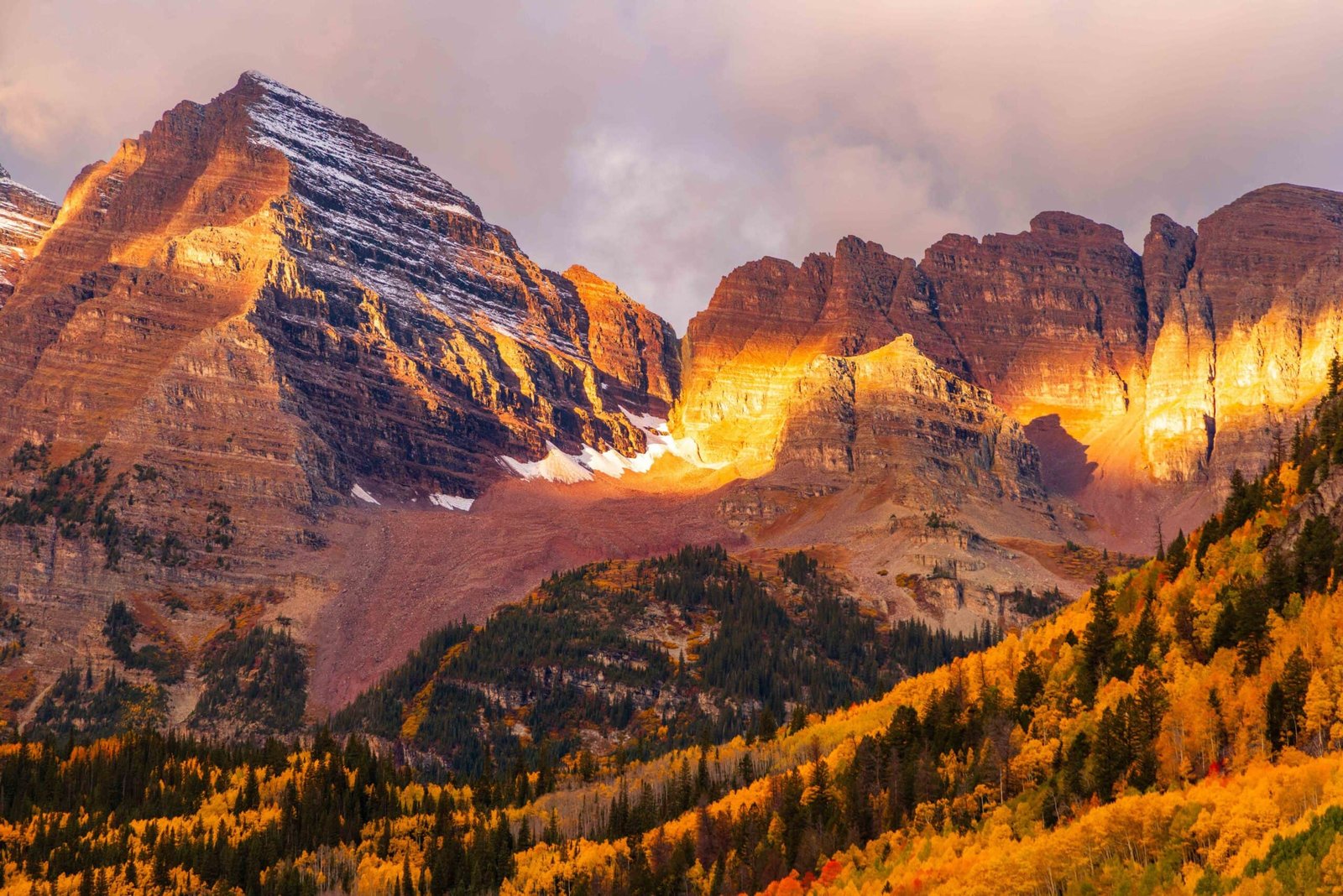
The Rockies do fall color differently. Instead of a broad mix of maples and oaks, the signature tree is the aspen, which turns a uniform, brilliant gold. When an entire mountainside of aspens turns at once, it is one of the most striking sights in American nature.
The catch is timing. Aspen color lasts only about two weeks, and it can vanish overnight with a hard freeze. You have to be flexible. I have driven six hours to catch peak aspen color and missed it by three days. I also caught it perfectly by checking a local webcam the morning I left.
Aspen and Maroon Bells, Colorado
Maroon Bells is the most photographed spot in Colorado, and fall is when it earns that reputation. Peak aspen color is typically late September to the first week of October. Access to Maroon Bells requires a reservation during peak season, so plan ahead (check current reservation rules on the official site).
Rocky Mountain National Park, Colorado
Trail Ridge Road and the Bear Lake corridor are the best fall drives in the park. Peak color is usually late September to early October. The park charges around $30 per vehicle for a 1-day pass or $35 for a 7-day pass (confirm the latest price directly with the National Park Service).
Grand Teton National Park, Wyoming
Grand Teton has the most dramatic foliage backdrop in the country, with the Teton Range rising behind aspen and cottonwood groves. Peak color is typically late September. Oxbow Bend is the classic photo spot.
Maya’s honest take: “Aspen season is short and unforgiving. Book a refundable hotel, watch the webcams, and be ready to drive on 48 hours’ notice. That is how you catch peak color in the Rockies.”
Best fall foliage in the Pacific Northwest
The Pacific Northwest has a longer, slower foliage season than the rest of the country. Peak color often does not arrive until late October or early November, and it can stretch into mid-November in mild years. The palette is different too, with more yellows and oranges from bigleaf maples and vine maples, plus the deep green of evergreens as a backdrop.
If you missed peak color in the Northeast or Rockies, the Pacific Northwest is your second chance. It is the last region in the country to turn.
Columbia River Gorge, Oregon and Washington
The Columbia River Gorge has waterfalls, basalt cliffs, and a mix of deciduous and evergreen forest. The Historic Columbia River Highway is one of the best fall drives in the country. Peak color is typically late October.
North Cascades, Washington
The North Cascades Highway is a 30-mile drive through some of the most dramatic mountain scenery in the lower 48. Peak color is usually late September to early October at higher elevations. The road closes seasonally, so check conditions before you go.
Willamette Valley, Oregon
The Willamette Valley is wine country, and fall is harvest season. The vineyards turn gold and red while the grape harvest is underway. Peak color is usually mid to late October, and it pairs well with wine tasting and farm-to-table dining.
How do you plan a fall foliage trip around peak color?
Timing is everything with fall foliage, and a few practical habits make the difference between a stunning trip and a brown, bare disappointment. Here is what I have learned from years of chasing color.
Book lodging early, but keep it flexible
Peak weekends at popular destinations sell out four to six weeks ahead, and prices climb 30 to 60 percent during peak season (check current rates on the official sites). Book a refundable rate as soon as you pick your window, then adjust if the color is running early or late. I use Booking.com for free cancellation options and Vrbo when I am traveling with a group and want a cabin or house rental.
Check state foliage trackers weekly
Every major foliage state publishes a weekly color report starting in mid-September. These are run by state tourism boards or university extension programs and are far more accurate than any fixed calendar. Vermont, New Hampshire, Maine, New York, Michigan, and North Carolina all have excellent trackers.
Travel mid-week
This is the single easiest way to improve a foliage trip. Weekend crowds at popular destinations double or triple. Lodging is cheaper Sunday through Thursday. Scenic drives are emptier. If you can only travel on weekends, go early in the morning before 9 a.m.
Combine foliage with a secondary activity
Pure leaf-peeping can get old after a day. Build your trip around a secondary activity: wine tasting in the Willamette Valley, apple picking in Door County, hiking in the Smokies, or a scenic train ride in New Hampshire. This makes the trip more memorable and gives you something to do if the color disappoints.
Have a backup destination
Foliage timing can shift. If your first-choice destination is running late, have a second option ready at a lower elevation or further south. This is where the regional sequence becomes genuinely useful. If Vermont is past peak, the Smokies might be hitting peak the same weekend.
Use the right booking tools
For flights to foliage destinations, compare prices on Kayak before you book. For hotel loyalty rewards, Hotels.com is a solid option. For guided foliage tours and scenic train rides, GetYourGuide has listings in most major foliage regions.
What mistakes should you avoid on a fall foliage trip?
I have made most of these mistakes myself, so consider this a list of things I learned the hard way.
Do not book a trip a year in advance without a flexible rate
Foliage timing varies by up to three weeks year to year. Locking in a non-refundable booking for a specific weekend a year out is a gamble. Book refundable, or wait until late August when the early forecasts come out.
Do not assume the famous spot is the best spot
The most photographed viewpoints are the most crowded. There is almost always a lesser-known pull-off or side road within a few miles that has equal color and a fraction of the people. Ask a local at a gas station or coffee shop. That advice has never failed me.
Do not plan a foliage trip around a single day
Weather can ruin a single day. Build at least a three-day window into your trip so you have flexibility if one day is rainy or overcast. Foliage looks best in bright but cloudy light anyway, so an overcast day is not a total loss.
Do not forget that elevation matters
In mountainous regions, the highest elevations peak first and the lowest peak last. If you are visiting the Smokies or the Rockies, you can often find peak color somewhere in the park for several weeks by driving up or down in elevation.
Do not underestimate the cold
Fall mornings in the mountains can drop below freezing. Bring layers, gloves, and a hat even if the daytime forecast looks mild. I have shivered through more October sunrises than I care to admit because I packed for the afternoon temperature.
Do not skip travel insurance for a foliage trip
Fall weather is unpredictable. A canceled flight, a closed road, or a sudden storm can derail a trip. Travel insurance is cheap relative to the cost of a lost trip. See our travel insurance guide for options.
Frequently asked questions about fall foliage
When does fall foliage peak in the U.S.?
Fall foliage peaks at different times depending on region. The Rockies and far northern Maine peak in late September. Most of New England and the Upper Midwest peak in early to mid-October. The Mid-Atlantic, Appalachians, and Pacific Northwest peak in late October to early November. Check state foliage trackers for exact timing each year.
What are the best places to see fall foliage in the U.S.?
The most consistently excellent destinations are Vermont’s Green Mountains, New Hampshire’s White Mountains, the Great Smoky Mountains, Michigan’s Upper Peninsula, and Colorado’s Aspen area. For fewer crowds, consider the Ozarks, Hocking Hills in Ohio, or the Columbia River Gorge in Oregon.
Is fall foliage early or late this year?
Foliage timing varies year to year based on September temperatures and rainfall. A warm September delays peak color by one to two weeks. A cool, dry September pulls it forward. Check your state’s foliage tracker starting in mid-September for the most accurate local forecast.
What is the best state for a fall foliage weekend trip?
Vermont is the classic answer and the most popular. For a quieter trip, Michigan’s Upper Peninsula or Door County in Wisconsin offer similar color with fewer crowds. For travelers based on the East Coast, Shenandoah National Park in Virginia is the most accessible option, just a few hours from D.C.
How far in advance should I book a fall foliage trip?
Book lodging four to six weeks in advance for peak weekends at popular destinations. Rates climb 30 to 60 percent during peak season (check current rates on the official sites). Choose refundable rates when possible so you can adjust if the color is running early or late.
Where can I see fall foliage without crowds?
The Midwest and Ozarks are the best bets for crowd-free foliage. Michigan’s Upper Peninsula, Door County in Wisconsin, Hocking Hills in Ohio, and the Ozarks in Missouri and Arkansas all offer excellent color with a fraction of the visitors. Traveling mid-week also makes a huge difference anywhere you go.
What is the best way to track fall foliage?
State tourism boards and university extension programs publish weekly foliage reports starting in mid-September. Vermont, New Hampshire, Maine, New York, Michigan, and North Carolina all have excellent trackers. These are more accurate than any fixed calendar because they update based on actual local conditions.
Is it worth visiting New England for fall foliage?
Yes, if you plan carefully. New England has the widest color range in the country, but it is also the most crowded. Go mid-week, avoid Columbus Day weekend, book lodging early, and focus on one state rather than trying to cover three. With those adjustments, it is absolutely worth it.
Plan your trip: booking platforms we trust
I use these platforms when planning my own fall foliage trips. They are reliable for comparing prices, reading recent reviews, and booking with confidence. I have noted what each one is best for so you can go straight to the one that fits your needs.
Agoda
Best for hotel deals, with strong coverage in mountain and resort towns.
Best for free cancellation options when foliage timing is uncertain.
Best for flight and hotel packages if you want to bundle and save.
Flight price comparison across multiple airlines and booking sites.
Best for cabins and vacation rentals in foliage regions, especially for groups.
Best for guided foliage tours, scenic train rides, and seasonal activities.
Loyalty rewards bookings, good if you collect stamps toward free nights.
Reviews and restaurant finds are useful for planning meals in small foliage towns.
WakaAbuja does its best to keep all information accurate at the time of publishing. Prices, policies, and availability change regularly. Always verify with official sources before you travel. We are not liable for errors caused by outdated information. Travel insurance is strongly recommended.