
advertisement
Chao Phraya River, Bangkok: The Complete Guide to Boats, History, and What to See
Fact-Checked By: Maya Whitfield, Senior Travel Editor at WakaAbuja — Senior Travel Editor at WakaAbuja
The Chao Phraya River is Bangkok’s main waterway, running 372 kilometers from the confluence of the Ping and Nan rivers at Nakhon Sawan down to the Gulf of Thailand. It flows directly through the heart of Bangkok and is still a working commuter route, not just a tourist attraction. The Chao Phraya Express Boat charges around 16 to 33 baht for a single commuter ride (confirm current fares at the pier), while tourist boats and dinner cruises run from roughly 150 baht up to 2,500 baht per person depending on the package (check current rates with the operator).
I have ridden the Chao Phraya more times than I can count, and I still remember the first time I made the mistake of paying tourist-boat prices for a route the locals were doing for pocket change. The river is not a sightseeing add-on in Bangkok. It is the spine of the city. Once you understand which boat to take and which piers matter, Bangkok becomes a completely different place to navigate. This guide is the one I wish someone had handed me before that first sweaty ride from Sathorn Pier.
Jump to: Quick Facts | Getting Around by Boat | What to See | Cruises and Dinner Boats | Pollution and Conservation | FAQ
Key takeaways
- The Chao Phraya runs 372 kilometers from Nakhon Sawan to the Gulf of Thailand and passes through Bangkok, Nonthaburi, Pathum Thani, and Samut Prakan.
- The Chao Phraya Express Boat is the commuter line locals use. Fares run roughly 16 to 33 baht per ride depending on distance (confirm current fares at the pier).
- Tourist boats with English commentary cost around 150 baht for a day pass (check current rates on the official site). They are slower and pricier than the commuter boats.
- Dinner cruises range from about 900 baht for a basic buffet boat to 2,500 baht or more for a premium experience (confirm current pricing with the operator).
- The best time to ride is early morning or late afternoon to avoid the heat and see the river at its most active.
- Wat Arun, the Grand Palace, and Chinatown are all reachable by pier. You do not need a tour to see them.
- The river faces ongoing pollution challenges, but cleanup efforts, including the Ocean Cleanup interceptor deployed in 2024, have made a visible difference in floating waste.
What are the key facts about the Chao Phraya River?
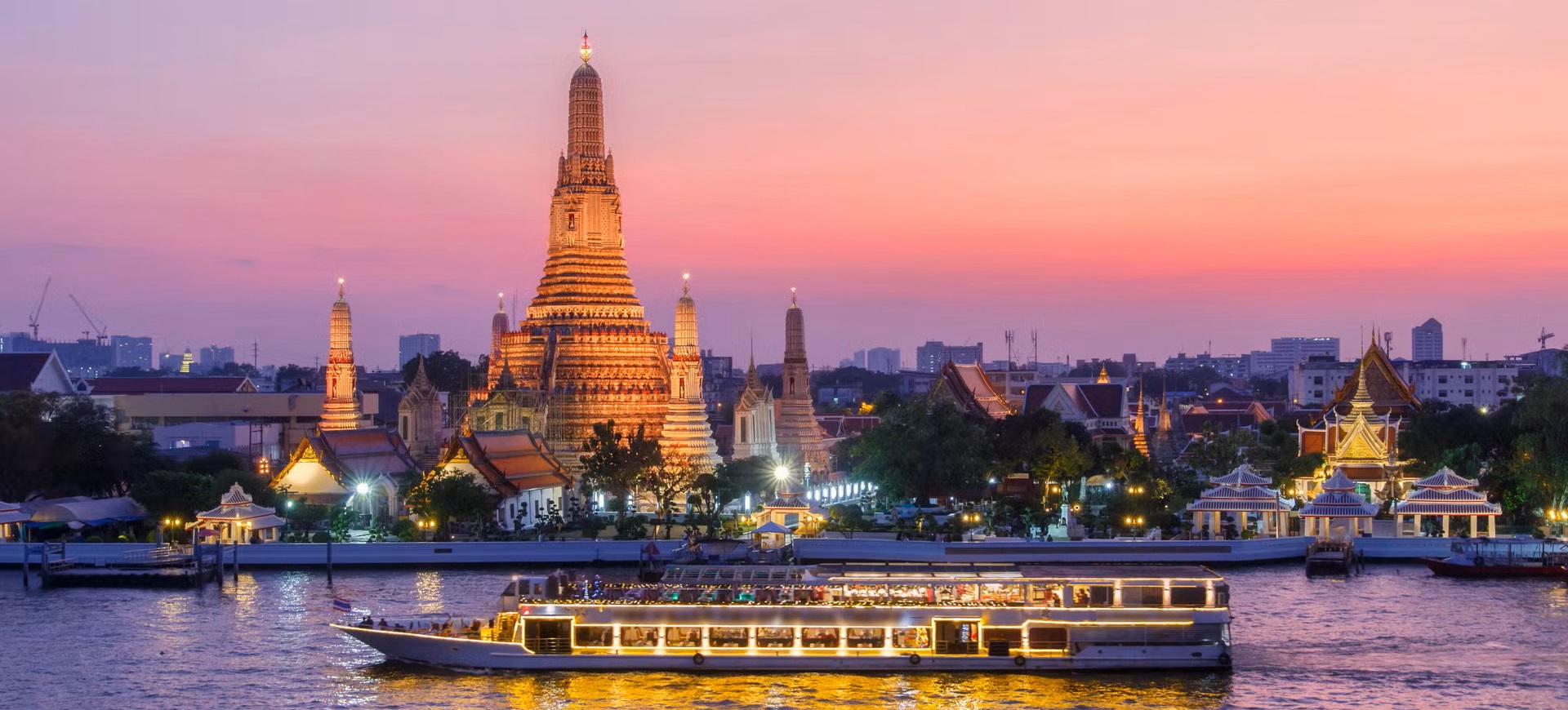
The Chao Phraya is 372 kilometers long. It begins where the Ping and Nan rivers meet at Nakhon Sawan in central Thailand and empties into the Gulf of Thailand. It is the largest river in Thailand by discharge and the primary river of the Bangkok metropolitan region. The river flows through or borders several provinces, including Nakhon Sawan, Uthai Thani, Chai Nat, Sing Buri, Ang Thong, Ayutthaya, Pathum Thani, Nonthaburi, Bangkok, and Samut Prakan.
The name “Chao Phraya” is a Thai royal title. In common usage, the river is often called “Maenam Chao Phraya,” where “maenam” simply means river. Thais frequently refer to it as the “River of Kings,” and it has carried that nickname for centuries because of its role in royal processions, trade, and the founding of Bangkok itself. When you ride past the Grand Palace and Wat Arun, you are moving through the exact stretch of water that shaped the city’s history.
For a deeper look at Bangkok’s broader travel planning, see our guide to the best things to do and our travel planning resources. If you are still sorting out entry documents, our visa section covers the basics.
How do you get around the Chao Phraya River by boat?
There are four main categories of boat on the river, and knowing which is which will save you both money and time. I learned this the hard way when I bought a 150 baht tourist day pass for a journey the commuter boat would have done for 16 baht. The tourist boat was slower, hotter, and less frequent. The commuter boat was faster, cheaper, and full of people going about their actual day.
The Chao Phraya Express Boat is the commuter service. It runs from Sathorn Pier in the south up to Nonthaburi in the north, with dozens of stops in between. Fares are distance-based and currently run about 16 to 33 baht per ride (confirm current fares at the pier). You pay on board, and you do not need to book ahead. This is the boat I take almost every time I am in Bangkok. It is not glamorous, but it is the fastest way to move along the river during the day.
The Tourist Boat is a separate service with English commentary and a day-pass model. It costs roughly 150 baht for an unlimited day pass (check current rates on the official site). It stops at the main attractions, and the commentary is helpful if you want context. But it is slower, and you will wait longer between boats.
Longtail boats are the small, wooden, noisy boats you see zipping across the river. They are not part of the commuter network. You hire them privately, either for a canal tour or a short crossing. Prices are negotiable and vary widely. Expect to pay around 1,000 to 1,500 baht per hour for a private longtail charter (confirm the rate with the boat driver before boarding). They are worth it for the canal experience, but not for routine river crossings.
Cross-river ferries are the cheapest option of all. They run constantly between opposite piers for about 5 baht per crossing (confirm current fares at the pier). If you just need to get from one bank to the other, this is the move.
Best for budget and speed
- Chao Phraya Express Boat: 16 to 33 baht per ride (confirm at pier)
- Cross-river ferry: about 5 baht per crossing (confirm at pier)
- Runs frequently from early morning to evening
- No booking required, pay on board
Worth considering
- Tourist Boat Day Pass: about 150 baht (check current rates)
- Longtail private charter: 1,000 to 1,500 baht per hour (confirm with driver)
- Useful for canal tours and quieter routes
- Negotiate the price before you board
Maya’s honest take: “Skip the tourist boat unless you genuinely want the commentary. The commuter boat is faster, cheaper, and shows you the real Bangkok. I have never once regretted taking the local line. I have regretted paying tourist prices more than once.”
What should you see along the Chao Phraya River?
The river’s banks hold most of Bangkok’s headline attractions, and almost all of them are reachable by pier. The advantage of the river is that you can string several major sites together in a single day without sitting in traffic.
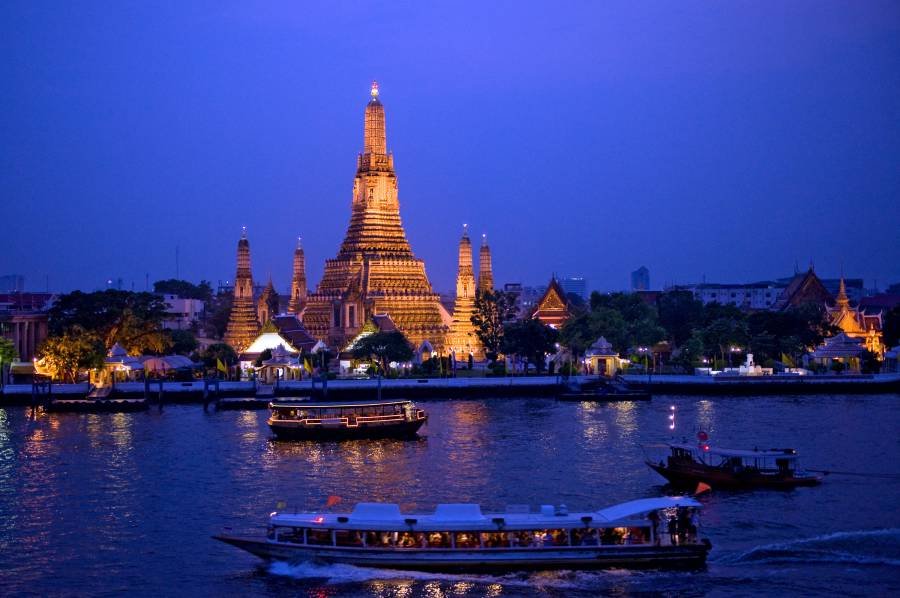
Wat Arun, the Temple of Dawn, sits on the west bank directly opposite the Grand Palace. It is one of the most photographed structures in Thailand, and the best view of it is from the east bank at sunset. Take the cross-river ferry from Tha Tien Pier for about 5 baht (confirm at the pier). The Grand Palace and Wat Phra Kaew are a short walk from Tha Chang Pier. This is the single busiest tourist area on the river, so go early. Chinatown, centered on Yaowarat Road, is a short walk from Ratchawong Pier. The food stalls here are the reason many people come to Bangkok in the first place.
If you want a quieter stretch, head north to Nonthaburi Pier and wander the local market. Or take a longtail boat into the Thonburi canals, where the city still moves at a slower pace. For more ideas on what to do in the city, browse our best things to do section.
Are Chao Phraya dinner cruises worth it?
Yes, with caveats. The dinner cruise market in Bangkok is enormous, and the quality varies more than any other river experience. At the low end, you get a buffet boat with a live band and a route that passes Wat Arun lit up at night. At the high end, you get a quieter vessel, better food, and a more curated route. The low-end boats are crowded, and the food is forgettable. The high-end boats are genuinely pleasant, and the views are excellent.
Prices range from roughly 900 baht per person for a basic buffet cruise to 2,500 baht or more for a premium dinner experience (confirm current pricing with the operator). Most cruises depart from either Sathorn Pier or River City Pier and last about two hours. Booking ahead is wise in high season, and you can compare options and reviews on GetYourGuide or TripAdvisor.
My honest advice: if you want a dinner cruise, book one in the mid-range, around 1,200 to 1,500 baht (confirm current pricing). The cheapest boats are not worth the money, and the most expensive ones are priced for tourists who want a guarantee rather than an experience. A mid-range boat gives you good food and a good route without the crowd.
How clean is the Chao Phraya River today?
The Chao Phraya has a pollution problem, and it has had one for decades. The river receives wastewater, industrial runoff, and a significant volume of plastic waste, particularly during the monsoon season when rain washes debris into the drainage system. Anyone who has ridden the river after a heavy rain has seen the plastic for themselves.
But the story is not entirely grim. In February 2024, the Ocean Cleanup project deployed an interceptor in the Chao Phraya, one of a series of deployments targeting the world’s most polluted rivers. The interceptor is designed to capture floating plastic before it reaches the Gulf of Thailand. Since its deployment, visible floating waste in the central Bangkok stretch has decreased, though the underlying water-quality challenges remain.
The Thai government has also invested in flood-management infrastructure, including the ongoing construction of the Chao Phraya II flood-relief channel, a 22-kilometer waterway designed to divert excess water around Bangkok. The channel was under construction as of 2024 and is intended to reduce the flood risk that has historically affected riverside communities. You can read more about the project through the Thai government’s water management agency.
Would I swim in the Chao Phraya? No. But I would not have swum in it ten years ago either, and the direction of travel is better than it was. If you care about this issue, support the cleanup efforts and avoid single-use plastics while you travel.
What mistakes do first-time Chao Phraya River visitors make?
I have made most of these myself, and I have watched countless other travelers make the rest.
Paying tourist-boat prices for a commuter route
The tourist boat and the commuter boat run on the same river and stop at many of the same piers. If you are not interested in the commentary, take the commuter boat and save your money for food. The fare difference is real: 16 to 33 baht versus 150 baht for a day pass (confirm current fares at the pier).
Riding at midday in April
Bangkok in April is genuinely hot, and the boats are not air-conditioned. I once rode from Sathorn to Nonthaburi at 1:00 PM and arrived drenched. Ride early morning or after 4:00 PM. The light is better, the heat is lower, and the river is more active with commuters.
Skipping the cross-river ferries
If you want to see Wat Arun from the east bank, the cross-river ferry is the way to do it. It costs about 5 baht (confirm at pier), takes two minutes, and gives you the best view of the temple without paying for a tour. Most tourists never use it because they do not know it exists.
Assuming the river is only for tourists
The Chao Phraya is a working river. People commute on it, deliver goods on it, and live along it. Treat it as infrastructure, not just an attraction, and you will understand Bangkok better.
Booking a dinner cruise without checking the route
Not all dinner cruises pass Wat Arun at night. If seeing the illuminated temple is the point for you, check the route before you book. Some budget boats turn around before the temple.
Forgetting to check the pier names
Bangkok piers have both Thai and English names, and the English names are not always intuitive. Tha Tien, Tha Chang, and Sathorn are the ones you will use most. Write them down or screenshot the map before you go.
Skipping travel insurance
Bangkok is a safe city, but river travel has its own risks, from slippery piers to occasional boat delays. Travel insurance is a small cost for peace of mind on any Thailand trip.
Frequently asked questions
How long is the Chao Phraya River?
The Chao Phraya River is 372 kilometres long. It begins at the confluence of the Ping and Nan rivers in Nakhon Sawan province and flows south to the Gulf of Thailand. It is the largest river in Thailand by discharge and the main waterway of the Bangkok region.
How much does the Chao Phraya Express Boat cost?
The Chao Phraya Express Boat costs about 16 to 33 baht per ride depending on distance (confirm current fares at the pier). The tourist boat with English commentary costs around 150 baht for a day pass (check current rates). Cross-river ferries cost about 5 baht per crossing (confirm at pier).
What is the best time to ride the Chao Phraya River?
Early morning or late afternoon is best. The heat is lower, the light is better for photography, and the river is at its most active with commuters. Avoid midday rides in April, which is the hottest month in Bangkok. Evening rides are also popular for dinner cruises and illuminated temple views.
Can you swim in the Chao Phraya River?
No. The Chao Phraya has significant pollution from wastewater, industrial runoff, and plastic waste. Swimming is not recommended and is not common among locals. The river is best experienced from a boat, not from the water itself.
What does “Chao Phraya” mean?
“Chao Phraya” is a Thai royal title, and the river is commonly known as the “River of Kings.” In everyday Thai, it is often called “Maenam Chao Phraya,” where “maenam” means river. The name reflects the waterway’s historical role in royal processions, trade, and the founding of Bangkok.
Are Chao Phraya dinner cruises worth the money?
Mid-range dinner cruises around 1,200 to 1,500 baht per person are worth it for the views and atmosphere (confirm current pricing with the operator). The cheapest buffet boats are crowded and the food is basic. The most expensive cruises are pleasant but priced for tourists. Check the route before booking if seeing Wat Arun at night matters to you.
Which piers should I use for the main attractions?
Use Tha Chang Pier for the Grand Palace and Wat Phra Kaew, Tha Tien Pier for Wat Arun and the cross-river ferry, and Ratchawong Pier for Chinatown. Sathorn Pier is the main southern hub with connections to the BTS Skytrain. These four piers cover most of what a first-time visitor wants to see.
Plan your trip: booking platforms we trust
I use these platforms because they are reliable for the specific logistics a Bangkok river trip requires. For hotels near the river, Booking.com and Agoda give the widest choice. For flights into Bangkok, Kayak is my go-to comparison tool. For river cruises and Bangkok tours, GetYourGuide and TripAdvisor have the most verified reviews.
Booking.com
General hotel search for riverside Bangkok stays.
Agoda
Best for Asian hotel deals in Bangkok and beyond.
Kayak
Flight price comparison into Bangkok’s airports.
GetYourGuide
Tours and activities including Chao Phraya dinner cruises.
TripAdvisor
Reviews and restaurant finds near the river.
WakaAbuja does its best to keep all information accurate at the time of publishing. Prices, policies, and availability change regularly. Always verify with official sources before you travel. We are not liable for errors caused by outdated information. Travel insurance is strongly recommended.