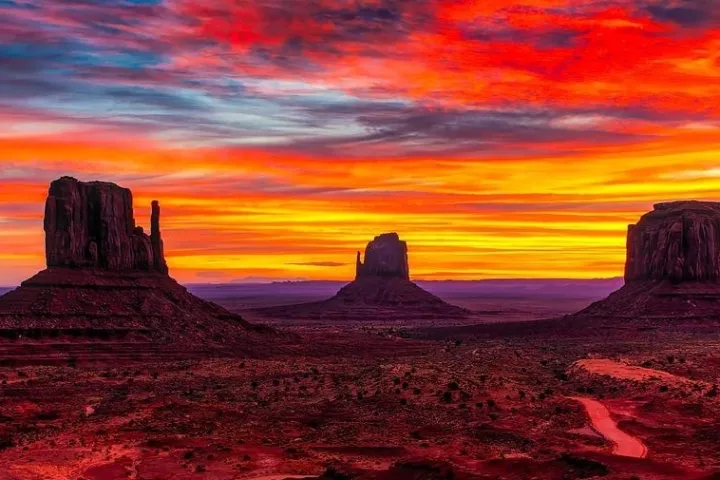
advertisement
Monument Valley Travel Guide: Fees, Best Time to Visit & What to See
Fact-Checked By Maya Whitfield, Senior Travel Editor at WakaAbuja
Monument Valley is a Navajo Tribal Park straddling the Arizona-Utah border, famous for its towering red sandstone buttes and its role in classic Western films. Entry costs $8 per person per day, and the 17-mile Valley Drive is the main self-guided experience. This guide covers every practical detail the Wikipedia entry leaves out: current fees, the best viewpoints in order, when to go for the best light, and how to visit respectfully on Navajo land.
Wikipedia will tell you the siltstone floor dates to the Permian period and that John Ford shot Stagecoach here in 1939. What it will not tell you is that the entry gate now takes credit cards but the roadside jewelry vendors prefer cash; that the Valley Drive takes a full two hours if you stop at every viewpoint; or that the Mittens glow red for roughly fifteen minutes at sunrise and you need to be at the right pull-off before the light peaks.
I have made the drive twice, once in perfect October light and once in a July dust storm that turned the entire valley orange-gray, and the difference between a rushed, half-informed visit and a properly planned one is the difference between a checklist stop and one of the best days you will spend in the American Southwest.
Jump to: Entry Fees & Tour Costs | Valley Drive Stops | Best Time to Visit | Getting There | Where to Stay | Respecting Navajo Land | vs. Other Parks | FAQs
Key takeaways
- Monument Valley Navajo Tribal Park charges an $8 per person entry fee, separate from any guided tour cost.
- The 17-mile unpaved Valley Drive loops past 11 numbered viewpoints and takes roughly two to three hours with stops.
- Sunrise and late afternoon produce the best light on the buttes. Midday light is flat and harsh for photography.
- The closest town with lodging is Kayenta, Arizona, about 30 minutes south. The View Hotel inside the park books out months in advance.
- Guided tours are required to access areas beyond the public Valley Drive, including backcountry arches and ancestral sites.
- This is Navajo Nation land, not a U.S. national park. Rules, cultural expectations, and photography restrictions differ from NPS sites.
- The nearest airports are in Flagstaff, Arizona (3 hours) and Albuquerque, New Mexico (4 hours). There is no public transit option.
How much does it cost to visit Monument Valley?
The entry fee for Monument Valley Navajo Tribal Park is $8 per person per day. This is a separate fee from the Navajo Nation Parks system and is not covered by any U.S. national park pass. Children under 9 enter free. The entry gate accepts credit cards, but I recommend carrying cash as a backup because the card machines have gone offline during both of my visits. The fee covers access to the visitor center, the museum, and the self-guided Valley Drive loop.
Guided tours cost extra and are priced per vehicle, not per person. A standard guided Jeep tour with a Navajo operator typically runs between $75 and $120 per person for a two- to three-hour excursion. Extended tours that reach Mystery Valley, Hunts Mesa, or backcountry arches can run $150 to $250 per person for a half-day. These tours are mandatory if you want to see anything beyond the 11 numbered stops on the public loop. The backcountry areas are closed to self-guided visitors, period. Check the official Navajo Nation Parks website for current tour operator listings and pricing before you book.
Typical cost snapshot (per person, self-guided): $8 park entry. Roughly $20 for gas from Kayenta and back. Bring your own water and lunch, roughly $10. Total: under $40 for a half-day independent visit, not counting lodging.
The Valley Drive: every stop, in order
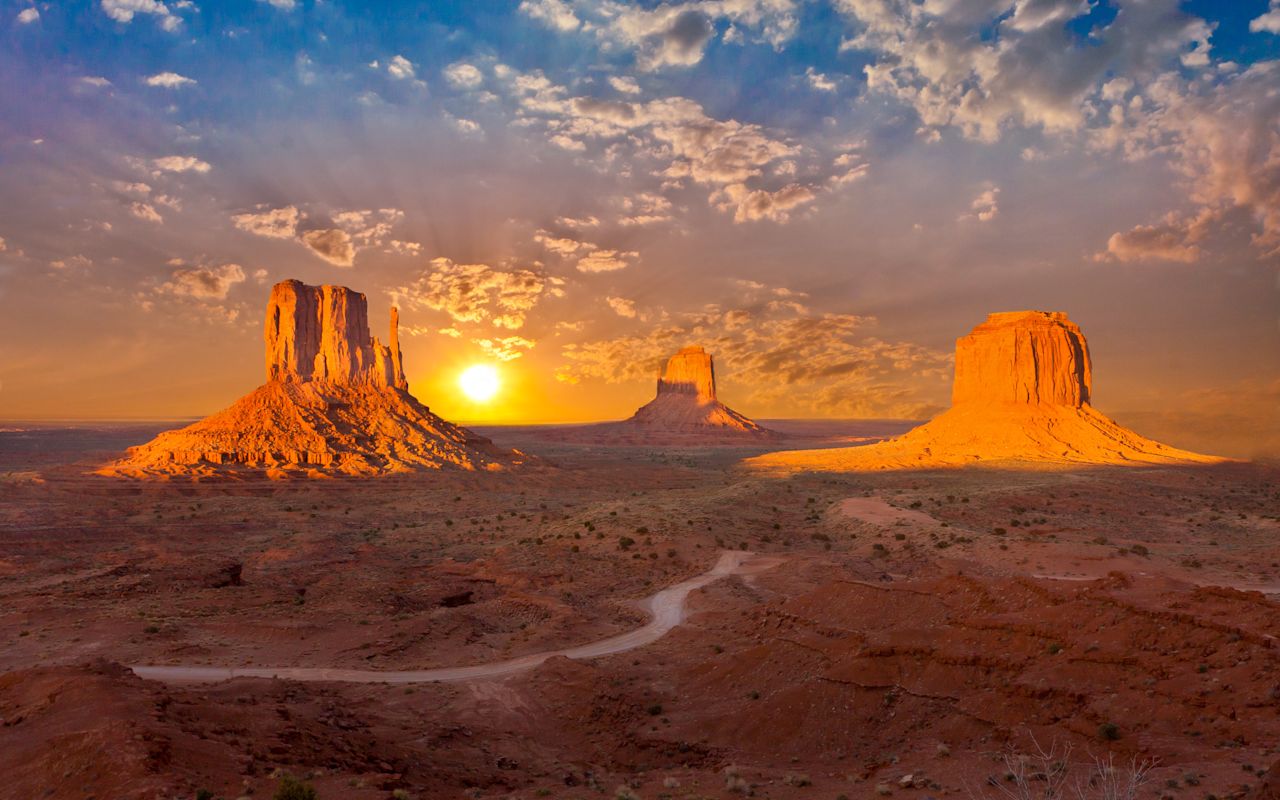
The 17-mile unpaved loop starts and ends at the visitor center. The road is dirt and gravel, heavily washboarded in places, and passable in a standard sedan during dry weather. After rain, it turns to deep, slippery mud, and the park closes the drive without warning. Count on two hours if you stop briefly at most viewpoints, or three hours if you linger with a camera. There are no services, no restrooms, and no water once you leave the visitor center. Go before 10 a.m. or after 3 p.m. for the best light and the fewest tour vehicles kicking up dust.
The numbered stops follow a counterclockwise loop. The Mittens Overlook (Stop 1) gives you the classic postcard view of West and East Mitten Buttes. Elephant Butte (Stop 2) is less photographed but worth a stop for the scale reference. John Ford Point (Stop 3) is where the famous director shot dozens of Westerns and where you will likely see a Navajo rider on horseback posing for tips. Artist’s Point (Stop 6) offers a wider panorama that takes in the full sweep of the valley floor. North Window (Stop 8) frames Camel Butte through a natural rock opening. Totem Pole Overlook (Stop 10) puts you face to face with the thin spire that appears in countless films and photographs. The final stops loop back toward the visitor center with rear views of the formations you have already passed.
Maya’s honest take: “Skip stops 4 and 5 if you are short on time. They are fine, but the real payoff is concentrated at Stops 1, 3, 6, 8, and 10. If you only have an hour in the vehicle, hit those five and you will leave with the photos you wanted.”
Best time to visit Monument Valley
The valley sits at roughly 5,500 feet elevation, so it avoids the extreme low-desert heat of Phoenix or Las Vegas, but it still swings hard between seasons. Spring and fall are the sweet spots. March through May and September through October deliver daytime temperatures in the 60s and 70s Fahrenheit, manageable for hiking and comfortable for standing at viewpoints. October is my personal pick. The light is slanted and golden all afternoon, and the summer monsoon dust has settled.
Summer, June through August, brings monsoon storms that can close the Valley Drive with almost no notice. The storms themselves are spectacular, with lightning over the buttes and walls of red dust moving across the valley floor, but they also strand visitors at the visitor center for hours. Winter is cold and quiet. Snow on the red rock is rare and stunning, but the visitor center runs reduced hours, and guided tours are less frequent. If you want that snow-dusted mitten photo, January and February are your window.
Spring (Mar–May)
- Mild daytime temps, cool mornings
- Wind can kick up dust in April
- Good light, manageable crowds
Fall (Sep–Oct)
- Best overall season for light and weather
- October delivers golden afternoon light
- Book The View Hotel months ahead
Summer (Jun–Aug)
- Monsoon storms can close the drive
- Midday heat reaches 90s Fahrenheit
- Dramatic sky photos if storms hold off
How to get to Monument Valley
Monument Valley sits in a remote corner of the Navajo Nation, and getting there requires a dedicated drive from whichever gateway city you fly into. The closest town with any services is Kayenta, Arizona, a 30-minute drive south of the park entrance. The nearest city with a commercial airport and rental cars is Flagstaff, Arizona, roughly three hours southwest. Albuquerque, New Mexico, is about four hours southeast. Salt Lake City is a six-hour drive north. There is no train, no bus, and no shuttle service. You need a vehicle.
From Flagstaff, take US-89 north to US-160 east through Tuba City and Kayenta, then turn north on US-163. The approach on US-163 is the iconic Forrest Gump Point stretch of highway, where the road seems to aim directly at the Mittens. From Moab, Utah, drive south on US-191 through Blanding and then follow US-163 south. The drive from Page, Arizona, takes about two hours via US-98 and US-160. Fill your gas tank in Kayenta or Mexican Hat before heading in. There is no fuel at the park.
Where to stay near Monument Valley
The View Hotel, located inside the park next to the visitor center, is the obvious choice and the one that books out months in advance. Every room faces the Mittens, and the sunrise view from the balcony is the reason people plan entire trips around a single night here. Expect to pay a premium for that view, typically $250 to $350 per night during peak season. Reservations open well ahead, and spring and fall dates fill completely.
Goulding’s Lodge, just across the Utah border roughly five miles from the park entrance, offers motel rooms and cabins at a lower price point, usually between $150 and $220 per night. Goulding’s also runs a small grocery store, a gas station, and a tour company. Kayenta, 30 minutes south, has basic chain motels and a handful of fast-food options, which makes it the practical budget base. If you are camping, the park itself has no campground, but Goulding’s runs an RV park and campground, and dispersed camping on Bureau of Land Management land outside the park boundary is an option if you are self-contained and prepared for a dry, exposed site.
Respecting Navajo land: what visitors need to understand
Monument Valley is not a U.S. national park. It is part of the Navajo Nation, a sovereign tribal territory with its own government, laws, and cultural protocols. The buttes are not just scenery; they are sacred. The Navajo name for the valley is Tsé Bii’ Ndzisgaii, meaning “valley of the rocks.” This is a living cultural landscape, not a film set, even though Hollywood treated it as one for decades.
Photography of Navajo residents, their homes, or their livestock requires explicit permission. Pointing a long lens at someone without asking is rude and, in some areas, can result in being asked to leave. The backcountry areas closed to self-guided driving are closed for a mix of safety and cultural preservation reasons. Do not try to sneak past a gate or follow a dirt track that is not on the official map. Stick to the public Valley Drive or book a Navajo guide who is authorized to take you further. The guided tour operators are locally owned, and the money you spend on a tour stays in the community. Asking your guide about the history and meaning of the formations will teach you more than any plaque at a pull-off.
Maya’s honest take: “On my first visit I was so focused on getting the perfect Mitten photo that I barely registered where I was standing. My second trip, I booked a half-day tour with a Navajo guide who told stories about the formations I had walked past without understanding. The valley felt completely different. If you can afford the tour, take it.”
Monument Valley compared to other Southwest parks
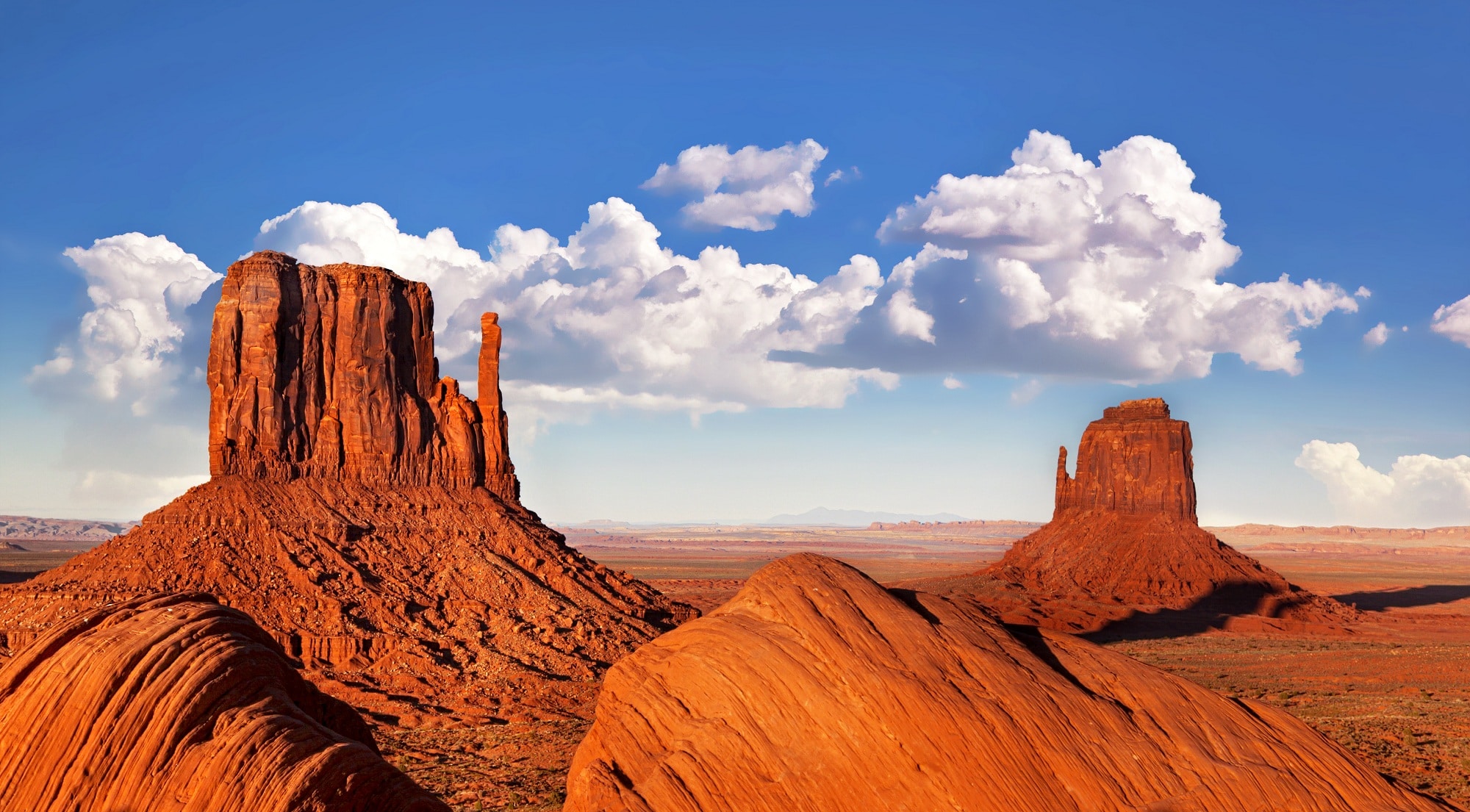
Monument Valley gets lumped into Southwest road trip itineraries alongside places like Arches National Park and Antelope Canyon, but the experience is fundamentally different. Arches is a paved-road, NPS-managed park with timed-entry permits and crowded trailheads. Monument Valley is unpaved, quieter, and run by the Navajo Nation. The geology is also distinct. Arches is Entrada sandstone arches and fins. Monument Valley is buttes and spires of de Chelly sandstone on a flat siltstone floor. They look nothing alike in person.
Monument Valley
Scenic driving on unpaved roads. Iconic butte views. Navajo-guided backcountry tours. No hiking trails on the valley floor. Entry fee paid to Navajo Nation Parks.
Arches National Park
Paved scenic drive with short hikes to named arches. Timed-entry reservations required. NPS-managed. Trailhead parking fills by early morning. Heavier crowds.
Antelope Canyon
Slot canyon on Navajo land near Page, Arizona. Guided tours only, no self-guided access. Photography-focused, narrow sandstone corridors. Completely different landform.
Canyonlands National Park
Vast overlooks and backcountry 4×4 roads. Much larger and more remote than Monument Valley. NPS-managed. Island in the Sky district offers wide canyon views, not butte formations.
Common mistakes to avoid at Monument Valley
Most of these are errors I have either made myself or watched other visitors trip over. They are easy to avoid with a little forethought.
- Arriving with no cash. The entry gate takes cards, but the roadside craft vendors and some tour operators prefer cash. Small bills in U.S. dollars are the most useful.
- Driving the Valley Loop at noon in July. The light is flat and harsh, the dust is thick, and you will bake in your car. Go before 10 a.m. or after 3 p.m., or save the drive for a cooler season.
- Assuming The View Hotel will have a room available for a walk-up. It will not. Book months ahead, especially for spring and fall.
- Ignoring storm warnings. A monsoon cell can turn the Valley Drive into impassable mud in under 30 minutes. If the sky darkens to the south or west, head back to the visitor center.
- Treating Monument Valley like a national park. Your America the Beautiful pass will not work here. The rules, the fees, and the cultural expectations are different. Read the signs and listen to the rangers.
- Skipping a guided tour because of the cost. The public loop is great, but the backcountry areas, Mystery Valley, Hunts Mesa, the arches, are the reason people return. Save the money for a tour if you can.
- Flying a drone. Drones are strictly prohibited across the entire Navajo Nation without a special permit, and enforcement has increased in recent years. Leave it in the car or at home.
Frequently asked questions
Is Monument Valley a national park?
No. Monument Valley is a Navajo Tribal Park located on Navajo Nation land. It is not part of the U.S. National Park Service system. Entry fees are collected by the Navajo Nation Parks and Recreation Department, and standard NPS passes like the America the Beautiful pass are not accepted.
Can you drive through Monument Valley without a tour?
Yes, the 17-mile Valley Drive is open to self-guided visitors in their own vehicles. The road is unpaved and rough but passable in a standard sedan during dry conditions. Areas beyond the Valley Drive, including Mystery Valley and Hunts Mesa, are closed to self-guided access and require a Navajo guide.
How long does the Valley Drive take?
Plan on two to three hours with stops at the major viewpoints. The loop is 17 miles of dirt and gravel road with a speed limit of 15 miles per hour. If you stop at all 11 numbered viewpoints and spend a few minutes at each, two hours is a comfortable pace without feeling rushed.
What is the best time of day for photography?
Sunrise and the hour immediately after, plus the last two hours before sunset, produce the warmest light and the deepest shadows on the buttes. The Mittens face east and catch the first morning light directly. Midday light between roughly 11 a.m. and 3 p.m. is flat and washes out the red tones that make the formations so striking.
Do you need a 4×4 for Monument Valley?
Not for the public Valley Drive during dry weather. A standard sedan handles the dirt and gravel road fine if you drive slowly and avoid the deepest ruts. After rain, the road turns to slick, deep mud and the park may close the drive entirely. A 4×4 is required for backcountry guided tours, but your tour operator provides the vehicle in those cases.
How far is Monument Valley from the Grand Canyon?
The drive from the South Rim of the Grand Canyon to Monument Valley takes roughly three hours and fifteen minutes via US-89 and US-160 through Tuba City and Kayenta. The North Rim is farther, closer to a four-hour drive. Monument Valley is often included in a larger Southwest road trip loop alongside the Grand Canyon, Page, and Moab.
Are drones allowed in Monument Valley?
No. The Navajo Nation has a strict no-drone policy across all Navajo Tribal Parks, including Monument Valley. Special permits are available for commercial and film projects but are not issued to recreational visitors. Flying a drone without permission risks confiscation of the device and a fine.
Plan your trip: booking platforms we trust
Monument Valley lodging is limited to a handful of properties, and The View Hotel books through its own site. The platforms below help with nearby accommodation in Kayenta, Mexican Hat, and Blanding, plus guided tour comparisons.
Best for finding rooms in Kayenta and Goulding’s Lodge with flexible cancellation terms.
Best for comparing guided Jeep and backcountry tour options with verified guest reviews.
Best for recent reviews of The View Hotel, Goulding’s, and specific Navajo tour operators.
Best for bundling a Flagstaff or Albuquerque flight with a rental car and a Kayenta hotel.