
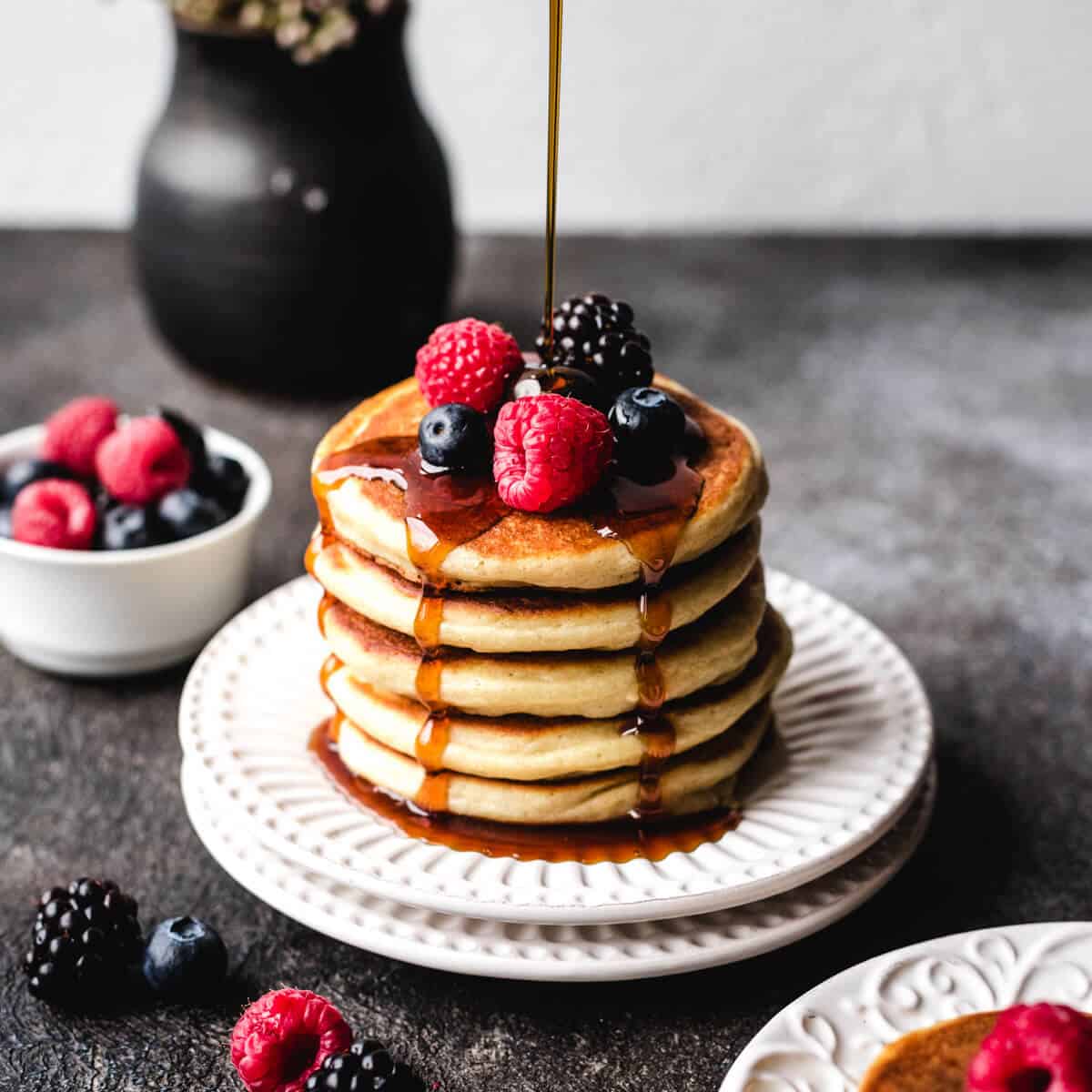
A perfect pancake recipe requires 7 simple pantry staples, a 5-minute prep, and a strict rule against overmixing. The real secret to fluffy pancakes every single time is letting the batter rest for 10 minutes while your pan heats to a precise medium heat.
I learned to make pancakes on a battered electric griddle in a tiny Toronto apartment, and I failed spectacularly for months. My first dozen attempts came out flat as hockey pucks, burned on the outside and raw in the middle. Chidi, our resident breakfast fanatic on the WakaAbuja team, finally pulled me aside and said, “You are rushing the resting stage. The batter needs to sit, just like you after a long flight.”
This recipe is the result of fixing every single mistake a home cook can make, so you get a stack of golden, cloud-like pancakes on your very first try.
Jump to: Ingredients | How to Make Pancakes | Why This Recipe Works | Common Pancake Problems & Fixes | Substitutions | Make-Ahead & Freezer | Topping Ideas | FAQs
Key takeaways
- Weigh your flour in grams for a 100% fail-proof batter consistency; cup measurements vary wildly.
- Rest the batter for exactly 10 minutes to let the gluten relax and the baking powder activate fully.
- Never press down on the pancakes with a spatula; it squeezes out all the air you just built up.
- A dry, non-stick pan wiped with just a trace of butter creates the most even golden-brown crust.
- Flat pancakes are almost always caused by expired baking powder or a frantic overmix.
- You can freeze cooked pancakes between sheets of wax paper and reheat them directly in the toaster.
- This batter works beautifully with dairy-free milk and a flax egg if you need an allergy-friendly swap.
What are the exact ingredients for a fluffy pancake recipe?
The ingredient list for a classic pancake is short, but precision matters. I always prefer to weigh my dry ingredients because scooping a measuring cup directly into a flour bag can pack in an extra 30 grams without you realizing it, and that is the fast track to a dense, gummy pancake. Fatima, our recipe tester based in Vancouver, triple-tested this ratio to ensure the batter spreads perfectly without turning into a crepe.
Use cold milk straight from the fridge. This slows down the melting of the butter when you combine the wet and dry mixes, creating those distinct pockets of steam that lift the batter as it cooks. If your milk is too warm, the fat emulsifies too quickly and you lose a bit of that internal lift.
Chidi’s honest take: “Don’t chase the fancy vanilla bean paste here. A good quality pure vanilla extract does the heavy lifting, but honestly, if quickly, drowning them in real maple syrup, you can skip the vanilla entirely. Save your money for the syrup.”
Core Ingredients
- All-purpose flour: 210g (1 1/2 cups) — spooned and leveled.
- Granulated sugar: 30g (2 tablespoons) — just enough for browning, not a cake.
- Baking powder: 12g (1 tablespoon) — check the expiry date ruthlessly.
- Fine sea salt: 3g (1/2 teaspoon) — balances the sweet.
- Large egg: 1, cold, straight from the fridge.
- Whole milk: 275ml (1 cup + 2 tablespoons), cold.
- Unsalted butter: 28g (2 tablespoons), melted and cooled slightly.
Flavor Boosters
- Vanilla extract: 5ml (1 teaspoon) — optional but recommended.
- Lemon zest: A whisper of fresh zest cuts through the richness.
- Melted butter for the pan: Just enough to wipe a sheen, never a puddle.
How to make pancakes from scratch without failing?
I used to dump everything into one bowl and beat it like it owed me money. That is a terrible strategy. The dry and wet ingredients must be mixed separately and combined with a delicate hand. Think of the batter like a muffin mix: you want it just combined, with lumps the size of small peas still visible. Those lumps are pockets of dry flour that will hydrate on the griddle and turn into fluffy air pockets.
Step-by-Step Instructions
- Whisk the dry mix. In a large bowl, whisk the flour, sugar, baking powder, and salt together until they are one uniform color.
- Combine the wet ingredients. In a separate medium bowl or a large liquid measuring jug, whisk the cold milk, egg, melted butter, and vanilla extract until the egg is fully broken down.
- Create the well. Make a deep well in the center of the dry ingredients. Pour the wet mixture into the well.
- Fold, don’t beat. Use a rubber spatula to fold the wet into the dry. Scrape the bottom and fold over the top. Stop the instant you no longer see streaks of dry flour. The batter will be thick and lumpy.
- Rest the batter. This is the non-negotiable step. Set the bowl aside for exactly 10 minutes. You will see tiny bubbles forming on the surface.
- Heat the pan. Place a heavy-bottomed non-stick skillet or griddle over medium heat. Let it preheat for a good 4 to 5 minutes. A water droplet should skitter across the surface before evaporating.
- Wipe the butter. Dip a crumpled paper towel in melted butter and wipe a very thin layer across the hot pan. It should barely be visible.
- Scoop and cook. Ladle a scant 1/4 cup of batter onto the hot surface. Use the back of the ladle to gently nudge it into a round shape if needed. Cook until the edges look dry and bubbles on the surface pop and leave little craters, about 2 to 3 minutes.
- Flip once. Slide a thin spatula fully under the pancake and flip in one confident motion. Cook the second side until golden brown, about 1 to 1.5 minutes more.
- Serve immediately. Stack them high and keep warm in a 200°F (95°C) oven on a wire rack if you are cooking in batches.
Why does this specific pancake recipe work better?
:max_bytes(150000):strip_icc()/45396-easy-pancakes-mfs-38-34bd7f71161446bfb69609fa46a301e4.jpg "Easy Pancake Recipe (Fluffy Every Time) - With Troubleshooting Tips 1")
The technique here relies on double-acting baking powder and heat control. Double-acting baking powder reacts first when it hits the liquid, creating those initial air bubbles during the resting phase, and reacts a second time on the griddle. That 10-minute rest also allows the gluten strands you formed during folding to relax completely. Relaxed gluten equals a tender crumb, not a rubbery texture.
As for the pan, medium heat is the universal sweet spot. High heat scorches the butter and sets the exterior before the center can cook, leaving a raw, gummy middle. Low heat dries the pancake out before it browns. I use a laser thermometer occasionally just to keep my cheap apartment stove honest; you want the surface temperature hovering around 350°F (175°C).
Fatima’s honest take: “Wipe the pan with butter for the first batch only. For the second batch, just wipe it with a dry paper towel to remove burnt crumbs. Too much fat in the pan fries the bottom instead of baking it, and you lose that even golden crust.”
Why are my pancakes flat, gummy, or pale?
Most recipe websites hand you a method and walk away. That leaves you alone in the kitchen staring at a sad, flat disc, wondering what went wrong. The chart below is a diagnostic tool built from our team’s collective hundreds of test batches. Match your symptom to the likely cause and you will never have a bad pancake morning again.
Flat, thin pancakes
Likely causes: Expired baking powder or a batter that was beaten smooth. Old baking powder has lost its chemical lift. Overmixing deflates any gas bubbles and develops too much gluten.
Fix: Toss baking powder that is older than 6 months. Fold the wet and dry ingredients with a spatula no more than 12 to 15 strokes.
Gummy or raw centers
Likely causes: Pan too hot, batter too thick, or flipping too early. A scorching pan sets the crust but leaves the inside uncooked.
Fix: Lower the heat to medium. If the batter seems thick, stir in a tablespoon of milk. Wait until bubbles pop and leave open holes before flipping.
Pale, no golden crust
Likely causes: Pan too cold or too much butter in the pan. A cold pan dries out the batter slowly without caramelizing the sugar. A puddle of butter steams the pancake.
Fix: Preheat for a full 5 minutes. Wipe the pan with a buttered paper towel so it looks dry, not greasy.
First pancake always ruined
Likely causes: Improper pan seasoning and temperature fluctuation. The first pancake often absorbs too much fat or hits a pan that hasn’t reached thermal equilibrium.
Fix: Wipe the pan, drop a tiny “test drip” of batter, and wait until it sizzles gently. Then commit to the full ladle.
Can I make pancakes dairy-free, egg-free, or gluten-free?
Yes, and the results are better than you would expect, provided you accept that the texture will shift slightly away from the classic version. I tested the dairy-free route with oat milk on a trip to a remote cabin in the Rockies where we ran out of fresh milk on day two. The pancakes were slightly sweeter and a touch softer, but they vanished off the plate just as fast. Here is what to swap and what to expect.
Dairy-Free
Swap whole milk for an equal volume of unsweetened oat milk or almond milk. Oat milk has the closest neutral flavor and viscosity. Cashew milk also works beautifully. Expect a slightly looser batter that spreads more on the griddle; flip gently.
Egg-Free
Mix 1 tablespoon of ground flaxseed meal with 3 tablespoons of water. Let it sit for 5 minutes to form a gel. This “flax egg” binds the batter well, but the pancakes will be slightly less tall and a bit more crumbly at the edges.
Gluten-Free
Use a quality 1-to-1 gluten-free flour blend that contains xanthan gum. Do not use a single-grain flour like straight rice flour. Rest the batter for 20 minutes instead of 10, as gluten-free flours need more time to hydrate and soften.
Can you freeze pancakes or make the batter ahead?
Freezing cooked pancakes is the ultimate weekday morning hack. I batch-cook a double recipe on Sunday afternoons while listening to a podcast, and I have a stockpile ready for the toaster all week. Do not freeze the raw batter. The baking powder will lose its secondary leavening punch by the next morning, leaving you with a flat, sad breakfast.
To freeze, lay the completely cooled pancakes on a parchment-lined baking sheet in a single layer and freeze for one hour until solid. Then stack them with small squares of wax paper between each one and place in a heavy-duty zip-top freezer bag. This prevents a solid block of fused pancakes. Reheat straight from frozen in a toaster on the lowest setting or in a 350°F (175°C) oven for 8 to 10 minutes. A microwave makes them floppy, so skip it unless you have no other option.
Chidi’s honest take: “Label the freezer bag with the date. I once found a mystery bag of pancakes from three months prior hidden behind frozen peas. They tasted like freezer burn and regret. They keep well for up to 2 months.”
What are the best pancake topping ideas for a crowd?
Plain butter and maple syrup is a classic for a reason, but a pancake bar makes a slow weekend breakfast feel like a celebration. I set out a few small bowls of different toppings and let everyone build their own stack. It is the lowest-effort, highest-impact hosting move I know. Fatima likes to do a “sweet and savory” split where the table gets both options.
Classic Sweet Bar
- Pure maple syrup, warmed slightly
- Fresh mixed berries and a dusting of powdered sugar
- Whipped cream and dark chocolate shavings
- Sliced bananas and a drizzle of honey
Savory & Adventurous
- Crispy bacon crumbles and a drizzle of warm peanut butter
- Greek yogurt, a pinch of za’atar, and a fried egg
- Smoked salmon, capers, and a lemon-dill creme fraiche
How do I get consistent results every time?
Invest in a kitchen scale
A digital scale costs less than a single brunch out and eliminates the single biggest variable in baking: flour compaction. Weighing 210 grams of flour guarantees the liquid-to-dry ratio stays locked in, batch after batch. This is the single piece of equipment that moved me from a hopeful cook to a confident one.
Do not skip the rest
The resting phase is scientifically non-negotiable. According to the baking science experts at King Arthur Baking Company, resting pancake batter allows the starch granules to absorb the liquid and begin swelling, which leads to a more tender texture. It also gives the gluten time to relax, preventing tough, elastic pancakes.
Season your pan
Even a non-stick surface benefits from a micro-layer of fat. I wipe the pan with a buttered paper towel and then wipe it again with a dry one. You want the pan to look almost naked. This prevents the batter from spreading unevenly and ensures a uniform golden brown crust across the entire surface.
What are the biggest mistakes people make with homemade pancakes?
We have ruined enough pancakes to fill a dumpster behind a diner, and the same errors come up over and over again. Avoiding these six pitfalls will put you ahead of 90% of home cooks on your first attempt.
- Whisking until smooth. A smooth pancake batter is a failed batter. Lumps are your friend. Let them be.
- Using a cold pan. Dropping batter onto a lukewarm surface leads to pale, greasy edges and no lift.
- Flipping more than once. Flip a pancake exactly once. A second flip compresses the crumb and deflates the air pockets.
- Pressing with the spatula. Never press down on a pancake. It feels satisfying, but it squeezes out the steam that makes it fluffy.
- Making the batter the night before. The baking powder’s first reaction happens in the bowl. By morning, that lift is dead. Mix the dry and wet ingredients the night before and store them separately if you want a head start.
- Adding too much butter to the pan. A pool of hot butter essentially fries the batter. It creates an uneven, lacy, crunchy edge that burns before the middle cooks.
Frequently asked questions
Why are my pancakes not fluffy?
The culprit is almost always expired baking powder or overmixing. Check the expiration date on your can. When you mix, fold gently and stop the second the flour streaks disappear. Lumps are perfectly fine.
Can I use water instead of milk?
You can, but the result will be flat in flavor and texture. Milk adds fat and sugar that promote browning and tenderness. Water produces a lean, papery pancake. In a pinch, mix water with a splash of heavy cream or melted butter to approximate milk.
How long should pancake batter rest?
Ten minutes is the sweet spot. It allows the gluten to relax and the baking powder to start forming air bubbles, but it is not so long that the batter loses its leavening power. Do not rest it for longer than 30 minutes.
What is the secret to golden brown pancakes?
A properly preheated medium-heat pan and a very light wipe of butter. The sugar in the batter needs steady, even heat to caramelize. Too much butter causes uneven frying and pale spots.
Can I make pancakes without eggs?
Yes, a flax egg works reliably. Mix one tablespoon of ground flaxseed with three tablespoons of water and let it sit for 5 minutes. The pancakes will be slightly denser and more delicate to flip, but they hold together.
How do I reheat frozen pancakes?
Reheat them straight from the freezer in a toaster on a low or frozen setting. This crisps the exterior and warms the inside without drying it out. An oven at 350°F (175°C) also works if you are reheating a large batch.
Plan your next food-focused getaway
Sometimes the best pancakes are the ones you eat at a tiny breakfast joint while traveling. The WakaAbuja team uses these platforms to find those perfect neighborhood stays and experiences whenever we hit the road to research food culture.
Great for finding boutique hotels with breakfast included.
Ideal for renting a full kitchen to cook your own pancake feasts.
The go-to for finding the highest-rated brunch spots in any city.
Book a local food tour or a market visit to source fresh ingredients.