Rocky Mountain Elk: Size, Range, Diet, and Where to See Them
Fact-Checked By Maya Whitfield, Senior Travel Editor at WakaAbuja
The Rocky Mountain elk (Cervus canadensis nelsoni) is the most widespread and populous of North America’s six elk subspecies, with bulls weighing up to 750 pounds and carrying antlers that can spread four feet wide. Named for the pale patch on its rump, not its antlers, this subspecies once numbered over 10 million before dropping below 100,000 by the early 1900s, then recovering to roughly a million animals today.
You can reliably see them in the wild at Rocky Mountain National Park, Yellowstone, and the Canadian Rockies, especially during the September-to-October rut.
The Rocky Mountain Elk Foundation’s website will sell you a membership. Wikipedia’s page will hand you a dense, uncited tangle of disease statistics and century-old translocation history. Neither tells you where to actually stand at dawn to watch a bull bugle with his breath steaming in the cold air or how to tell a Rocky Mountain elk from a Roosevelt elk at a glance. This guide fills both gaps. It is a field-ready reference built on cited numbers, not brochure copy, and it answers the questions you actually type into a search bar before a trip west.
Jump to: At a Glance | Subspecies Comparison | Size & Appearance | Diet | Antlers | Rut & Behavior | Range & Population | CWD | Where to See Them | FAQs
Key takeaways
- Rocky Mountain elk are the largest-antlered of the six North American elk subspecies, with mature bulls averaging 700 pounds and standing five feet at the shoulder.
- Their current range covers ten western U.S. states and four Canadian provinces, with transplanted herds now established as far east as Pennsylvania and Kentucky.
- The rut runs from late August through October. Bulls bugle, wallow, and fight for harems during this window, and it is the single best time to observe them.
- Chronic wasting disease (CWD) is present in some Rocky Mountain elk populations, but transmission to humans has never been documented, and state agencies test harvested animals for it.
- Rocky Mountain National Park in Colorado and the Mammoth Hot Springs area of Yellowstone offer the most reliable public-land viewing in the lower 48 states.
- Elk are not deer. A full-grown bull elk weighs roughly three times what a large mule deer buck weighs, and the antlers are entirely different in structure.
Rocky Mountain elk at a glance

Before diving into the details, here are the core numbers that define this subspecies. Every figure below is drawn from state wildlife agency data and peer-reviewed survey work, not marketing copy.
Size (bull)
Weight: 600–750 lbs
Shoulder height: ~5 ft
Length: 8 ft nose to tail
Antler spread: up to 4 ft
Size (cow)
Weight: 450–550 lbs
Shoulder height: ~4.5 ft
Cows do not grow antlers
Lifespan: 10–13 years wild
Range & population
10 western states + transplant herds
4 Canadian provinces
Est. total: ~1 million animals
Largest herd: Colorado
How Rocky Mountain elk compare to other elk subspecies
North America has six recognized elk subspecies. Four survive today. Two are extinct. The Rocky Mountain elk sits in the middle of the size range, smaller than the coastal Roosevelt elk but larger than the Tule elk of California, and it carries the widest antlers relative to body size of any subspecies. The table below gives you a scannable side-by-side reference.
Rocky Mountain
Weight: 600–750 lbs (bull)
Antlers: Largest spread, up to 4 ft
Range: Rockies, transplanted east
Status: Stable, ~1 million
Roosevelt’s
Weight: 700–900 lbs (bull)
Antlers: Narrower, thicker beams
Range: Coastal PNW rainforest
Status: Stable, smaller population
Tule
Weight: 450–550 lbs (bull)
Antlers: Smallest of living subspecies
Range: Central California only
Status: Recovering, ~5,000
Manitoban
Weight: 600–700 lbs (bull)
Antlers: Similar to Rocky Mountain
Range: Manitoba, Saskatchewan
Status: Stable, least-studied
Eastern (extinct)
Last recorded: 1877 in Pennsylvania
Cause: Unregulated hunting, habitat loss
Merriam’s (extinct)
Last recorded: 1906 in Arizona
Cause: Market hunting, range competition
Size and physical characteristics

A mature bull Rocky Mountain elk stands roughly five feet at the shoulder and stretches eight feet from nose to rump. Cows are about 20 percent smaller and lack antlers entirely. The name “wapiti,” used interchangeably with “elk,” comes from a Shawnee word meaning “white rump.” ” That pale rump patch is the single most reliable field mark for distinguishing an elk from a moose or a deer at a distance.
Their coat changes seasonally. In summer, it is a rich copper-brown. By late fall, they grow a thicker, darker winter coat with a pronounced dark mane on the neck and shoulders of bulls. Calves are born spotted in late May and June, losing their spots by late summer. The coloration, combined with the sheer size of a bull in rut, makes misidentification unlikely once you have seen one up close.
Maya’s honest take: “The first time I saw a bull elk in the wild, I was in Rocky Mountain National Park at dawn. It crossed the road twenty feet in front of the car, and I genuinely could not process how large it was. Photos do not prepare you for the sheer mass of the animal.”
Diet and seasonal feeding habits
Elk are ruminants with a four-chambered stomach, and their diet shifts dramatically with the seasons. In summer, they graze heavily on grasses and forbs in alpine meadows. Come winter, when snow covers their high-elevation range, they descend into lower valleys and switch to browsing woody shrubs, bark, and dried grasses. Research on Rocky Mountain elk diet composition shows roughly 65 percent grasses, 15 percent shrubs, 5 percent moss and lichen, and 2 percent forbs during winter months, with the balance made up of sedges and rushes.
An adult elk consumes roughly 10 to 15 pounds of forage per day. This high intake requirement is why elk migrate. The seasonal movement from summer range to winter range, often covering 20 to 40 miles, is driven entirely by food availability and snow depth. In places like the Greater Yellowstone Ecosystem, some herds travel over 60 miles between seasonal ranges.
Antlers and the annual growth cycle
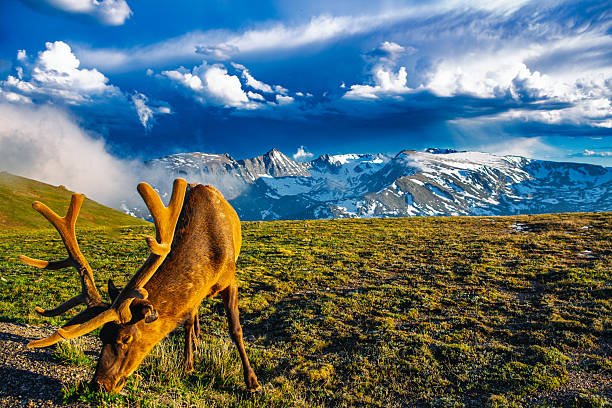
Only bulls grow antlers, and they shed and regrow them every single year. The cycle starts in spring, triggered by increasing daylight. New antlers grow rapidly, covered in a soft, blood-rich tissue called velvet that supplies nutrients to the developing bone. By late summer, a bull’s antlers can grow up to an inch per day, making them among the fastest-growing mammalian tissue known.
By August, the velvet dries up and the bull rubs it off against trees and shrubs, revealing the hardened bone beneath. This polished bone is what you see during the September rut, when bulls use their antlers to fight for dominance. Antlers are shed in late winter, usually by March, and the cycle begins again. Testosterone levels control the entire process. Castrated bulls, called steers, do not shed their antlers normally and often grow deformed, permanent velvet-covered racks.
Behavior: the rut, herds, and vocalizations
The rut is the annual breeding season, running from late August through October with a peak in mid-September. Bulls gather harems of cows and defend them aggressively against rival bulls. The iconic bugle call starts as a high-pitched whistle and drops into a guttural roar. It serves as both a challenge to other bulls and a way to keep cows close. Cows and calves communicate with mews and barks, higher-pitched vocalizations that carry less distance but function as constant contact calls within the herd.
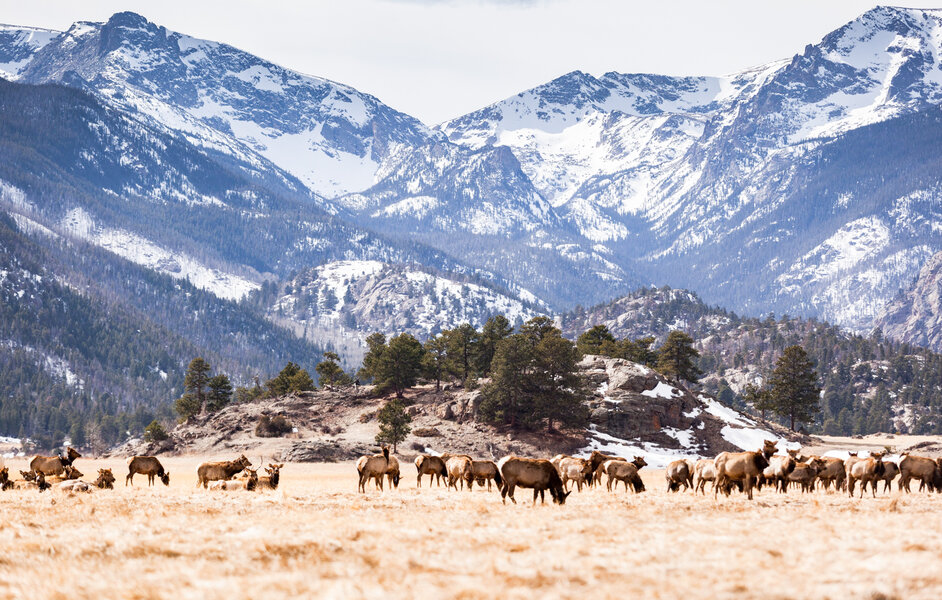
Outside the rut, elk are highly social. Cows and calves live in large maternal herds. Bulls form smaller bachelor groups or roam alone. Herd sizes swell in winter when snow concentrates animals on low-elevation ranges. Wallowing, where a bull rolls in mud or dust and urinates on himself, is a rut-specific behavior. The scent-soaked mud acts as a chemical signal to cows and a warning to rival bulls. It is one of the most reliable field signs that the rut is active in a given drainage.
Range and population: then and now
Before European settlement, elk ranged across nearly all of North America. Population estimates place the pre-settlement number at over 10 million animals. By the early 1900s, unregulated market hunting and habitat loss had reduced that number to roughly 90,000 elk, confined to the most remote corners of the West. The recovery since then, driven by state-led reintroduction programs and conservation funding from hunting license fees, is one of North America’s genuine wildlife success stories.
Today, Colorado alone holds an estimated 280,000 elk, the largest herd of any state or province. Montana, Wyoming, Idaho, and Oregon each hold healthy six-figure herds. Transplanted populations now exist in Pennsylvania, Kentucky, Michigan, and several other eastern states where the extinct Eastern elk once roamed. Parks Canada manages thriving herds in Jasper and Banff National Parks. The current continental population sits near one million animals, stable but subject to habitat pressure and disease risk.
Health and disease: what to know about CWD
Chronic wasting disease (CWD) is a prion disease that affects elk, deer, and moose. It is always fatal, and it spreads through direct contact and contaminated soil. CWD has been detected in wild and captive elk herds in several western states, including Colorado, Wyoming, and Montana, as well as in some transplanted eastern herds.
Here is the context Wikipedia’s disease-heavy page skips. There has never been a documented case of CWD transmission to humans. The Centers for Disease Control and Prevention and the World Health Organization both advise against eating meat from CWD-positive animals, and state wildlife agencies offer free or low-cost testing for harvested elk. The disease is managed through surveillance, targeted culling in affected areas, and restrictions on transporting carcasses across state lines. It is a serious wildlife management challenge, not a reason to avoid visiting elk country or to treat elk as dangerous to be near.
Where to see Rocky Mountain elk in the wild
This is the section the official fact sheets and the Wikipedia entry both skip entirely. Seeing a wild elk is not difficult if you know where and when to go. The rut, from September through early October, is the best window. Bulls are active, visible, and vocal at dawn and dusk. Outside the rut, elk are still present in these locations but tend to retreat into thicker cover during midday.
Rocky Mountain National Park, Colorado
The Moraine Park and Horseshoe Park meadows are the most reliable viewing areas. Arrive before sunrise in September and you will hear bugling before you can see the animals. The park can close certain areas during the rut to prevent visitor-elk conflicts, so check current closures at the visitor center. Keep at least 25 yards of distance. The park posts rangers in viewing areas during peak season specifically to enforce this.
Yellowstone National Park, Wyoming and Montana
Mammoth Hot Springs and the Lamar Valley are the two most consistent spots. Mammoth’s elk are habituated to human presence and often graze on the manicured lawns near the visitor center. Lamar Valley gives you a wilder, more expansive viewing experience with the added possibility of seeing wolves interacting with the herd. Dawn and dusk are the active windows, but mammoth elk are often visible throughout the day during the rut.
Jasper and Banff National Parks, Alberta
The town of Jasper itself often has elk grazing on the outskirts, particularly near the Jasper Park Lodge golf course. In Banff, the Bow Valley Parkway and the Vermilion Lakes area produce reliable early-morning sightings. Canadian elk are the same Rocky Mountain subspecies, and the September rut timing is identical to the U.S. Rockies.
State-level viewing
Pennsylvania’s elk herd, concentrated around Benezette in Elk County, is a transplanted Rocky Mountain elk population that now exceeds 1,000 animals. The Pennsylvania Game Commission manages a dedicated viewing area with interpretive signage. Kentucky and Michigan also have huntable, viewable herds in designated wildlife management areas. These eastern viewing opportunities are often less crowded than the national parks and offer a different experience entirely.
Mistakes to avoid around wild elk
Elk are not aggressive by default, but they are large, fast, and intensely protective during the rut and calving season. Every year, visitors to national parks get charged because they ignored the distance rule. Here is what not to do.
- Approaching a bull during the rut. A bull defending a harem sees you as a threat. Stay at least 25 yards away, and further if the animal is staring at you, pacing, or lowering its antlers.
- Getting between a cow and her calf. Calving season runs May through June. A cow elk will charge and kick if she perceives a threat to her calf. Give wide berth.
- Using a camera flash or bright phone light at dawn or dusk. It disorients the animals and, in some parks, is a ticketed offense.
- Stopping your car in the middle of a park road. Pull fully onto the shoulder or into a designated pullout before watching or photographing elk.
- Feeding elk. It habituates them to humans, alters their migration patterns, and is illegal in every national park and most state wildlife areas. Fines are steep.
- Assuming an elk lying down chewing its cud is relaxed and safe to approach. It is resting and processing food. It can stand and charge in seconds if startled.
Frequently asked questions
What is the difference between an elk and a Rocky Mountain elk?
“Elk” is the species name for Cervus canadensis, which includes all six North American subspecies. “Rocky Mountain elk” refers specifically to the subspecies Cervus canadensis nelsoni, the most widespread and populous of the six. When most people in the United States say “elk,” they are picturing a Rocky Mountain elk.
How big is a full-grown Rocky Mountain elk?
A mature bull Rocky Mountain elk weighs between 600 and 750 pounds and stands roughly five feet at the shoulder. From nose to tail, it stretches about eight feet. Cows are smaller, typically weighing between 450 and 550 pounds and standing about four and a half feet at the shoulder.
Are Rocky Mountain elk dangerous?
Elk are not predators and do not hunt humans, but they are large wild animals that can become aggressive if they feel threatened. Bulls during the September–October rut and cows with calves during May and June are the most likely to charge. Maintain at least 25 yards of distance and never position yourself between a cow and her calf.
How long do Rocky Mountain elk live?
In the wild, a Rocky Mountain elk typically lives 10 to 13 years. Bulls tend to have shorter lifespans than cows due to the physical toll of the rut and higher hunter harvest rates in managed populations. In captivity, elk can live beyond 20 years.
What do Rocky Mountain elk eat?
Elk are ruminant herbivores with a four-chambered stomach. Their diet shifts seasonally. In summer, they graze heavily on grasses and forbs in alpine meadows. In winter, they descend to lower elevations and browse on woody shrubs, bark, and dried grasses. An adult elk consumes 10 to 15 pounds of forage per day.
Where is the best place to see Rocky Mountain elk?
Rocky Mountain National Park in Colorado and Yellowstone National Park in Wyoming and Montana offer the most reliable public-land viewing in the United States. Moraine Park, Horseshoe Park, Mammoth Hot Springs, and the Lamar Valley are the specific areas where elk are consistently visible, especially during the September rut.
Do female elk have antlers?
No. Only male elk, called bulls, grow antlers. Cows do not grow antlers. Antlers are shed and regrown annually, controlled by testosterone levels. A castrated bull elk will grow deformed, permanent velvet-covered antlers that it never sheds.
Plan your trip: booking platforms we trust
For wildlife-viewing trips targeting Rocky Mountain elk, I prioritize accommodation close to park entrances and flexible cancellation policies, since early-morning viewing demands a short drive from bed to meadow. The platforms below are what I use when booking my own elk-viewing trips to Colorado and Wyoming.
Best for finding Estes Park and Gardiner motels with free cancellation and early-check-in options for dawn viewing.
Best for guided wildlife-viewing tours in Rocky Mountain National Park and Yellowstone with expert naturalist guides.
Best for whole cabins near Estes Park or Gardiner, especially for multi-family groups during the fall rut season.
Best for comparing flights into Denver International Airport for Rocky Mountain National Park or Bozeman for Yellowstone access.