advertisement
The Wave is a 6.4-mile round-trip hike across unmarked desert terrain in the Vermilion Cliffs Wilderness. You cannot visit without a permit won through an extremely competitive lottery system. Only 64 people per day are allowed in, and your odds of winning are roughly 4 to 10 percent depending on the season.
I stood at the Wire Pass trailhead at 6:15 AM with my permit clipped to my backpack and a knot in my stomach. Chidi, our WakaAbuja team lead, had warned me: “The BLM ranger said if you miss the turn at the wash, you are walking into open desert with zero shade. ” He was not exaggerating.
This guide contains everything I learned on that hike and everything I wish I had studied before applying for the permit lottery eight months earlier. No brochure speaks. Just the logistics, the fear, and the sandstone.
Jump to: Permit Lottery Strategy | Trail Navigation | Photography Guide | Safety | Best Time to Go | Alternatives | FAQs
Key takeaways
- The Wave is not a marked trail. You navigate using a BLM-provided photo map. GPS alone is not enough.
- Only 64 people win permits each day: 48 from the online advance lottery, 16 from the in-person daily lottery in Kanab or Page.
- Mid-week dates in December and January have the highest win rates because fewer people apply.
- The hike takes 4 to 6 hours round trip for most hikers. There is zero shade and no water source.
- Flash floods kill people in this canyon system. Never enter if rain is in the forecast.
- If you lose the permit lottery, White Pocket offers similarly surreal formations with no permit required.
How to Win a Permit for The Wave: Lottery Strategy That Actually Works
The permit system is brutal by design. The Bureau of Land Management caps visitors to protect the fragile Navajo sandstone formations. You face two paths: the advance online lottery and the daily walk-in lottery. Neither is easy. Fatima, our Lagos correspondent, applied eleven times before her name was drawn. She told me she screamed in her kitchen when the email arrived.
Advance Online Lottery (4 Months Out)
Applications open on recreation.gov exactly four months before your intended hike date. For a March 1st hike, you apply in November. The window stays open for 10 days. You pick up to three date choices and rank them. The system draws winners after the window closes. Forty-eight permits are awarded for each date. Groups can be up to six people. Here is the trick: apply for mid-week dates in the dead of winter. December, January, and February see a fraction of the applications that April and May attract. Your odds jump from roughly 4 percent to closer to 10 or 12 percent. That is still terrible, but it triples your chances.
Daily Walk-In Lottery (2 Days Before)
Sixteen additional permits are released every day for a hike date two days later. The walk-in lottery currently operates from Kanab, Utah, and Page, Arizona. You must be physically present at 8:30 AM local time. The draw happens at 9:00 AM. You fill out a paper application and watch the ranger pull numbers from a bingo cage. It is deeply stressful. I watched a man cry when his number was called. Apply during shoulder seasons for this one too. Summer walk-in lotteries can draw over 100 people competing for 16 spots.
Chidi’s honest take: “Apply for a January Tuesday with a group of four. Large groups reduce the number of applications in the pool because one win covers more hikers. Solos dilute the odds.”
The application fee is $9 per group. If you win, each person pays an additional $7 permit fee. You pick up the physical permit the day before your hike at the BLM office in Kanab or Page. Bring government-issued ID. The ranger will hand you a photo map and a laminated route guide. Do not lose that map. It is your lifeline.
Navigating the Wave Trail: Step-by-Step Without Getting Lost
There are no cairns. No signs. No cell service. The BLM map shows you eight photo waypoints. You match the landscape to the photos. This sounds manageable until you are standing in a dry wash with sandstone walls that look identical in three directions. The trailhead begins at Wire Pass, a dusty parking lot off House Rock Valley Road. You sign the register and walk north across the wash. Within ten minutes you cross the Arizona-Utah state line, which is marked by a small sign. The first mile is flat, sandy, and deceptively easy.
The critical navigation point comes at roughly the 1.2-mile mark. You must exit the main wash and climb a steep sandstone ridge to your right. This is where hikers get lost. They stay in the wash and wander into the open desert. The BLM photo map shows a specific crack in the rock wall as your turn marker. Memorize it. Once you climb the ridge, you cross a series of sandstone domes with footprints leading vaguely southwest. There is no single path. You pick your way across the rock. Around mile 2.5 you will see the signature formation ahead, rising like a petrified wave. The final approach drops into a bowl of swirling cross-bedded rock.
@joosesalas Replying to @blaqstorm everything you need to know about the wave hike #solotravel #adventuretravel #hikes
Fatima’s honest take: “I took a photo of the wash exit point with my phone. When I looked back, returning, the ridge looked completely different from the opposite direction. Mark waypoints on your GPS, not just in your head.”
Total elevation gain is roughly 400 feet, but the constant up-and-down across slickrock makes it feel like more. The return trip is easier to navigate because The Wave itself is visible as a landmark for the first mile back. Carry a dedicated GPS unit loaded with waypoints. A phone battery dies faster than you think in desert heat. Write the BLM emergency number on your permit: 928-643-8100. The nearest hospital is in Page, over an hour away.
How to Photograph The Wave: Angles, Light, and Camera Settings
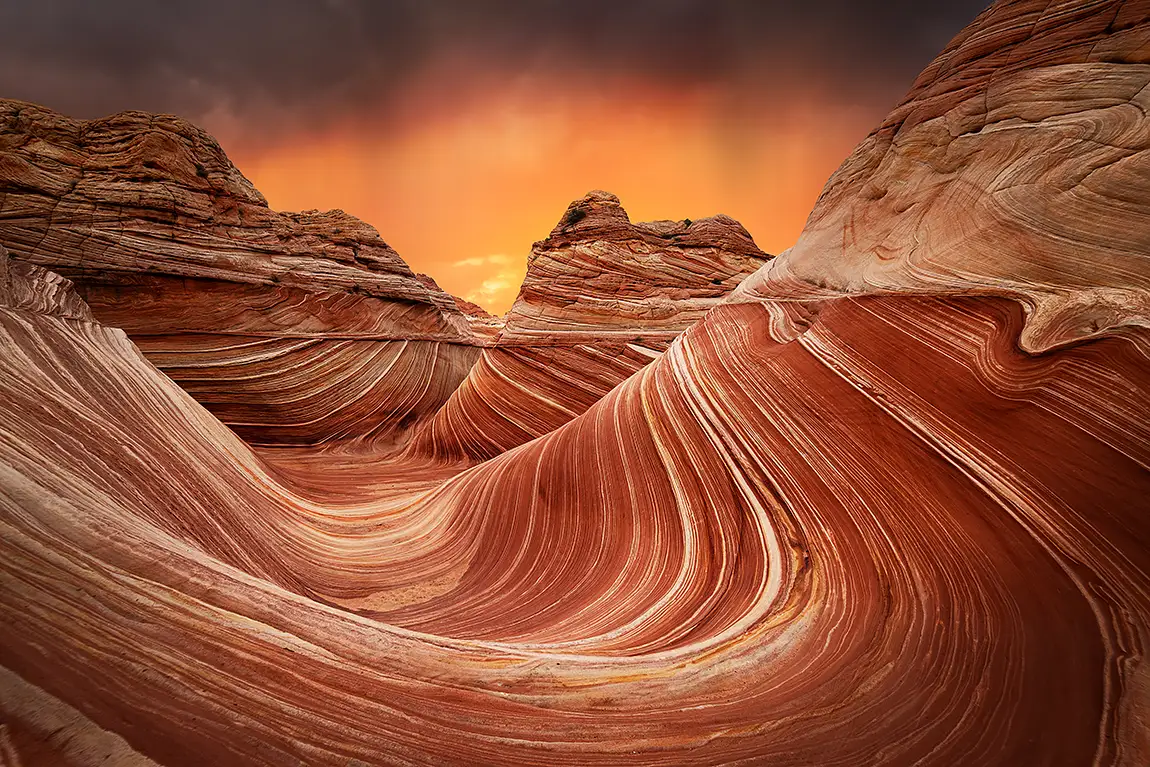
Every photographer chases the same shot. The tight corridor where the sandstone walls curl like a breaking sea. That classic composition is taken with a wide-angle lens at roughly 16mm, pointed slightly upward from a low crouch. But the shot everyone misses is from the top of the ridge looking down into the bowl. Bring a telephoto lens for that perspective. The compressed layers look like a topographic map come to life.
Midday light fills the narrow corridors without harsh shadows, which is why the BLM recommends it. But the truly stunning light happens in the last hour before sunset when the sandstone glows orange and the striations deepen. The problem: you cannot legally be on the trail after dark without special permission. Plan your return so you hit the trailhead by sunset. Check local golden hour times on your permit date.
Camera Setup Tips
- Wide-angle lens (16-35mm) for the main corridor
- Polarizing filter to cut glare on slickrock
- ISO 100, aperture f/8 to f/11 for depth
- Bracket exposures: the contrast between shadow and sunlit rock is extreme
Compositions Beyond the Classic
- The “second wave” formation 200 yards south
- Detail shots of cross-bedding swirls at your feet
- The arch window framing the valley to the west
- Reflection pools after rain in the sandstone bowls
What Is The Wave? The Geology Behind the Swirls
The Wave is Navajo sandstone deposited roughly 190 million years ago during the Jurassic Period. This region was a massive erg, a sand sea larger than the modern Sahara. Dunes migrated across the landscape under fierce winds. Over millennia, the dunes compacted into stone, and iron oxide minerals painted the layers in bands of red, orange, and cream. The U-shaped troughs you photograph are not carved by water. They are ancient dune troughs, fossilized wind ripples frozen in stone.
Ute and Paiute people traveled through these canyons long before the first photographers arrived. Petroglyphs exist on protected sections of the Coyote Buttes area. Treat every rock surface as sacred. Do not scratch, carve, or take any rocks. The fines for disturbing the formation start at $500 and escalate to federal prosecution for serious damage.
Safety at The Wave: Heat, Flash Floods, and Getting Lost
This is not a state park with ranger stations and water fountains. This is raw wilderness. The dangers are real and kill unprepared hikers.
Heat Exhaustion
Temperatures exceed 100 degrees Fahrenheit from June through September. The sandstone reflects heat upward. Carry a minimum of one gallon of water per person. Start hiking by sunrise and plan to be back at the trailhead by noon. A wide-brimmed hat and long-sleeved sun shirt are not optional.
Flash Floods
Wire Pass and Buckskin Gulch are slot canyon systems that funnel water from storms 50 miles away. A thunderstorm you cannot see can send a wall of water through the wash you crossed. Check the National Weather Service flash flood rating before you leave. If it is “probable,” cancel your hike. The permit is not worth your life. In 2023, a hiker was swept through Buckskin Gulch and miraculously survived with broken bones after being carried over a mile.
Navigation Failure
The BLM reports multiple search and rescue operations each year for Wave hikers who missed the wash exit. A 62-year-old man was airlifted in 2021 after wandering six miles in the wrong direction. Carry a satellite messenger like a Garmin inReach. Cell phones show zero bars for the entire hike.
Best Time to Hike The Wave: Month-by-Month Breakdown
March to April
Pleasant temperatures. Peak permit competition. Wildflowers possible.
May to June
Rapidly heating. The lottery is still crowded. Start hiking before 6 AM.
July to August
Dangerous heat. Monsoon flash flood risk peaks. Some days exceed 105 degrees.
September to October
Ideal temperatures return. Fall light is golden. Lottery competition is moderate.
November to February
Cold mornings. Snow possible. Best lottery odds. Short daylight limits photo time.
A Perfect Day at The Wave: Sample Itinerary from Page, Arizona
Chidi and I left Page at 5:00 AM. We grabbed breakfast burritos from a gas station on Lake Powell Boulevard. The drive to the Wire Pass trailhead takes roughly 50 minutes on House Rock Valley Road, a dirt track that becomes impassable after rain. We signed the register at 6:15 AM and hiked in cool shadows. We reached The Wave by 8:00 AM and had the formation to ourselves for almost an hour before the next hikers arrived. We photographed until 10:30 AM, ate lunch in the shade of an alcove, and began the return hike at 11:30 AM. Back at the car by 1:00 PM.
After the hike, we drove east to the Navajo Bridge over Marble Canyon. California condors roost under the bridge. We ate dinner at Big John’s Texas BBQ in Page. If you stay in Kanab, the drive to the trailhead is longer, but the town has more lodging options. Book accommodations on Booking.com well in advance.
Should You Hire a Guide for The Wave?
BLM-authorized outfitters charge between $200 and $350 per person. They handle navigation, carry emergency gear, and often know hidden compositions. For first-time desert hikers or anyone with poor map-reading skills, a guide eliminates the very real risk of getting lost. Dreamland Safari Tours and Kanab Tour Company are two of the licensed operators. Check their availability on GetYourGuide.
If you are an experienced hiker comfortable with off-trail navigation, the BLM map is sufficient. I went solo and felt nervous but capable. Fatima hired a guide and said the geological commentary alone was worth the price. Guides do not increase your lottery odds. You must win the permit first, then book the guide.
What If You Do Not Win the Lottery? 4 Worthy Alternatives
White Pocket
No permit required. Brain-rock formations with the same swirling Navajo Sandstone as The Wave. The road in is deep sand and requires high-clearance 4WD. Guided tours from Kanab are widely available. Honestly, White Pocket rivals The Wave is visual drama and has zero crowds.
Buckskin Gulch
One of the longest slot canyons in the world. A day-use permit is required but easy to obtain at the trailhead. The Wire Pass Trailhead leads directly into it. The slot narrows to arm’s width in sections. Flash flood risk here is extreme. Check forecasts obsessively.
South Coyote Buttes
Separate permit lottery, far less competitive than The Wave. Features “Paw Hole” and other vivid sandstone formations. Only 20 permits per day. Apply through recreation.gov the same way as the North Coyote Buttes lottery.
Antelope Canyon
Requires a Navajo guide. Upper and Lower Antelope Canyon are extremely crowded but photograph beautifully. Book tours on TripAdvisor months ahead for peak season slots. Not a wilderness experience, but the light beams are real.
What to Pack and Wear for The Wave
The Non-Negotiable Gear List
One gallon of water per person. Salty snacks. Sun hat. Sunglasses. Long-sleeved sun shirt. Sturdy hiking boots with good grip on slickrock. The BLM photo map. A GPS unit with pre-loaded waypoints. A satellite messenger. A headlamp even if you plan to finish before dark. Trekking poles help on the steep sandstone slabs. Leave cotton clothing at home. It holds sweat and chills you rapidly when the desert wind picks up.
Common Mistakes First-Timers Make at The Wave
- Relying on phone GPS only. Batteries drain fast in heat, and GPS signal bounces off canyon walls.
- Starting too late. A 10 AM start in July is dangerous. The heat peaks between noon and 4 PM.
- Not checking House Rock Valley Road conditions. Rain turns it to impassable clay. The BLM closes it periodically.
- Forgetting the physical permit. Rangers do spot checks at the trailhead. No permit means a federal citation.
- Underestimating navigation difficulty. Dozens of social trails crisscross the slickrock. The photo map is the only official route.
- Ignoring flash flood warnings. Even a “possible” rating on the NWS scale should make you reconsider entering any wash.
Frequently asked questions
How hard is the hike to The Wave?
Moderately strenuous. The distance is only 6.4 miles round trip, but there is no trail, loose sand, or steep slickrock climbs. Navigating without markers adds mental fatigue. Most fit hikers complete it in 4 to 6 hours.
Can kids hike The Wave?
Yes, but they must be comfortable with off-trail hiking and heat exposure. The BLM does not set an age minimum, but guided tour operators often recommend ages 10 and up. Carry all water and snacks for them.
What are the actual odds of winning the lottery?
Roughly 4 to 8 percent for peak spring and fall dates. Winter dates can reach 10 to 12 percent. The daily in-person lottery odds fluctuate wildly based on how many people show up but often fall in the 5 to 15 percent range.
Is there cell service at The Wave?
No. There is zero cell service at the trailhead, on the hike, or at The Wave itself. Download offline maps before you leave Page or Kanab. Carry a satellite messenger for emergencies.
Can I bring my dog to The Wave?
No. Pets are not allowed on the trail, even on a leash. The desert heat and sensitive sandstone ecology make it unsafe and damaging. Service animals require prior BLM approval.
How far in advance should I apply for the permit?
Exactly four months before your intended hike date. The advance lottery opens on the first of the month, four months prior, and runs for 10 days. Mark your calendar and set reminders.
Plan your trip: booking platforms we trust
The WakaAbuja team relies on these platforms to build our Arizona desert trips. We trust them because their cancellation terms are transparent and their inventory covers the remote corners of the Southwest.