
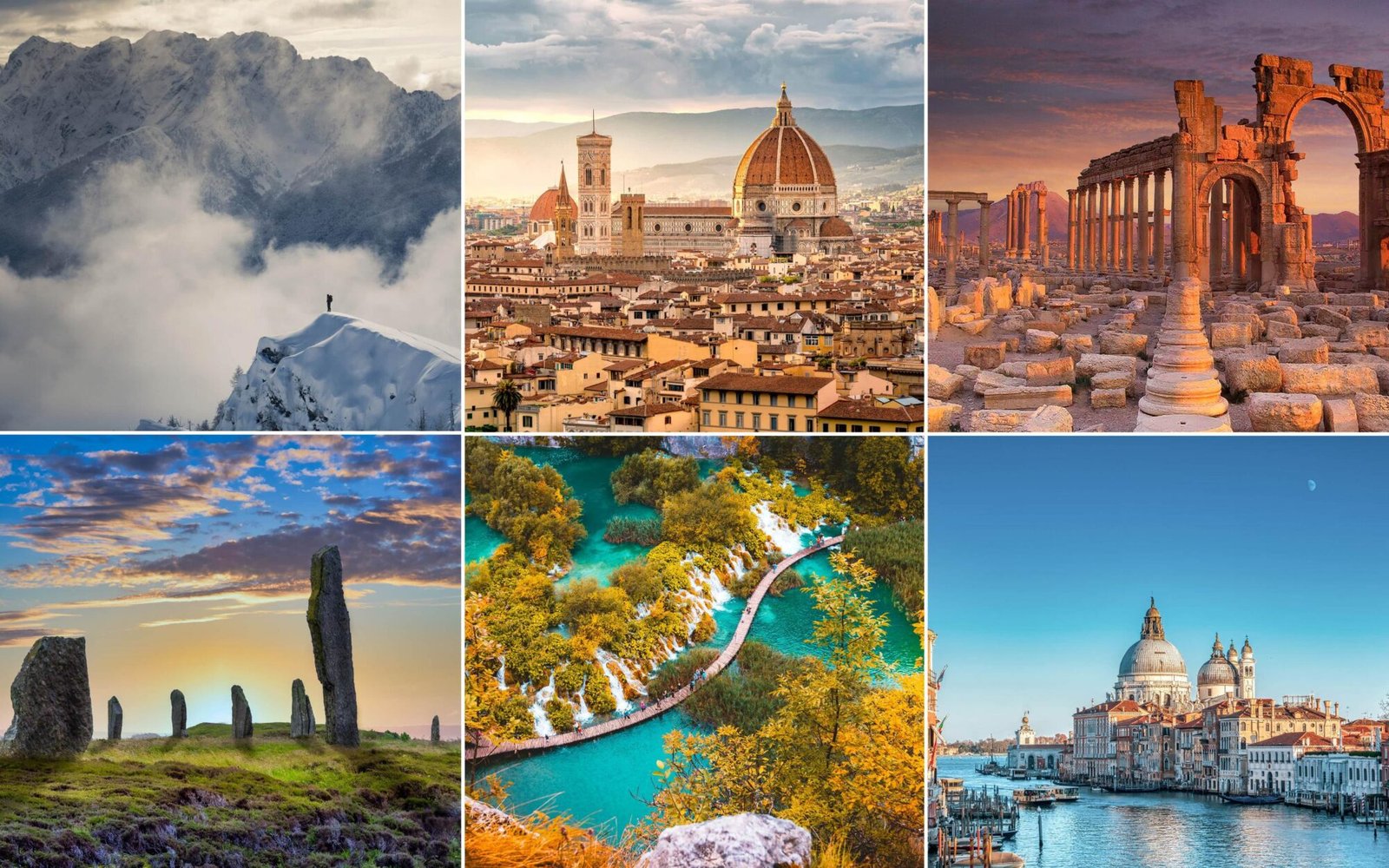
Explore the world’s UNESCO World Heritage Sites, from ancient monuments and historic cities to extraordinary natural landscapes.
Fact-Checked By: Maya Whitfield—Senior Travel Editor at WakaAbuja
There are currently 1,273 UNESCO World Heritage Sites worldwide, split into 991 cultural sites, 240 natural sites, and 42 mixed sites, spread across 173 States Parties. Italy has the most with 60 sites, followed by China with 59 and Germany with 54. Around 58 sites are on the List of World Heritage in Danger, and 3 have been delisted entirely.
UNESCO’s own website is the definitive database, and it should be your first stop if you just want the raw official list. But the official page will not tell you why one site is more worth your time than another, which sites you can realistically visit on a single trip, or which ones are quietly falling apart. This article fills that gap.
It is a curated, plain-English guide to the UNESCO World Heritage Sites, organized by region, with context on what makes each cluster worth the trip and the practical detail the official database never gives you.
Jump to: What It Means | How Sites Get Chosen | Europe | Asia | Africa | Americas | Oceania | Newest Inscriptions | In Danger | How to Visit | FAQ
Key takeaways
- 1,273 sites total. 991 cultural, 240 natural, and 42 mixed. The list grows by roughly 20 to 30 sites each year when the World Heritage Committee meets.
- Italy has the most sites, with 60, followed by China (59) and Germany (54).
- To be inscribed, a site must meet at least one of 10 criteria and demonstrate “outstanding universal value.”
- 58 sites are on the In Danger list, threatened by war, climate change, development, or neglect. Visiting them responsibly can help fund protection.
- Only 3 sites have ever been delisted: the Arabian Oryx Sanctuary in Oman, the Dresden Elbe Valley in Germany, and the Liverpool Maritime Mercantile City in the UK.
- The list is not just castles and cathedrals. It includes entire cities, farming landscapes, railways, deserts, and underwater sites.
What Does UNESCO World Heritage Status Actually Mean?
World Heritage status is a legal designation, not a tourism award. When a site is inscribed, the country that nominated it commits to protecting it under the World Heritage Convention, which was adopted in 1972. UNESCO does not own the site. It does not run it. It does not fund it on an ongoing basis. It provides a framework, monitoring, and international pressure, and the actual management stays with the national or local government.
In practice, that means World Heritage status is a big deal for preservation but not a guarantee of anything for visitors. Some sites are impeccably maintained with excellent visitor infrastructure. Others are remote, underfunded, or difficult to reach. A few are actively in danger. The designation itself is what earns the site a spot on the list, not the visitor experience.
Maya Whitfield’s honest take: “UNESCO status is a starting signal, not a finishing signal. I have visited sites with the designation that had no signposts and no visitor center, and I have visited unlisted sites with better infrastructure than some World Heritage properties. Check what the actual visitor experience is before you assume the status guarantees it.”
How Do Sites Get Chosen for the UNESCO List?
Sites are chosen based on “outstanding universal value,” which means they are judged to be so exceptional that their loss would be a loss to all of humanity. That judgment is applied against 10 criteria: six cultural and four natural.
The 10 criteria in plain English
- A masterpiece of human creative genius
- Evidence of a major interchange of human values
- Unique or exceptional testimony to a cultural tradition or civilization
- An outstanding example of a type of building, technology, or landscape
- An outstanding example of traditional human settlement or land use
- Directly associated with events, ideas, or beliefs of outstanding significance
- Contains superlative natural phenomena or exceptional natural beauty
- An outstanding example of major stages in Earth’s history
- An outstanding example of significant ecological and biological processes
- Contains the most important natural habitats for biological diversity
Sites that qualify under criteria i through vi are cultural. Sites that qualify under vii through x are natural. Sites that meet at least one cultural and one natural criterion are classified as mixed, and there are only 42 of those in the world. Each country submits a Tentative List of sites it intends to nominate, and sites are formally inscribed when the World Heritage Committee meets, usually once a year.
UNESCO World Heritage Sites in Europe
Europe has the highest concentration of World Heritage Sites of any region, and Italy leads the world with 60. The density means you can realistically visit several sites in a single trip, especially in Italy, Spain, and Germany, where sites cluster within a few hours of each other.
Italy
Top sites: Historic Centre of Rome, Venice and its Lagoon, Historic Centre of Florence, Cinque Terre, Amalfi Coast, Pompeii and Herculaneum, Trulli of Alberobello, and Sassi of Matera
Why visit: Italy has the highest density of sites in the world. You could spend a month in the country and still not see them all.
Spain and Portugal
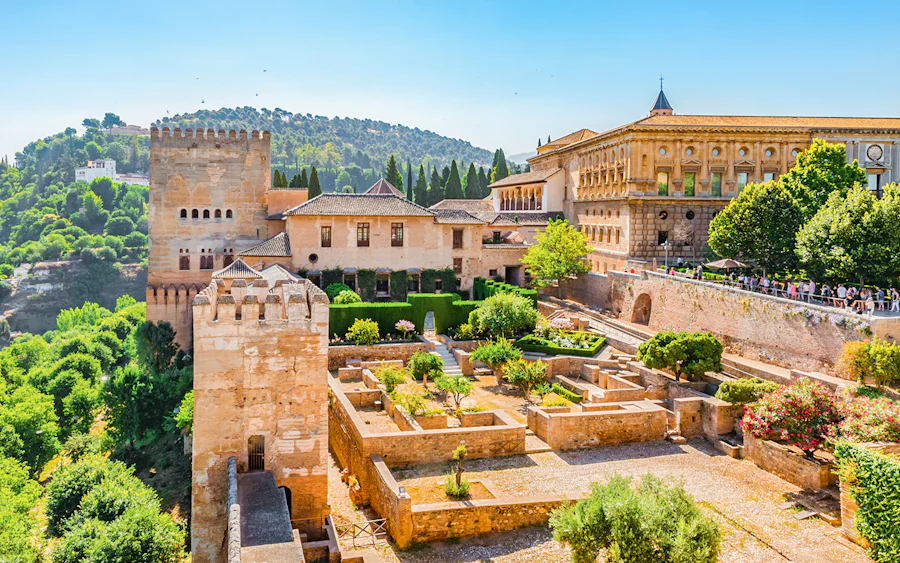
Top sites: Alhambra and Generalife in Granada, Historic Centre of Cordoba, Works of Antoni Gaudi in Barcelona, Historic Centre of Porto, and Jeronimos Monastery in Lisbon.
Why visit: The Moorish architecture in southern Spain is genuinely unique, and the Gaudi sites in Barcelona are unlike anything else in Europe.
France, Germany, and the UK
Top sites: Banks of the Seine in Paris, Mont-Saint-Michel, Cologne Cathedral, Bauhaus sites in Germany, Stonehenge, City of Bath
Why visit: These sites are the most accessible in the world for travelers based in Western Europe, and each country has a well-developed tourist infrastructure around them.
UNESCO World Heritage Sites in Asia
China is second in the world with 59 sites, and India is sixth with 42. The region is also home to some of the most spectacular natural sites on the list, including several that sit at the intersection of culture and nature.
China
Top sites: The Great Wall, Forbidden City in Beijing, Terracotta Army in Xi’an, Classical Gardens of Suzhou, Historic Centre of Macao
Why visit: The scale of Chinese heritage sites is unmatched, and many are far less crowded than you would expect outside the major holidays.
India and Southeast Asia
Top sites: Taj Mahal, Qutb Minar in Delhi, Khajuraho temples, Borobudur in Indonesia, and Angkor in Cambodia
Why visit: Angkor and Borobudur are the two most significant temple complexes in Southeast Asia, and both are easily reached from major tourist hubs.
Japan and Korea
Top sites: Historic Monuments of Ancient Kyoto, Itsukushima Shrine, Historic Villages of Shirakawa-go and Gokayama, Changdeokgung Palace in Seoul
Why visit: Japan’s sites reward slow travel. Kyoto alone has 17 separate World Heritage properties.
UNESCO World Heritage Sites in Africa
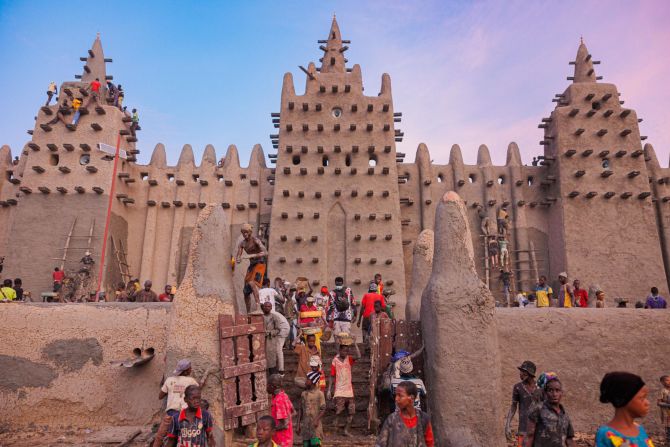
Africa is underrepresented on the World Heritage list relative to its cultural and natural richness, but it holds some of the most spectacular sites anywhere. Several are also on the In Danger list, and visiting them responsibly has a real impact.
Egypt and North Africa
Top sites: Memphis and its necropolis, including the Pyramids of Giza, Ancient Thebes and the Valley of the Kings, Nubian Monuments at Abu Simbel, and the Medina of Fez in Morocco
Why visit: The pyramids are the only surviving wonder of the ancient world, and the Nubian monuments are among the most impressive archaeological sites anywhere.
Sub-Saharan Africa
Top sites: Serengeti National Park, Kilimanjaro, Victoria Falls, Great Zimbabwe Ruins, Lalibela rock-hewn churches in Ethiopia, and Robben Island in South Africa
Why visit: The natural sites here rival anything on the list, and the cultural sites like Lalibela and Great Zimbabwe are under-visited relative to their significance.
UNESCO World Heritage Sites in the Americas
The Americas span everything from pre-Columbian cities in Mexico and Peru to national parks in the US and Canada that define what “natural heritage” means.
Mexico, Central America, and the Caribbean
Top sites: Chichen Itza, Teotihuacan, Historic Centre of Mexico City, Tikal in Guatemala, Historic Centre of Havana, and Morne Trois Pitons in Dominica
Why visit: Mexico has 35 sites, making it the most World Heritage-rich country in the Americas, and Tikal is arguably the most spectacular Maya site anywhere.
South America
Top sites: Machu Picchu, Historic Centre of Cusco, Galapagos Islands, Iguazu Falls, Historic Centre of Lima, Cartagena in Colombia
Why visit: Machu Picchu and the Galapagos are the two most iconic sites in South America, and both require advance planning to visit responsibly.
United States and Canada
Top sites: Grand Canyon, Yellowstone, Yosemite, Statue of Liberty, Independence Hall, Mesa Verde, Canadian Rocky Mountain Parks, Historic District of Old Quebec
Why visit: The US and Canada combined hold 49 sites, most of which are national parks with excellent visitor infrastructure.
UNESCO World Heritage Sites in Oceania
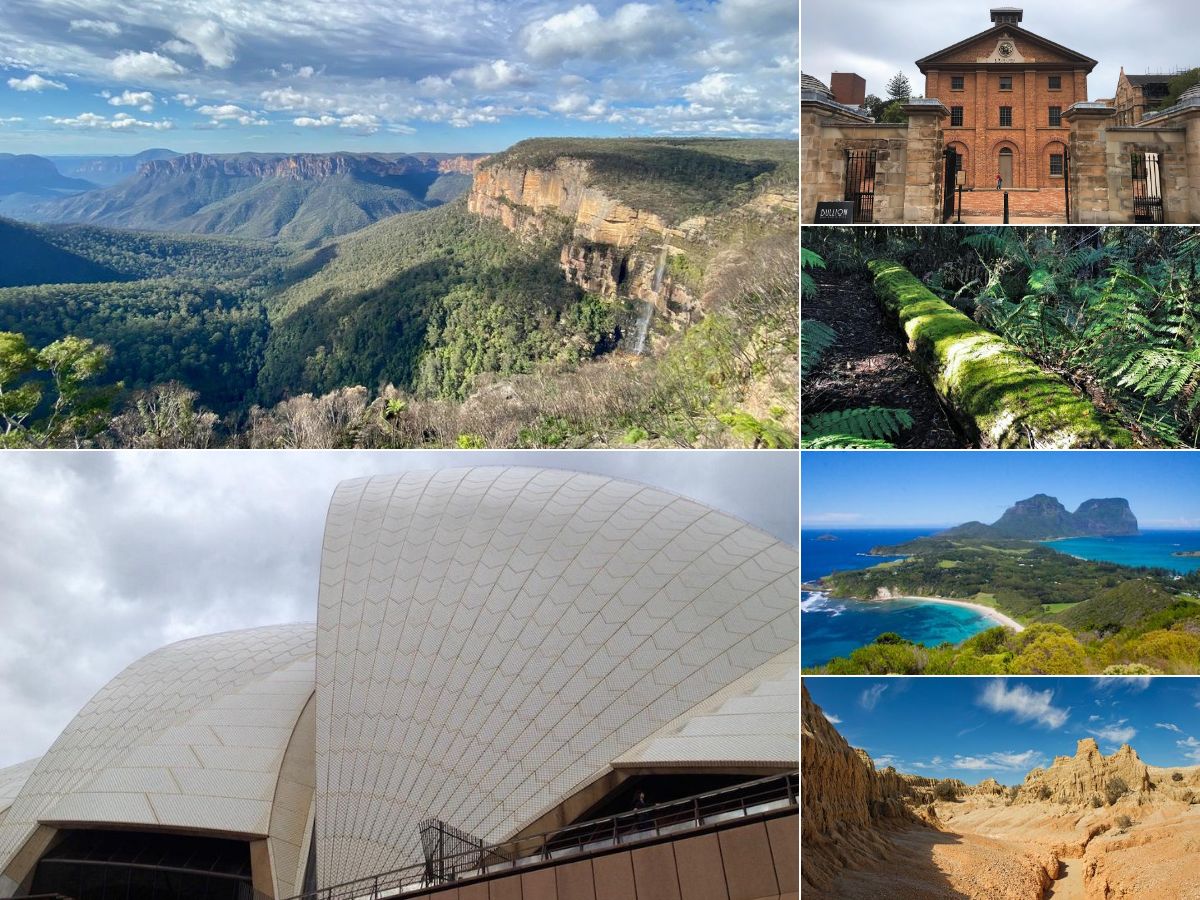
Oceania’s sites are among the most isolated and most extraordinary on the list. The region includes the world’s largest coral reef system, some of the oldest rainforests on earth, and cultural landscapes that have been continuously inhabited for tens of thousands of years.
Australia and New Zealand
Top sites: Great Barrier Reef, Sydney Opera House, Uluru-Kata Tjuta, Wet Tropics of Queensland, Te Wahipounamu, Tongariro National Park
Why visit: The Great Barrier Reef is the most famous natural site in the region, and the cultural significance of Uluru to Aboriginal Australians makes it one of the most meaningful sites on the entire list.
Pacific Islands
Top sites: Rock Islands of Palau, Chief Roi Mata’s Domain in Vanuatu, Levuka Historical Port Town in Fiji, Nan Madol in Micronesia
Why visit: These are among the least-visited World Heritage Sites in the world, and reaching them is a genuine adventure in itself.
Newest UNESCO World Heritage Sites (Most Recent Inscriptions)
The World Heritage Committee meets annually and typically inscribes 20 to 30 new sites per cycle. Recent inscriptions have trended toward cultural landscapes, industrial heritage, and sites representing historically underrepresented regions and communities.
Recent additions have included the Via Appia in Italy, the Flow Country in Scotland, the Marquesas Islands in French Polynesia, and several sites connected to twentieth-century history that were previously overlooked. New inscriptions are announced each summer after the annual committee session, and the count updates immediately on the official UNESCO website. If you are planning a trip around a specific site, check its inscription status directly with UNESCO, since a nominated site is not yet officially listed until the committee approves it.
Which UNESCO Sites Are Currently In Danger?
58 sites are on the List of World Heritage in Danger. The designation is meant to mobilize international attention and resources, not to shame the country that hosts the site. A site can be listed as in danger because of armed conflict, natural disasters, pollution, poaching, unchecked tourism, or planned development.
Notable sites currently in danger
- Everglades National Park (US): Threatened by urban development and water diversion.
- Chan Chan Archaeological Zone (Peru): Threatened by El Niño flooding and erosion.
- Historic Centre of Vienna (Austria): Listed due to high-rise development proposals.
- Site of Palmyra (Syria): Damaged by armed conflict.
- Nan Madol (Micronesia): Threatened by mangrove overgrowth and siltation.
- Venice and its Lagoon (Italy): Repeatedly threatened by flooding and mass tourism.
Visiting a site on the In Danger list, when it is safe to do so, can help support the local economy that depends on its protection. The designation is often accompanied by international funding and monitoring that only becomes more effective when the site has an economic reason to be preserved.
How Do You Plan a Trip Around UNESCO World Heritage Sites?
UNESCO itself does not sell tickets or run visitor programs. The practical planning happens at the national park service level, the site’s own tourism board, or through tour operators. The key is to treat the World Heritage listing as a filter, not a booking tool.
Practical tips
- Cluster by region. Italy, Spain, and Japan have enough sites within a short distance that you can visit several in one trip.
- Check access rules. Some sites require guided tours only, some have timed entry, and a few, like Machu Picchu, require advance permits.
- Go in shoulder season. Crowd levels at the most famous sites drop dramatically in May and October.
- Book the most famous sites ahead. Alhambra, Machu Picchu, and Angkor all sell timed entry that runs out in peak months.
- Consider less-visited sites. Some of the most rewarding World Heritage properties are ones that very few tourists reach, often because they require an extra flight or a long drive.
Frequently asked questions about UNESCO World Heritage Sites
How many UNESCO World Heritage Sites are there?
There are currently 1,273 UNESCO World Heritage Sites. That includes 991 cultural sites, 240 natural sites, and 42 mixed sites. The number grows by roughly 20 to 30 each year when the World Heritage Committee meets.
Which country has the most UNESCO World Heritage Sites?
Italy has the most with 60 sites, followed by China with 59 and Germany with 54. France, Spain, and India round out the top six, each with more than 40 sites.
Can a site be removed from the UNESCO list?
Yes, but only three sites have ever been delisted: the Arabian Oryx Sanctuary in Oman, the Dresden Elbe Valley in Germany, and the Liverpool Maritime Mercantile City in the UK. Delisting usually follows a country’s failure to protect the site after repeated warnings.
What does “In Danger” mean for a UNESCO site?
“In Danger” means the site faces a specific threat to its outstanding universal value, such as armed conflict, natural disaster, pollution, or unchecked development. The designation triggers international monitoring and funding, and it does not mean the site is closed to visitors.
Are UNESCO World Heritage Sites free to visit?
No. Many charge admission, and some require advance timed tickets. A few, like most of the Roman Forum, are part of larger paid attractions. A small number, like many churches and public squares, are free. Always check the official site page before you go.
What is the difference between cultural, natural, and mixed UNESCO sites?
Cultural sites meet at least one of the first six criteria, which cover human creativity and history. Natural sites meet at least one of the last four criteria, which cover geology, ecology, and biodiversity. Mixed sites meet at least one of each, and there are only 42 in the world.
How often is the UNESCO World Heritage list updated?
The World Heritage Committee meets once a year, usually in mid-year, and inscribes new sites during that session. The official list is updated immediately after each session, and sites can also be added to or removed from the In Danger list at the same meetings.
Plan your trip: booking platforms we trust
These are the platforms I actually use to plan trips around World Heritage Sites. I always cross-check the official UNESCO page for a site against one of these before booking.
Booking.com
Best for comparing hotel rates near major World Heritage Sites worldwide.
Expedia
Useful for bundling flights and hotels into one package for longer heritage-focused trips.
Kayak
Best for checking flight prices to more remote World Heritage destinations.
GetYourGuide
Good for booking guided tours at sites that require them, like Machu Picchu and the Alhambra.
TripAdvisor
Essential for reading recent visitor reviews of the sites themselves.
Vrbo
Useful for renting a villa or apartment when visiting heritage towns over several days.
WakaAbuja does its best to keep all information accurate at the time of publishing. Prices, policies, and availability change regularly. Always verify with official sources before you travel. We are not liable for errors caused by outdated information. Travel insurance is strongly recommended.