advertisement
Best Places to Scuba Dive: 20 Destinations Ranked by What You’ll Actually Want
Fact-Checked By: Maya Whitfield, Senior Travel Editor at WakaAbuja—read my full travel bio here
Quick answer:
The best places to scuba dive depend on what you actually want from the trip. For beginners, the Bahamas and Cozumel offer calm, shallow reefs with easy certification dives. For big-animal encounters, the Galápagos, Maldives, and Cocos Island deliver sharks, mantas, and whale sharks. For wreck divers, Chuuk Lagoon and Scapa Flow are unmatched. Budget divers should look at Thailand’s Similan Islands and Honduras’s Bay Islands, where a full dive package can run under $1,000 per week (confirm current rates with local operators, as prices shift with season and fuel costs).
Two divers can read the same “best destinations” list and want completely different trips. One wants shark encounters on a budget. The other wants a calm reef to finish an Open Water certification without fighting a current. Most ranking pages ignore that split entirely, listing 26 destinations in a row with 80 words each and no way to filter. I have logged dives across four continents, made every mistake a new diver can make, and watched friends book the wrong atoll for their skill level. This guide fixes that. Every destination below gets a real skill-level label, a season window, a cost tier, and an honest note on who it is actually for.
Jump to: How I ranked these | Best overall | Best for beginners | Best for advanced divers | Best for sharks | Best for wrecks | Best on a budget | Best time to visit | Certification needed | FAQs
Key takeaways
- Raja Ampat, Indonesia, consistently ranks as the single best overall destination for biodiversity, with over 1,500 fish species recorded (source: Conservation International).
- Beginners should start with the Bahamas, Cozumel, or Koh Tao, where shallow reefs and mild currents make certification dives stress-free.
- Advanced divers chasing big animals should prioritize the Galápagos, Cocos Island, and the Maldives between June and November.
- Wreck specialists have two clear winners: Chuuk Lagoon in Micronesia and Scapa Flow in Scotland.
- Budget-conscious divers can get a full week of diving, accommodation, and meals in Honduras or Thailand for under $1,200 (verify current package rates directly with dive shops).
- Certification requirements vary by site: some destinations, like the Galápagos, require Advanced Open Water and 50+ logged dives.
- Visibility, season, and cost tier matter more than brand-name recognition when choosing a destination.
How did I rank the best places to scuba dive?
I scored every destination on six factors: marine biodiversity, accessibility for different skill levels, visibility consistency, cost tier, season length, and whether the destination offers something genuinely unique that you cannot get elsewhere. I did not rank based on hype or Instagram popularity. I ranked based on what a diver can realistically expect when they book the trip.
I pulled species counts and protected-area data from Conservation International, the IUCN, and official marine park authorities. I cross-referenced seasonality with historical visibility reports from dive operators. I also factored in my own logged dives and the honest feedback of instructors I have met in Roatán, Cozumel, and Bali. No destination paid for placement. No operator sponsored a section. This is a decision tool, not a brochure.

Maya Whitfield’s honest take: “The most common mistake I see is divers booking a bucket-list destination before they have the skill set for it. Raja Ampat with 20 logged dives is miserable. Raja Ampat with 200 is paradise. Match the destination to your logbook, not your Pinterest board.”
What are the best overall scuba diving destinations in the world?
These five destinations deliver the strongest combination of biodiversity, visibility, accessibility, and consistency across seasons. They are the ones I recommend when someone asks, “If I only do one dive trip, where should it be?”
Raja Ampat, Indonesia
Raja Ampat sits in the Coral Triangle, the global epicenter of marine biodiversity. Conservation International surveys recorded 1,508 fish species and 537 coral species in the Bird’s Head Seascape, which is more than any other comparable area on Earth. Visibility regularly hits 30 to 40 meters (check seasonal reports with local operators). The trade-off is access: you need a liveaboard or a long ferry-and-homestay combination, and the best sites require Advanced Open Water plus strong current experience. A 10-night liveaboard runs roughly $3,500 to $5,000 per person (confirm current pricing directly with the operator, as fuel surcharges vary).
Galápagos Islands, Ecuador
Nowhere else puts you in the water with hammerhead schools, whale sharks, sea lions, and marine iguanas on the same trip. The Galápagos Marine Reserve covers 133,000 square kilometers and is a UNESCO World Heritage Site. Dive conditions are cold, current-heavy, and genuinely demanding. Most operators require Advanced Open Water and 50+ logged dives. A liveaboard week runs about $4,000 to $6,000 (verify current rates and park fees with the operator).
Maldives
The Maldives delivers manta rays, whale sharks, and reef sharks with resort-level comfort. The best diving happens in the atolls reached by liveaboard, not the house reefs. Visibility often exceeds 30 meters. A seven-night liveaboard costs roughly $2,000 to $4,000 depending on cabin class and season (check current rates on the official operator site).
Red Sea, Egypt
The Red Sea offers world-class reef health, wreck diving at Thistlegorm, and easy access from Sharm El Sheikh or Hurghada. It is one of the most affordable big-name destinations on this list. A week of diving with accommodation can run $700 to $1,500 (confirm current package prices with local dive centers). Water is warm year-round, though summer surface temperatures exceed 40°C.
Great Barrier Reef, Australia
The Great Barrier Reef is the largest living structure on Earth, stretching over 2,300 kilometers. It is not the single best reef system for biodiversity anymore due to bleaching events, but it remains a must-dive for the scale and the access. Day trips from Cairns start around $200 (check current rates with operators), and liveaboard trips run $800 to $2,500 (verify pricing directly).
Best for
- Raja Ampat: biodiversity and coral health
- Galápagos: big animals and unique species
- Maldives: mantas, whale sharks, and comfort
- Red Sea: wrecks and value
- Great Barrier Reef: scale and accessibility
Worth considering
- Palau for drift diving and jellyfish lake
- Fiji for soft coral and shark feeds
What are the best places to scuba dive for beginners?
Beginners need calm water, shallow depths, warm temperatures, and patient instructors. These four destinations deliver all of that without sacrificing marine life.
Bahamas
The Bahamas is the easiest place in the Caribbean to learn. New Providence and Grand Bahama have shallow reef sites in 5 to 12 meters of water, with nurse sharks and reef fish everywhere. Water temperature stays between 24°C and 29°C year-round. A two-tank dive trip runs about $120 to $180 (confirm current rates with local shops). The Bahamas also has the Exuma Cays Land and Sea Park, a no-take marine protected area established in 1958.
Cozumel, Mexico
Cozumel’s drift diving is famous, but beginners can start on the shallow reefs at Chankanaab and Dzul Ha. Visibility often exceeds 30 meters. Currents are mild on the west side, which is where most certification dives happen. A two-tank trip costs about $80 to $120 (check current prices with operators). Cozumel is also part of the Mesoamerican Reef, the second-largest barrier reef in the world.
Koh Tao, Thailand
Koh Tao certifies more divers per year than almost anywhere else on Earth. The dive sites around the island are shallow, warm, and cheap. An Open Water certification course costs roughly $250 to $350 (verify current pricing with local schools). Visibility is not world-class, often 10 to 20 meters, but the learning environment is unbeatable for the price.
Roatán, Honduras
Roatán sits on the Mesoamerican Reef and offers shore diving from the beach, which is ideal for new divers who want to practice without boat pressure. A two-tank boat dive costs about $60 to $90 (confirm rates with local operators). The island is also one of the most affordable places in the Caribbean for a dive-focused trip.
Maya Whitfield’s honest take: “If you are nervous about your first ocean dives, do them in Roatán from the shore. You can walk in, practice your mask clearing, and walk out for lunch. No boat, no pressure, no ego.”
Where should advanced and technical divers go?
Advanced divers want current, depth, and sites that reward experience. These destinations punish complacency and reward skill.
Cocos Island, Costa Rica
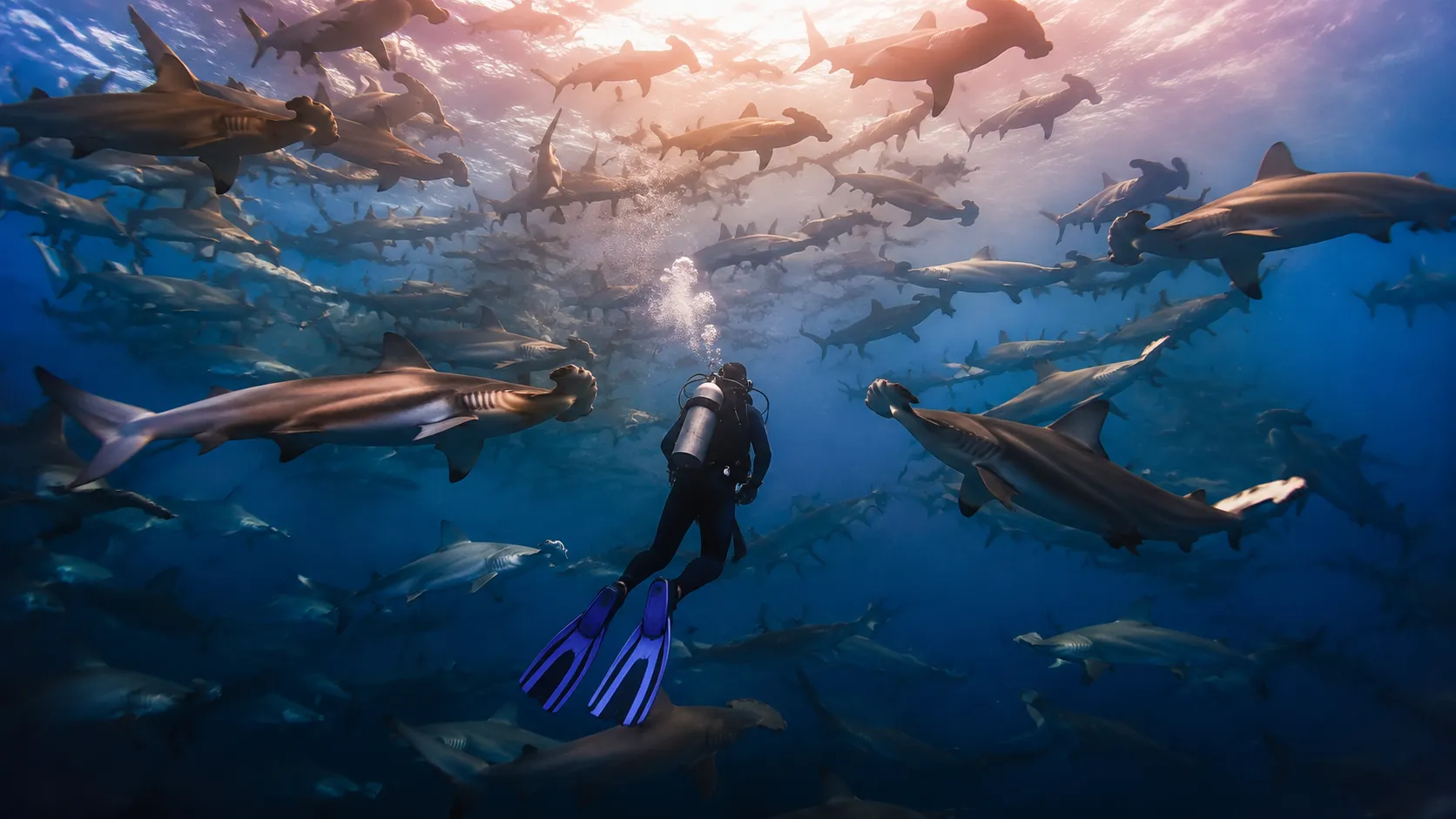
Cocos Island is a 36-hour boat ride from the Costa Rican mainland and a UNESCO World Heritage Site. It is famous for hammerhead schools that can number in the hundreds. Dive conditions involve strong currents, thermoclines, and open-ocean crossings. Most operators require Advanced Open Water, 100+ logged dives, and a recent dive medical. A 10-day liveaboard costs about $5,000 to $7,000 (confirm current rates with the operator).
Chuuk Lagoon, Micronesia
Chuuk Lagoon holds the wreckage of over 60 Japanese ships sunk during Operation Hailstone in February 1944. It is the world’s premier wreck diving destination. Many wrecks sit in 15 to 50 meters of water, with penetration opportunities for trained wreck divers. Visibility is often 20 to 30 meters. A week of diving with accommodation runs about $2,000 to $3,500 (check current pricing with local operators).
Scapa Flow, Scotland
Scapa Flow is where the German High Seas Fleet was scuttled in 1919. Seven major wrecks remain, sitting in cold, dark water at 20 to 45 meters. This is drysuit territory. Visibility is often 5 to 15 meters, and the currents can be fierce. A week of diving with accommodation costs about $800 to $1,500 (verify current rates with local charters).
Best for
- Cocos Island: hammerhead schools and open-ocean action
- Chuuk Lagoon: wreck penetration and history
- Scapa Flow: cold-water wreck diving and drysuit training
Worth considering
- Truk Lagoon for technical wreck certification
- Bikini Atoll for deep wreck diving and history
Which destinations are best for sharks and big pelagics?
If you want sharks, mantas, and whale sharks, these four destinations deliver consistently. They require comfort in current and open water.
Fakarava, French Polynesia
Fakarava’s south pass is a UNESCO Biosphere Reserve and one of the best places on Earth to see grey reef sharks in large numbers. The pass is a drift dive with strong current. Visibility often exceeds 30 meters. A week of diving with accommodation runs about $2,500 to $4,000 (confirm current rates with local operators).
Maldives
The Maldives is one of the most reliable places to see whale sharks and manta rays. Hanifaru Bay in Baa Atoll is a UNESCO Biosphere Reserve where mantas aggregate in large numbers between June and November. A liveaboard week costs about $2,000 to $4,000 (check current pricing with operators).
Galápagos Islands
The Galápagos is the only place where you can dive with hammerheads, whale sharks, and marine iguanas on the same trip. The best season for whale sharks is June to November. A liveaboard week runs about $4,000 to $6,000 (verify current rates and park fees).
Bahamas
Tiger Beach in the Bahamas is famous for tiger shark encounters. The sharks are not fed during dives, but operators use chum to attract them. This is a baited dive, which some divers avoid on ethical grounds. A three-night tiger shark trip costs about $1,500 to $2,500 (confirm current rates with operators).
What are the best places to scuba dive for wrecks?
Wreck divers are a specific breed. They want history, structure, and penetration. These three destinations are the global standouts.
Chuuk Lagoon, Micronesia
Chuuk Lagoon is the world’s best wreck diving destination. The Japanese fleet sunk in 1944 includes battleships, destroyers, submarines, and aircraft. Many wrecks are in recreational depths, but some require technical training. A week of diving with accommodation costs about $2,000 to $3,500 (check current pricing with local operators).
Scapa Flow, Scotland
Scapa Flow is the other great wreck destination. The German High Seas Fleet was scuttled here in 1919. Seven major wrecks remain, including the battleship SMS Markgraf and the light cruiser SMS Karlsruhe. Cold water and a drysuit are required, but the history is unmatched. A week of diving costs about $800 to $1,500 (verify current rates with charters).
Red Sea, Egypt
The SS Thistlegorm is one of the most famous wrecks in the world. It was sunk by German bombers in 1941 and sits in 30 meters of water. The wreck is accessible to advanced open-water divers. A day trip to Thistlegorm from Sharm El Sheikh costs about $100 to $150 (confirm current prices with local operators).
Maya Whitfield’s honest take: “Do not penetrate a wreck without proper training. I have seen certified divers swim into silt-out conditions and panic. Take the wreck specialty course before you book Chuuk or Scapa Flow.”
Where can you scuba dive on a budget?
Diving does not have to cost $5,000 per trip. These three destinations offer world-class diving at prices that will not wreck your savings.
Koh Tao, Thailand
Koh Tao is the cheapest place in the world to get certified and to dive. An open water course costs about $250 to $350 (verify current pricing with local schools). A fun dive trip costs about $30 to $50 (confirm rates with operators). Accommodation starts at $10 per night. The diving is not the best in Thailand, but it is good enough for beginners and budget travelers.
Roatán, Honduras
Roatán offers Caribbean diving at a fraction of the cost of the Bahamas or Cayman Islands. A two-tank boat dive costs about $60 to $90 (check current prices with local shops). Accommodation starts at $20 per night. The reef is healthy, and the shore diving is excellent.
Red Sea, Egypt
The Red Sea is the best value in the world for reef diving. A week of diving with accommodation and meals can cost $700 to $1,500 (confirm current package prices with local dive centers). The reef is pristine, the visibility is excellent, and the wrecks are world-class. The trade-off is that some areas have geopolitical risk, so check your government’s travel advisory before booking.

When is the best time to scuba dive in each destination?
Seasonality matters more than most divers realize. The same destination can be world-class in one month and undiveable in another. Here is the short version for each region.
Caribbean and Atlantic
The Caribbean dry season runs December to April. Visibility is best in March and April. Hurricane season runs June to November, which is also when water temperatures peak. Cozumel and Roatán are diveable year-round, but the best conditions are December to April.
Indo-Pacific
Raja Ampat is best from October to April. Komodo is best from April to December. The Maldives dry season runs November to April, but manta and whale shark sightings peak June to November in Baa Atoll. Thailand’s Similan Islands are only open from October to May due to the monsoon.
Red Sea
The Red Sea is diveable year-round. Water temperature ranges from 22°C in winter to 30°C in summer. Visibility is best in spring and autumn. Summer surface temperatures are extremely hot, so many divers prefer March to May and September to November.
Galápagos and Cocos
The Galápagos is diveable year-round, but the best season for whale sharks and hammerheads is June to November. Cocos Island is best from June to December. Both destinations have strong currents and cold thermoclines, so a 5mm wetsuit or drysuit is recommended.
What certification do you need for each destination?
Certification requirements are not one-size-fits-all. Some destinations will accept an open water certification. Others require advanced open water, 50+ logged dives, or a recent dive medical. Here is the breakdown.
Open water is enough.
Bahamas, Cozumel, Koh Tao, Roatán, and the Great Barrier Reef all have shallow, calm sites suitable for open-water divers. You can book most of these destinations with just an open water certification and a recent dive.
Advanced Open Water required
Raja Ampat, Maldives, Red Sea (for Thistlegorm), and Fakarava require advanced open water for most sites. Some operators also require 50+ logged dives for drift diving and deep sites.
Advanced plus 50 to 100 logged dives
Galápagos, Cocos Island, and Chuuk Lagoon require advanced open water plus 50 to 100 logged dives. Some operators also require a recent dive medical and proof of dive insurance. Check with the specific operator before you book.
Technical certification recommended
Scapa Flow and Bikini Atoll involve depths beyond recreational limits or require decompression diving. Technical certification is recommended for the deepest wrecks. If you are not technically certified, you can still dive the shallower wrecks, but you will miss the best ones.
For more practical travel planning advice, including how to organize dive trips alongside other activities, see the Travel Planning section on WakaAbuja. If you need to sort out entry requirements before booking a liveaboard, the Visa section has country-by-country guidance.
What mistakes should you avoid when choosing a scuba diving destination?
I have made most of these mistakes myself. Learn from my logbook so you do not repeat them.
Booking a destination that exceeds your skill level
Raja Ampat, Galápagos, and Cocos Island are not beginner destinations. If you book them with 20 logged dives, you will spend the trip stressed and cold instead of enjoying the diving. Match the destination to your certification and experience level.
Ignoring seasonality
The Maldives in July is not the same as the Maldives in February. Thailand’s Similan Islands are closed from May to October. The Red Sea is brutally hot in July and August. Check the season before you book, not after.
Underestimating currents
Drift diving is fun until you are separated from your group. Destinations like Fakarava, Cocos, and the Galápagos have strong currents that require experience and a surface marker buoy. If you have never done a drift dive, take a course before you go.
Skipping dive insurance
Standard travel insurance often excludes scuba diving, especially beyond 18 meters. Dive-specific insurance like DAN (Divers Alert Network) covers decompression illness and evacuation. A policy costs about $50 to $150 per trip (confirm current rates on the official DAN site). This is not optional for remote destinations.
Choosing a destination based on price alone
Koh Tao is cheap, but the diving is average. The Red Sea is affordable and world-class. Do not optimize for cost if it means sacrificing the experience you actually want. A $300 difference in trip cost is not worth a week of mediocre diving.
Overlooking local operator quality
Not all dive shops are equal. I have seen operators cut safety corners to save fuel. Read recent reviews on TripAdvisor or Google, ask about group sizes and divemaster ratios, and confirm that the boat has oxygen and a first aid kit on board. If the price seems too good to be true, it usually is.
Forgetting about surface intervals and no-fly times
You cannot fly for 18 to 24 hours after your last dive. If you book a liveaboard that ends the same day as your flight, you will miss the flight or violate the no-fly rule. Build in a buffer day. This is a rule from the Divers Alert Network, not a suggestion.
Frequently asked questions about the best places to scuba dive
What is the cheapest place to scuba dive?
Koh Tao in Thailand is the cheapest place to get certified and to dive, with open water courses around $250 to $350 and fun dives around $30 to $50 (confirm current prices with local schools). Roatán in Honduras is the cheapest Caribbean option, with two-tank boat dives around $60 to $90 (check current rates with operators). The Red Sea offers the best value for world-class reef diving.
What is the best destination for first-time divers?
The Bahamas and Cozumel are the best destinations for first-time divers. Both offer calm, shallow reefs, warm water, and excellent instructor availability. Roatán is also excellent because you can practice from shore before committing to a boat dive. Avoid destinations with strong currents or cold water for your first ocean dives.
Where is the best place to dive with sharks?
Cocos Island in Costa Rica is the best place to dive with hammerhead sharks, with schools that can number in the hundreds. Fakarava in French Polynesia is excellent for grey reef sharks. Tiger Beach in the Bahamas is famous for tiger sharks, though it is a baited dive. The Galápagos offers hammerheads, whale sharks, and reef sharks on the same trip.
How much does a scuba diving trip cost?
Costs range widely based on destination and type. Budget trips to Koh Tao or Roatán cost about $700 to $1,200 for a week, including accommodation and diving (verify current package rates with local operators). Mid-range liveaboards in the Maldives or Red Sea cost about $2,000 to $4,000 (check current rates with operators). Premium trips to Galápagos or Cocos cost about $4,000 to $7,000 (confirm current pricing and park fees).
What certification do I need for the best dive destinations?
It depends on the destination. Open Water is enough for the Bahamas, Cozumel, Koh Tao, and Roatán. Advanced open water is required for Raja Ampat, the Maldives, and the Thistlegorm wreck in the Red Sea. Galápagos, Cocos Island, and Chuuk Lagoon require advanced open water plus 50 to 100 logged dives. Always check with the specific operator before booking.
What is the best time of year to scuba dive?
It depends on the region. The Caribbean is best from December to April. Raja Ampat is best from October to April. The Maldives dry season runs November to April, but manta and whale shark sightings peak June to November in Baa Atoll. The Red Sea is diveable year-round, with the best visibility in spring and autumn. The Galápagos is best June to November for big animals.
Do I need dive insurance?
Yes. Standard travel insurance often excludes scuba diving, especially beyond 18 meters or on liveaboards. DAN (Divers Alert Network) offers dive-specific coverage for decompression illness and evacuation. A policy costs about $50 to $150 per trip (confirm current rates on the official DAN site). This is essential for remote destinations where evacuation is expensive and difficult.
Which is better for diving: liveaboard or land-based?
Liveaboards get you to remote sites that day boats cannot reach. They are better for Raja Ampat, the Maldives, Galápagos, and Cocos. Land-based diving is better for beginners, budget travelers, and anyone who wants to mix diving with other activities. For a first trip, start land-based. For a bucket-list trip, book a liveaboard.
Plan your trip: booking platforms we trust
I do not earn a commission from every link on this page, but I do use these platforms myself. They are the ones I check first when I am planning a dive trip, booking a liveaboard, or comparing flight prices. Each one is genuinely useful at a different stage of planning. For dive destinations, hotels, and travel logistics, WakaAbuja has dedicated categories that go deeper: Hotels, Best Things to Do, Travel Planning, and Visa Guides. For flights, start with WakaAbuja’s flight search before checking the comparison sites below.
Agoda
Best for hotel deals across Asia, including Thailand, Indonesia, and the Philippines.
Booking.com
General hotel search with strong coverage in the Caribbean and Red Sea.
Kayak
Flight price comparison for multi-leg trips to remote dive destinations.
Expedia
Flight and hotel packages for dive trips that combine multiple stops.
GetYourGuide
Tours and activities, including snorkeling and introductory dive experiences.
Vrbo
Family villas and vacation rentals for land-based dive trips.
Hotels.com
Loyalty rewards bookings for divers who travel frequently.
TripAdvisor
Reviews and restaurant finds for dive towns and liveaboard departure points.
WakaAbuja does its best to keep all information accurate at the time of publishing. Prices, policies, and availability change regularly. Always verify with official sources before you travel. We are not liable for errors caused by outdated information. Travel insurance is strongly recommended.