Camping Checklist Printable: The Exact Gear You Need for Every Trip Length
Fact-Checked By: Maya Whitfield—Senior Travel Editor at WakaAbuja
A printable camping checklist should give you exact quantities, not vague ranges. For a 2-day trip, pack 2 pairs of socks, 1 pair of pants, and 6 liters of water per person. For a 5-day trip, pack 5 pairs of socks, 2 pairs of pants, and 15 liters of water per person. Download the free PDF below, no email required, and use the comparison table to adjust for car camping, backpacking, RV, or family trips.
I have stood in a campsite at 10 p.m. realizing I brought a stove but no fuel, and I have also carried a full-size pillow and a cast iron pan on a backpacking trip because I used a generic checklist that did not tell me otherwise. The problem with most printable camping checklists is not that they are missing items.
The problem is that they are missing quantities. This one gives you exact counts, by trip length, so you stop guessing and start packing.
Jump to: How Many Items? | Full Gear List | Camping Type Comparison | Budget Worksheet | Free PDF Download | FAQ
Key takeaways
- Exact quantities beat vague ranges. This checklist tells you how many pairs of socks, liters of water, and fuel canisters to bring.
- Water is the most under-packed item. Plan 3 liters per person per day for drinking and cooking.
- Car camping and backpacking are not the same list. Backpacking cuts the comfort items and adds weight-saving gear.
- A basic kit costs 3,300 to 7,500 SEK to assemble from scratch. Rent the big three first if you are new (confirm the latest price directly with the operator).
- Leave the axe, Dutch oven, and extra tarp at home. Overpacking is the most common first-timer mistake.
- The free PDF is editable. Print it and check boxes, or copy the Google Sheets version to customize it for your trip.
How Many Items Do You Actually Need?
The exact number of items changes with trip length. Here is the quick reference for a solo car camper in mild weather. Adjust up for winter, kids, or pets.
2-day trip
- Socks: 2 pairs per person
- Underwear: 2 pairs per person
- Pants: 1 pair per person
- Shirts: 2 per person
- Water: 6 liters per person
- Fuel: 1 small canister
5-day trip
- Socks: 5 pairs per person
- Underwear: 5 pairs per person
- Pants: 2 pairs per person
- Shirts: 5 per person
- Water: 15 liters per person
- Fuel: 2 canisters or 1 large
Week-long trip
- Socks: 7 pairs per person
- Underwear: 7 pairs per person
- Pants: 3 pairs per person
- Shirts: 7 per person
- Water: 21 liters per person
- Fuel: 2 large canisters
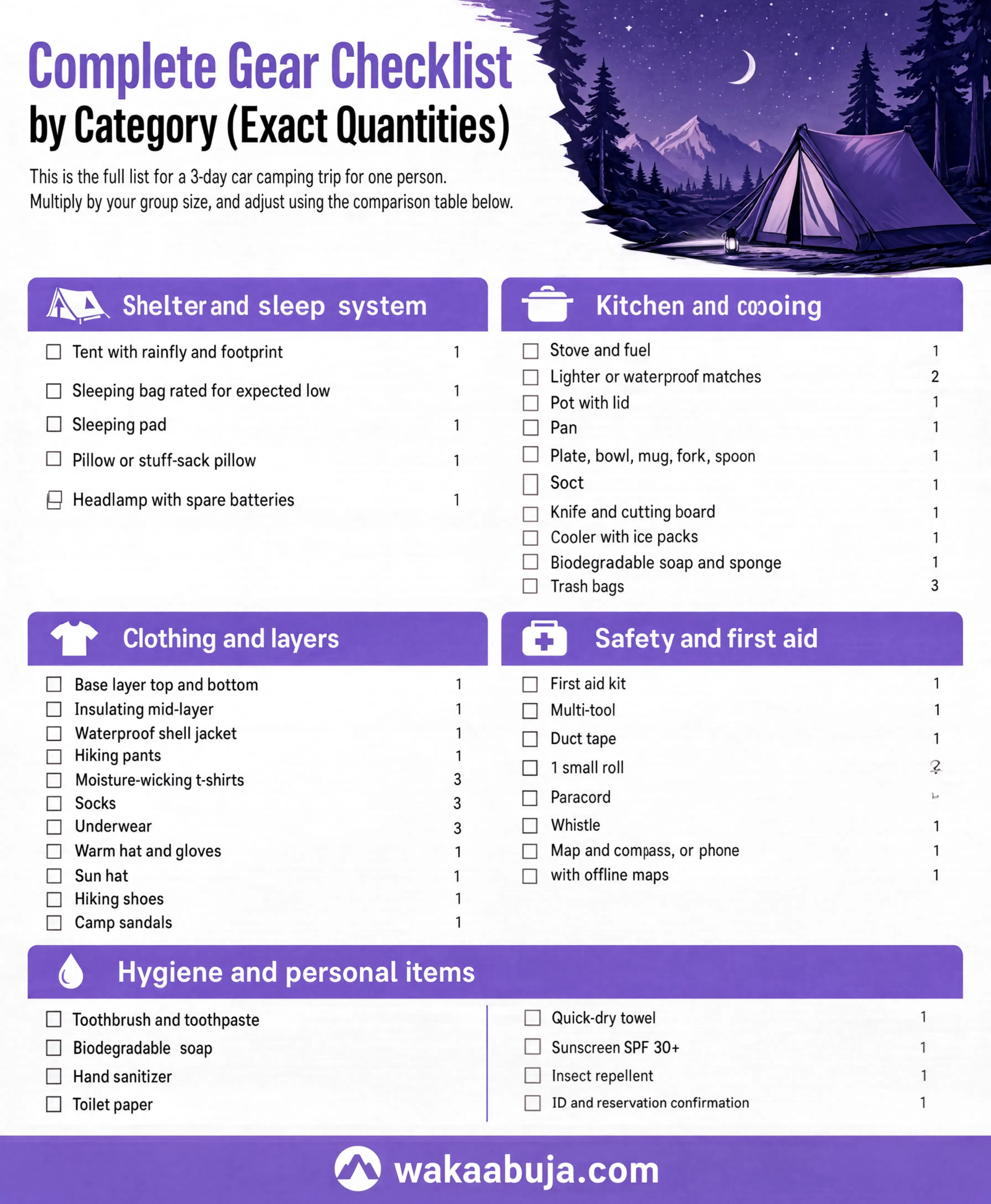
Complete Gear Checklist by Category (Exact Quantities)
This is the full list for a 3-day car camping trip for one person. Multiply by your group size, and adjust using the comparison table below.
Shelter and sleep system
- Tent with rainfly and footprint: 1
- Sleeping bag rated for expected low: 1
- Sleeping pad: 1
- Pillow or stuff-sack pillow: 1
- Headlamp with spare batteries: 1
Kitchen and cooking
- Stove and fuel: 1
- Lighter or waterproof matches: 2
- Pot with lid: 1
- Pan: 1
- Plate, bowl, mug, fork, spoon: 1 set
- Knife and cutting board: 1
- Cooler with ice packs: 1
- Biodegradable soap and sponge: 1
- Trash bags: 3
Clothing and layers
- Base layer top and bottom: 1 set
- Insulating mid-layer: 1
- Waterproof shell jacket: 1
- Hiking pants: 1
- Moisture-wicking t-shirts: 3
- Socks: 3 pairs
- Underwear: 3 pairs
- Warm hat and gloves: 1 set
- Sun hat: 1
- Hiking shoes: 1
- Camp sandals: 1
Safety and first aid
- First aid kit: 1
- Multi-tool: 1
- Duct tape: 1 small roll
- Paracord: 5 meters
- Whistle: 1
- Map and compass, or phone with offline maps: 1
Hygiene and personal items
- Toothbrush and toothpaste: 1
- Biodegradable soap: 1
- Hand sanitizer: 1
- Toilet paper: 1 roll
- Quick-dry towel: 1
- Sunscreen SPF 30+: 1
- Insect repellent: 1
- ID and reservation confirmation: 1
Car Camping vs. Backpacking vs. RV vs. Family: What Changes
The core list stays the same, but the specifics shift a lot. Here is what to add or drop depending on your trip type.
Car camping
Add: cooler, camp chairs, lantern, real pillow, extra tarp.
Drop: Nothing. You have the car; use it.
Backpacking
Add: water filter, ultralight stove, backpacking tent, and bear canister where required.
Drop: Camp chairs, lantern, cooler, extra shoes, full-size pillow.
RV camping
Add: Leveling blocks, sewer hose, water hose, and electrical adapter.
Drop: Tent and sleeping pad if you sleep inside the RV.
Family with kids
Add: Extra clothes, favorite snacks, comfort items, entertainment, and kids’ first aid.
Drop: Fragile gear you do not want sticky fingers on.
Full Budget Worksheet: What a Basic Kit Actually Costs
Here is an itemized worksheet for a basic car camping setup, not just per-category ranges. Prices are approximate and in Swedish kronor (confirm the latest price directly with the operator).
Itemized costs
Tent: 1,000 to 2,500 SEK
Sleeping bag: 800 to 1,500 SEK
Sleeping pad: 500 to 1,200 SEK
Stove: 300 to 800 SEK
Headlamp: 200 to 500 SEK
Kitchen set (pot, pan, utensils): 400 to 800 SEK
First aid kit: 150 to 400 SEK
Total basic kit: 3,350 to 7,700 SEK
If you are not sure you will camp more than twice, rent the tent, sleeping bag, and sleeping pad first. Buying everything before your first trip is the most expensive mistake I see.
Maya Whitfield’s honest take: “I bought a cheap tent, a cheap sleeping bag, and a cheap pad for my first trip. I replaced all three within a year. Buy decent gear once, or rent until you know what you actually need.”
Get the Free Printable Camping Checklist PDF.
No email required. Click below to download the printable PDF, or make a copy of the Google Sheets version to customize it for your trip. The PDF includes checkboxes and the exact quantities from this page.
What Should You NOT Pack?
Overpacking is the most common first-timer mistake. Here is what to leave at home.
- Too many clothes. You will not change as often as you think. Stick to the quantities above.
- An axe or large knife. You do not need to chop wood at most established campsites.
- A Dutch oven or cast iron pan. It is heavy, slow to heat, and hard to clean.
- Extra tarps “just in case.” Your tent has a rainfly. That is enough.
- Full-size pillows. They take up too much room. Use a stuff-sack pillow.
- Bluetooth speakers. Quiet hours exist for a reason. Your neighbors did not come to hear your playlist.
Frequently asked questions about printable camping checklists
Is the printable camping checklist really free?
Yes. The PDF is free to download, and no email address is required. You can print it as many times as you want, and the Google Sheets version is free to copy and edit.
Can I customize the checklist for my trip?
Yes. The Google Sheets version is fully editable. You can add items, remove items, and adjust quantities. The PDF is designed to be printed and checked off by hand if you prefer paper.
How many pairs of socks should I pack for camping?
Pack one pair of socks per day, plus one spare pair in wet conditions. For a 3-day trip, that means 3 pairs in dry weather and 4 to 5 pairs if you expect rain or river crossings.
How much water do I need for a camping trip?
Plan 3 liters of water per person per day for drinking and cooking. For a 3-day trip for one person, that is 9 liters. Bring more if you are hiking in hot weather or have no water source at the site.
What is the difference between car camping and backpacking checklists?
Car camping lets you bring comfort items like chairs, a cooler, and a real pillow. Backpacking cuts those items and adds weight-saving gear like a water filter, ultralight stove, and a smaller tent.
Is there a winter camping checklist?
Yes. For winter trips, add a sleeping bag rated for at least 10 degrees colder than the expected low, a four-season tent, insulated boots, and extra base layers. The exact quantities depend on your trip length.
What should I not bring camping?
Leave the axe, Dutch oven, extra tarps, full-size pillows, and Bluetooth speakers at home. Overpacking is more common than underpacking, and every extra item adds weight and setup time.
Plan your trip: gear and booking resources we trust
These are the platforms I actually use to research and buy camping gear. I always cross-check official gear sites against at least one of these before purchasing.
REI
Best for researching gear specs and reading expert buying guides before you purchase.
Booking.com
Useful for finding cabins or glamping sites near major camping areas.
Expedia
Good for bundling a car rental with a hotel near the campsite for the night before.
GetYourGuide
Best for booking guided camping trips or outdoor experiences if you want a structured first trip.
TripAdvisor
Essential for reading campsite reviews and finding good spots near national parks.
Vrbo
Useful for renting a cabin near a camping area for a mixed indoor-outdoor trip.
WakaAbuja does its best to keep all information accurate at the time of publishing. Prices, policies, and availability change regularly. Always verify with official sources before you travel. We are not liable for errors caused by outdated information. Travel insurance is strongly recommended.