advertisement
Medicine Lake Canada: All You SHOULD Know Before Going (Reviews & Guide)
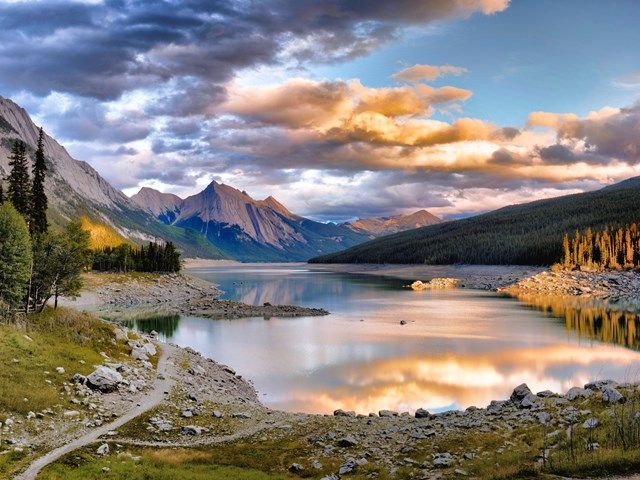
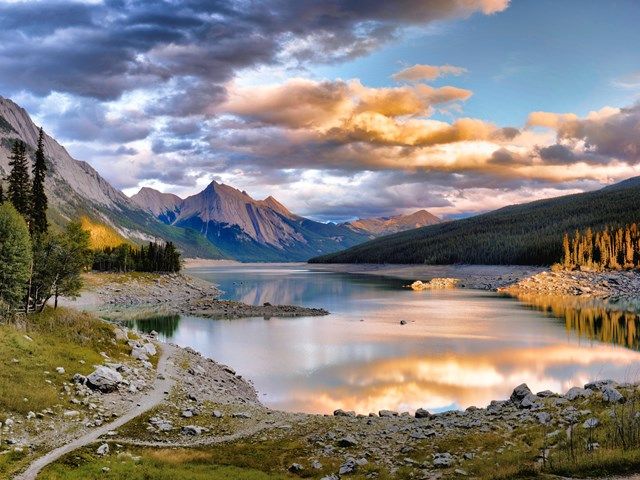
Medicine Lake is not a typical lake. It is a geological phenomenon where an underground cave system drains roughly 24,000 liters of water per second each autumn, leaving a dry mudflat by winter. You will find it 20 kilometers southeast of the Jasper townsite along Maligne Lake Road, but to see it in full, you must visit between June and mid-September.
I first drove up Maligne Lake Road in early October a few years back. I had read about the “disappearing lake” and expected to see water slowly swirling down a visible drain. Instead, I stared at a vast, muddy basin with a tiny stream meandering through the center. A local from Jasper had pulled over beside me and laughed. “You’re about six weeks too late,” he said. “In August, I was kayaking exactly where you are standing.”
That moment reshaped this entire guide. I realized visitors need one place that explains the science, the legend, and the precise timing of this strange lake. You need to know when to go, where to park, and what actually happens to all that water.
Jump to: Quick Facts | Why It Disappears | Seasonal Guide | The Name Origin | 1950s Plug Attempts | Wildlife & Fishing | How to Visit | Maligne Valley Day Trip | FAQs
Key takeaways
- The lake drains like a bathtub each fall through a massive underground karst system, not a surface river.
- Peak water levels occur from June to early September; the lakebed is often completely dry by November.
- The name comes from Indigenous peoples who called it “medicine” because of the powerful, mysterious drainage they could not explain.
- Grizzly bears, moose, caribou, and bald eagles are frequently spotted along the shoreline in spring and summer.
- The water resurfaces 17 kilometers downstream at Maligne Canyon after traveling through the cave network.
- You need a vehicle to access the viewpoint pullouts along Maligne Lake Road; there is no public transit route.
What Is Medicine Lake? Quick Facts
Medicine Lake sits inside Jasper National Park, a 20-minute drive from the Jasper townsite boundary. It is roughly 7 kilometers long and relatively shallow, but its depth fluctuates dramatically by season. It is not a “real” lake in the geological sense because it has no visible outlet. The water instead drains through holes in the limestone bedrock, which are only visible when the water level drops.
Lena’s honest take: “I made the mistake of thinking Medicine Lake was a hiking destination. It is not. It is a roadside stop with a few pullouts. The magic is what you see from the viewing areas, not a trail around the water. Come here for the phenomenon, not the trek.”
At a glance
- Length: ~7 km
- Drive from Jasper: 20–30 minutes
- Best time to visit: Mid-June to early September
- Entry fee: Covered by your Parks Canada pass
Worth knowing
- Washrooms: No permanent facilities at the lake viewpoints; plan accordingly.
- Cell service: Patchy to nonexistent along Maligne Lake Road.
- Road conditions: Fully paved, but watch for wildlife crossing.
Why Does Medicine Lake Disappear Every Year?
The lake is a textbook example of a karst drainage system. Beneath the lakebed, the limestone bedrock is riddled with cracks and sinkholes. When the snow melts in spring and the glacial runoff from Maligne Lake upstream is strong, the water supply overwhelms the drainage capacity, and the basin fills up. By late summer, the incoming flow slows down, but the holes at the bottom keep draining water at a constant rate. Eventually, the lake essentially pulls its own plug.
Researchers conducted a famous dye-tracing experiment in the 1970s to prove where the water went. They poured biodegradable dye into the sinking lake water and waited. The dye reappeared 17 kilometers away in springs at Maligne Canyon, confirming one of the most extensive underground drainage networks known in North America. The current scientific consensus pegs the drainage rate at roughly 24,000 liters per second during the draining phase. That means a full Olympic swimming pool would empty in under two minutes if it shared Medicine Lake’s plumbing.
Chidi from our team’s honest take: “I think the dye experiment is the coolest detail nobody talks about. The fact that scientists colored water, watched it vanish, and then found it days later pouring out of a canyon wall miles away is like something from a detective novel. That is the story you should tell your kids in the car on the drive up.”
When Does Medicine Lake Actually Drain? A Month-by-Month Guide
Timing your visit correctly determines whether you see a pristine blue lake or a muddy grassland. I have driven up in July and seen kayakers, and I have driven up in late September and walked across the cracked mud of the basin floor.
Peak water (June–August)
Glacial melt is at its maximum. The lake looks like a classic Rocky Mountain postcard. This is the only window for kayaking or seeing the shoreline fully submerged. Wildlife is active along the banks.
Draining phase (September–October)
The lake recedes quickly. Mudflats appear, and the stream cuts a narrow channel through the center. You can sometimes see the sinkholes exposed. This is the most dramatic time to witness the phenomenon, but you won’t see a full lake.
Dry lakebed (November–May)
The basin is mostly empty. Snow covers the dry mud. You are looking at a wide, flat meadow. The road is open, but Maligne Lake Road can close during heavy snow. Always check the Parks Canada road report before driving out.
Where Does the Name “Medicine Lake” Come From?
Encyclopedia entries skip this entirely, but the name is key to the lake’s character. Indigenous peoples, particularly the Stoney First Nation, viewed the unexplained drainage as a form of powerful medicine or magic. A body of water that swallowed itself and returned each year defied logic, so the name reflected a spiritual respect for the forces at work. Early European fur traders and surveyors kept the name, and it stuck. When you visit and watch the water level change, you understand why someone would attribute it to something supernatural rather than limestone geology.
For more cultural context on Indigenous place names in the region, the Parks Canada interpretive centre in Jasper provides detailed exhibits that pair well with a visit here.
The 1950s Attempts to Plug the Drain
In the 1950s, frustrated locals decided to try to stop the lake from disappearing. They stuffed old mattresses, newspapers, and logs into the visible sinkholes, hoping to clog the drainage and create a permanent lake. The effort failed completely. The relentless pressure of the water pushed the debris aside within days, and the lake drained as scheduled. It is a charming, almost absurd piece of local history that underscores how indifferent the geology is to human intervention. You cannot plug a 17-kilometre cave system with a newspaper.
If you want to read the hard science on why plugging sinkholes is futile, the foundational hydrogeology reference is Smart’s 1988 paper in the Journal of Hydrology, which maps the underground conduit network that makes this lake behave like a giant seasonal timer.
Wildlife and Fishing at Medicine Lake

The shoreline and surrounding forest function as a wildlife corridor. We have spotted a black bear foraging near the first pullout in late spring, and a moose wading through the shallows during a July morning. Bring binoculars, stay inside your vehicle for close encounters, and never approach wildlife.
Fish species include rainbow trout and brook trout. Anglers must carry a valid national park fishing permit. The best fishing is typically in June and July, before the water levels recede and the fish become concentrated in the narrowing stream channel. Once the lake drains, fishing here is impossible, so check the seasonal water levels before you pack your rod.
Lena’s honest take: “I am not a fisher, but I am a wildlife nerd. The best sighting I ever had was a bald eagle circling over the drained lakebed in late October. With no water, the small mammals were exposed, and the eagle was hunting. It was this raw, quiet scene you miss if you only come in July.”
How to Get to Medicine Lake: Directions, Parking, and Best Viewpoints
From Jasper town centre, drive east on Highway 16 for roughly 3 kilometres and turn right onto Maligne Lake Road. Follow this paved road for about 20 kilometres until you reach the lake. The drive itself winds through forest with occasional mountain views, and you will cross a wildlife gate. Watch for bighorn sheep on the road near the switchbacks.
There is no single “parking lot” for Medicine Lake. Instead, there are multiple gravel pullouts along the road. The two main viewpoints are near the southern end of the lake, roughly 25 kilometres from the turnoff. My favourite spot is the larger pullout with the interpretive panel explaining the drainage. It gives you a wide view of the basin, and in dry months, you can walk down to the lakebed from there. If you need a flight to Edmonton or Calgary to start your Jasper road trip, Kayak consistently finds the best transatlantic connections for our team.
Road trip essentials
- Fill your petrol tank in Jasper before heading out. There is no fuel on Maligne Lake Road.
- Download offline maps. Cell service vanishes a few kilometres past the turnoff.
- Buy a Parks Canada day pass or annual Discovery Pass online in advance.
What to pack
- Bear spray and knowledge of how to use it properly.
- Warm layers even in July; mountain weather shifts fast.
- A telephoto lens or binoculars for wildlife on distant slopes.
Pair It With: A Perfect Maligne Valley Day Trip
Medicine Lake is best experienced as one stop on a longer drive deeper into the Maligne Valley. The lake is the midpoint. We recommend this sequence: start early at Maligne Canyon, where the water that drains from Medicine Lake resurfaces dramatically in a deep limestone gorge. Walk the bridge trails at the top of the canyon. Then drive past Medicine Lake, stopping at the viewpoints we described, and continue all the way to Maligne Lake, the largest glacial lake in Jasper National Park.
At Maligne Lake, you can book a boat cruise to Spirit Island, a world-famous photo location that even non-photographers recognize. For booking boat tours and activities across the Rockies, GetYourGuide lists a range of local operators with verified reviews. For overnight stays, Jasper has limited accommodation, so we book our cabins through Booking.com several months in advance for summer visits. A full Maligne Valley day trip, with the lake as the centrepiece, works perfectly when you accept that you are spending six to eight hours on a single, unforgettable road.
What Are the Most Common Mistakes Visitors Make?
- Arriving in late September expecting a full lake. The water is gone by then. You will see mud. Adjust your expectations or your calendar.
- Assuming there is a hiking loop around the lake. There is no maintained shoreline trail. This is a roadside stop and a drive-up viewpoint experience.
- Ignoring the Maligne Canyon connection. Visiting Medicine Lake without seeing where the water resurfaces is reading half a book. Drive the full valley.
- Leaving food in your vehicle at pullouts. Bears know these stops. A locked car with a sandwich inside is still a target for a determined animal.
- Not checking road closures. Maligne Lake Road can close for avalanche control in winter and late spring. Check the Parks Canada website the morning of your visit.
- Rushing past the interpretive signs. The panels explain the dye-tracing study and the hydrology. Spending five minutes reading them changes how you see the view.
Frequently asked questions
Is Medicine Lake worth visiting when it is dry?
Yes, if you are interested in geology. Walking on the cracked mud of the lakebed in late autumn gives you a close look at the exposed sinkholes and the narrow stream that remains. However, if you want the classic blue-lake photo, a dry visit will disappoint you. Know what you are signing up for.
Can you swim or kayak in Medicine Lake?
You can kayak in peak summer when water levels are high, but there are no formal boat launches. Swimming is possible but the water stays extremely cold due to glacial melt. Most people simply admire it from the viewpoints.
Where exactly does the water from Medicine Lake go?
It travels through an underground cave system for roughly 17 kilometres and resurfaces at Maligne Canyon, downstream from the lake. Dye-tracing studies in the 1970s confirmed this direct underground connection between the lake and the canyon springs.
What is the best time of day to visit Medicine Lake?
Early morning offers the calmest water for reflections and the best wildlife spotting. Afternoons are busier with tour groups. Sunset in July can cast a golden light across the full lake basin, but by late summer the sun drops behind the mountains earlier.
Do I need a park pass to see Medicine Lake?
Yes. You need a valid Parks Canada pass because Medicine Lake sits inside Jasper National Park. You can buy a day pass or an annual Discovery Pass at the park gates, in the Jasper information centre, or online. Have it displayed on your dashboard.
How long should I spend at Medicine Lake?
Plan for a 20 to 30 minute stop. You can walk to the viewpoint, read the interpretive signs, and take photos. There is no full hiking trail, so it is a shorter stop compared to Maligne Canyon or Maligne Lake at either end of the road.
Plan your Jasper trip: resources we use
Our team books all our Canadian Rockies road trips through a handful of platforms we trust for transparent pricing and solid cancellation policies. A flexible booking is key, because mountain weather can scramble even the best-laid itinerary.
Our go-to for Jasper cabins and lodges.
Bundles flights and SUV rentals well.
Tracks flight price drops for Edmonton.
Books Maligne Lake boat tours easily.
Recent wildlife sighting reports from other travellers.
Family-sized chalets with full kitchens.