
advertisement
Airline carry-on luggage sizes can make or break a smooth boarding experience, so check the dimensions and weight limits before you head to the airport.
Fact-Checked By: Maya Whitfield—Senior Travel Editor at WakaAbuja
Most US airlines cap carry-on luggage at 22 x 14 x 9 inches (56 x 36 x 23 cm), including wheels and handles. Weight limits typically do not apply on legacy US carriers, but Frontier, Hawaiian, and many international airlines do enforce weight caps of 15 to 22 pounds (confirm the latest rules directly with the airline). The single biggest reason a compliant-looking bag gets gate-checked is that the advertised size does not include the wheels and handles.
I watched a traveler at a Denver gate spend eight minutes arguing that her bag was “carry-on size” while the sizer told a different story. The bag was labeled 22 x 14 x 9. The actual outside measurement was 23.5 x 15 x 10 once the wheels and telescoping handle were counted.
That half-inch over is enough to get you flagged. This guide gives you the real dimensions by airline, the measuring mistake that causes most gate checks, and what to do if your bag fails at the counter.
Jump to: The Quick Answer | How Airlines Measure | Size by Airline | The IATA Optimal Size | Carry-On vs. Personal Item | Weight Limits | If Your Bag Fails | FAQ
Key takeaways
- 22 x 14 x 9 inches is the standard carry-on limit for most US airlines. That is 45 linear inches (confirm the latest rules directly with the airline).
- Wheels and handles count. A bag marketed as 22 inches is often 23 to 24 inches when measured outside.
- Weight limits are the hidden trap. Frontier, Hawaiian, and many international carriers cap carry-ons at 15 to 22 pounds.
- Basic economy changes everything. On some fares you get a personal item only, no carry-on at all.
- The IATA “optimal” size is 21.5 x 13.5 x 7.5 inches. A bag at that size works on almost every airline worldwide.
- Gate-check fees run $65 to $100 on US legacy carriers if your bag fails at the gate (confirm the latest rules directly with the airline).
What Is the Standard Carry-On Size?
The standard carry-on size for most US airlines is 22 x 14 x 9 inches, which is 45 linear inches. In metric, that is 56 x 36 x 23 centimeters. This is the outside dimension, including wheels, handles, and any external pockets. Most bags sold as “carry-on” are built to this exact spec.
But the standard is not universal. Southwest allows slightly larger bags. Frontier and Allegiant allow slightly smaller ones. International carriers like Ryanair, easyJet, and Air France use metric dimensions that often do not match the US standard. If you fly on more than one airline in a single trip, you have to comply with the strictest one.

How Do Airlines Actually Measure Your Bag?
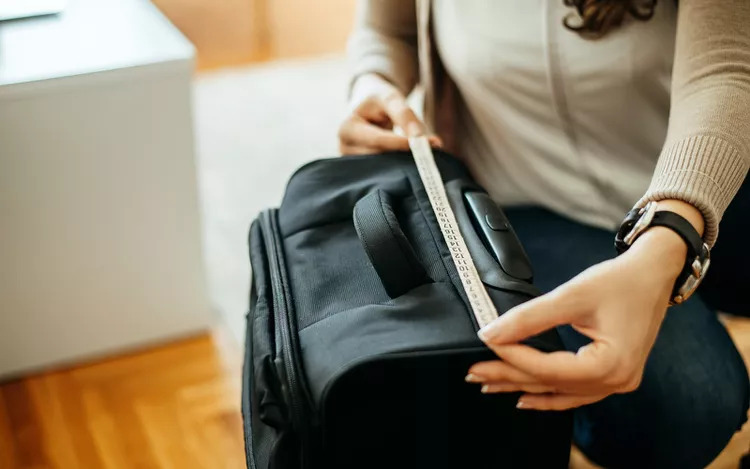
This is where most travelers get tripped up. Airlines measure the outside of the bag, not the internal compartment. That means every wheel, every handle, every external pocket, and every compression strap counts toward the total. A bag advertised as 22 x 14 x 9 might measure 23.5 x 15 x 10 once you account for those exterior features.
At the gate, the agent uses a metal sizer bin. If your bag does not slide in easily without force, it goes to the hold. I have seen soft-sided bags squeak through when overstuffed but compressed, and hard-shell bags fail even when technically at the limit because the shell does not give. The bin is the final word, not the spec sheet.
Maya Whitfield’s honest take: “Measure your bag yourself at home with a tape measure, outside, wheels included. If it is over 22 inches, do not fly Basic Economy with it. You will pay more at the gate than you would have for a checked bag.”
Carry-On Size by Airline
Here are the current carry-on dimensions for the major US airlines and the international carriers most travelers encounter. All dimensions are outside measurements in inches, including wheels and handles. Always confirm on the airline’s own site before you fly, since policies change without notice (confirm the latest rules directly with the airline).
American Airlines
Size: 22 x 14 x 9 in.
Weight: No limit on domestic carry-ons
Personal item: 18 x 14 x 8 in
Delta Air Lines
Size: 22 x 14 x 9 in.
Weight: No limit on domestic carry-ons
Personal item: Fits under seat, no fixed size
United Airlines
Size: 22 x 14 x 9 in.
Weight: No limit on domestic carry-ons
Personal item: 17 x 10 x 9 in
Southwest Airlines
Size: 24 x 16 x 10 in.
Weight: No limit
Personal item: 18.5 x 13.5 x 8.5 in
JetBlue
Size: 22 x 14 x 9 in.
Weight: No limit on most fares
Personal item: 17 x 13 x 8 in
Alaska Airlines
Size: 22 x 14 x 9 in.
Weight: No limit
Personal item: 15 x 11 x 6 in
Frontier Airlines
Size: 24 x 16 x 10 in for carry-on
Weight: 35 lb limit enforced
Personal item: 8 x 18 x 14 in., must fit under seat
Hawaiian Airlines
Size: 22 x 14 x 9 in.
Weight: 25 lb limit on carry-on
Personal item: 18 x 14 x 8 in
Allegiant Air
Size: 22 x 14 x 9 in.
Weight: No published limit
Personal item: 7 x 15 x 16 in
Ryanair (Europe)
Size: 21.6 x 15.7 x 7.8 in
Weight: 22 lb limit
Personal item: 15.7 x 9.8 x 7.8 in, free
easyJet (Europe)
Size: 22 x 17.7 x 9.8 in
Weight: 33 lb limit
Personal item: 17.7 x 14.2 x 7.9 in
Air France (International)
Size: 21.7 x 13.8 x 9.9 in.
Weight: 26 lb limit in economy
Personal item: 15.7 x 11.8 x 5.9 in
Note: Spirit Airlines ceased operations in 2026. Any size chart still listing Spirit as an active carrier is out of date. If you are holding a Spirit ticket, contact the issuing agency for rebooking.
What Is the IATA “Optimal” Carry-On Size?
The International Air Transport Association (IATA) recommends a smaller “optimal” carry-on size of 21.5 x 13.5 x 7.5 inches (55 x 35 x 20 cm). This is not a rule. It is a recommendation for bag manufacturers and airlines to standardize around so that a single bag can work on almost every airline worldwide.
If you fly frequently on different carriers, especially in Europe and Asia, buying a bag at the IATA optimal size is the smartest choice. It will fit in almost every overhead bin and pass almost every sizer. The trade-off is less packing space. I travel for a week in an IATA-size bag, and it works fine if you pack light and use packing cubes. For more packing strategies, see our travel planning guides.
Carry-On vs. Personal Item: Where Is the Line?
A carry-on goes in the overhead bin. A personal item goes under the seat in front of you. Personal items are usually smaller, around 17 x 10 x 9 inches on most US carriers. On Basic Economy fares, many airlines only allow a personal item, and you will pay extra for a carry-on.
The line gets confusing because some airlines, like Southwest, use the terms interchangeably in their marketing. The rule of thumb: if it has wheels and a telescoping handle, it is a carry-on. If it is a purse, a briefcase, a small backpack, or a laptop bag, it is a personal item. A duffel bag is a gray area and usually depends on whether it fits under the seat.
If you are traveling on a basic economy fare and need both, budget for the carry-on fee. On most US airlines that run $30 to $40 each way (confirm the latest rules directly with the airline), which is often less than a gate-check fee.
Which Airlines Enforce Carry-On Weight Limits?
Most US legacy carriers do not weigh carry-on bags. This is a genuine difference from European and Asian airlines, where carry-on weight limits are strictly enforced at check-in and at the gate.
Airlines that do enforce carry-on weight limits include Hawaiian (25 pounds), Frontier (35 pounds), Ryanair (22 pounds), easyJet (33 pounds), and Air France (26 pounds in economy) (confirm the latest rules directly with the airline). If you fly any of these, pack with a portable luggage scale. I have watched travelers at a Ryanair gate repack their bags into their jacket pockets to avoid a 60 euro overweight fee. That is not a fun way to start a holiday.
What Happens If Your Bag Does Not Fit the Sizer?
If your bag does not fit in the sizer at the gate, the agent will gate-check it. That means it goes into the hold, and you retrieve it at the jet bridge when you land. It is annoying but rarely a disaster. The cost is what hurts.
Gate-check fees by airline
American Airlines: $65 to $100 at the gate (confirm the latest rules directly with the airline)
Delta Air Lines: $65 at the gate
United Airlines: $65 to $100 at the gate
Frontier: $79 to $99 at the gate
Allegiant: $50 to $75 at the gate
If you know in advance your bag might fail, buy the carry-on fee at check-in or online before you reach the gate. Pre-purchasing runs $30 to $50 on most carriers, which is often half the gate price. If your bag is genuinely borderline, packing cubes and compressing soft items can help it slide through the sizer. Hard-shell bags do not have that flexibility.
What Are the Most Common Carry-On Mistakes?
- Trusting the advertised size. Measure the outside of your bag yourself, wheels included, before you fly.
- Flying basic economy with a carry-on. On most US carriers, Basic Economy is a personal item only. Read the fare rules before you book.
- Assuming weight does not matter. Frontier, Hawaiian, and most international carriers weigh carry-ons. A portable scale costs about $15 (confirm the latest price directly with the airline).
- Overstuffing a soft bag. If it bulges, it will not fit the sizer even if the empty dimensions are compliant.
- Forgetting the second leg of a multi-airline trip. Comply with the strictest airline’s rules, not the first one.
- Not buying the fee in advance. Pre-purchasing a carry-on online is almost always cheaper than paying at the gate.
- Assuming the sizer is optional. It is not. The gate agent can force a check even if your bag technically fits the bin in the cabin.
Frequently asked questions about carry-on luggage sizes
What is the standard carry-on size for US airlines?
The standard carry-on size for most US airlines is 22 x 14 x 9 inches, including wheels and handles. That is 45 linear inches, or 56 x 36 x 23 centimeters in metric. Southwest and Frontier allow slightly larger bags, and Allegiant allows slightly smaller ones.
Do carry-on wheels and handles count toward the size limit?
Yes. Airlines measure the outside of the bag, including wheels, handles, and external pockets. This is the single most common reason a bag labeled as “carry-on size” fails at the gate.
Do airlines weigh carry-on luggage?
Most US legacy carriers do not weigh carry-on bags. Frontier, Hawaiian, Ryanair, easyJet, and Air France do enforce weight limits, typically 22 to 35 pounds (confirm the latest rules directly with the airline). Bring a portable luggage scale if you are flying any of these.
What is the IATA optimal carry-on size?
The IATA recommends 21.5 x 13.5 x 7.5 inches as the optimal carry-on size. It is a guideline, not a rule, but a bag at that size fits almost every airline worldwide. It is the smartest choice if you fly on multiple carriers in one trip.
How much does it cost if my carry-on gets gate-checked?
Gate-check fees on US airlines run $65 to $100 (confirm the latest rules directly with the airline). Buying the fee online or at check-in before you reach the gate usually costs $30 to $50, which is significantly less.
Is a backpack a carry-on or a personal item?
It depends on size. A small backpack fits under the seat and counts as a personal item. A large hiking backpack or a backpack with a frame counts as a carry-on and must fit the 22 x 14 x 9 inch limit. Check the airline’s specific size chart.
Can I bring a carry-on on a basic economy ticket?
On most US airlines, Basic Economy only includes a personal item, not a carry-on. You will pay $30 to $50 each way for a carry-on (confirm the latest rules directly with the airline). Read the fare rules carefully before booking.
Plan your trip: booking platforms we trust
Once you have confirmed your carry-on dimensions, these are the platforms I use to book flights and hotels. I always compare the airline’s own site against at least one of these before paying, and I always read the fare rules before I commit to Basic Economy.
Kayak
Best for comparing flight prices and filtering by carry-on allowances.
Expedia
Useful for bundling flights and hotels into one booking.
Booking.com
Reliable for hotels with free cancellation if your travel plans change.
Agoda
Best for hotel deals across Asia and the Middle East.
GetYourGuide
Good for booking airport transfers and tours at your destination.
TripAdvisor
Essential for reading hotel reviews and finding restaurants.
For more planning resources, see our travel planning guides, our hotel reviews, and our things to do section. Ready to book? Start with our discounted flights page.
WakaAbuja does its best to keep all information accurate at the time of publishing. Prices, policies, and availability change regularly. Always verify with official sources before you travel. We are not liable for errors caused by outdated information. Travel insurance is strongly recommended.