advertisement
Best Beaches in Greece: 25 Picks Ranked by Sand, Crowds, and Cost
Elafonisi in Crete and Balos Lagoon are the two most photographed beaches in Greece, but the best beach for your trip depends on your island, your budget, and how many people you can tolerate. Crete, Naxos, Milos, and Paros offer the strongest combination of sand quality, facilities, and ferry access. Lounger and umbrella sets at organized beaches typically run 10 to 30 euros per set (confirm current prices with the beach operator), while free public beaches are everywhere if you carry your own gear. The Meltemi wind blows hardest in July and August across the Cyclades, which matters more than most guides admit.
Greece has roughly 6,000 islands and islets, and about 230 of them are inhabited. That number matters because “best beach in Greece” is not one answer. It is a question about which island you are on, what month you are traveling, and whether you want a beach club with a waiter or a cove you reach by hiking fifteen minutes.
I have spent four summers beach-hopping across the Cyclades and the Ionian, and the beaches I return to are never the ones at the top of a generic list. This guide ranks 25 by sand type, crowd level, and real cost.
Jump to: At a Glance | Crete | Cyclades | Ionian | Mainland and Halkidiki | Wind and Meltemi | Best Time | FAQ
Key takeaways
- Elafonisi and Balos in Crete are the most famous beaches in Greece, but both get punishingly crowded in July and August.
- Lounger and umbrella sets at organized beaches run roughly 10 to 30 euros per set (confirm current prices with the beach operator).
- Free public beaches exist on every island. The trade-off is carrying your own umbrella, water, and shade.
- The Meltemi wind blows hardest across the Cyclades in July and August. It creates dramatic scenery and genuinely uncomfortable beach days.
- Crete, Naxos, Milos, and Paros offer the best combination of sand quality, facilities, and ferry access for a multi-island trip.
- Pebble beaches dominate the Ionian and parts of the Cyclades. Water shoes are worth packing.
- Ferry costs between islands typically run 20 to 60 euros per leg depending on distance and vessel type (check current fares with the ferry operator).
Which Greek beach is right for you? Compare the top 25 at a glance.
Most Greek beach guides make you read thousands of words before you know whether a beach is sandy or pebbly, crowded or quiet, or reachable without a car. This one starts with the comparison. I built it after watching a friend book a two-week trip to Mykonos, expecting quiet coves and finding beach clubs with minimum spending instead.
Best for families
- Elafonisi, Crete (shallow lagoon)
- Plaka, Naxos (long, shallow sand)
- Agios Prokopios, Naxos (organized and calm)
Best for scenery
- Balos Lagoon, Crete
- Sarakiniko, Milos (white rock)
- Myrtos, Kefalonia
Best for quiet
- Vroulidia, Sifnos
- Lia, Mykonos (off-season)
- Kleftiko, Milos (boat access only)
Best without a car
- Kokkari, Samos (bus from town)
- Agia Anna, Naxos (bus from Naxos Town)
- Faliraki, Rhodes (bus from Rhodes Town)
The best beaches in Crete
Crete is the largest Greek island and the one with the widest range of beaches. It has pink sand, white sand, pebble coves, and organized resort beaches all within a few hours of each other. If you can only visit one island for beaches, this is the one.
Elafonisi Beach
Elafonisi is the beach you have seen in photos, with pink-tinted sand and a shallow lagoon that makes the water look impossibly clear. It sits at the southwestern tip of Crete, about 75 kilometers from Chania. The pink color comes from crushed shells and corals mixed into the sand, and it is most visible in the wet sand near the waterline.
Sand and facilities: Fine sand, shallow lagoon, organized section with loungers and umbrellas, plus a large free public area.
Getting there: Driving from Chania takes about 1.5 hours, or take a bus from Chania, roughly 15 to 25 euros round trip (confirm current fares with the operator).
Cost: Lounger and umbrella sets run about 10 to 20 euros (check current prices on arrival).
Crowd level and timing: Very crowded from late June through August. Arrive before 10 AM or after 4 PM. May, early June, and September are far better.
Balos Lagoon
Balos is the most dramatic beach in Crete and arguably in Greece. The lagoon sits at the northwestern tip of the island, with white sand, shallow turquoise water, and a rocky peninsula you can walk out onto. The downside is access. You either take a boat from Kissamos or drive a rough dirt road to a parking area, then hike down.
Sand and facilities: White sand, very shallow lagoon, minimal natural shade. A small canteen operates at the top of the trail in summer.
Getting there: Boat from Kissamos port, roughly 27 to 35 euros round trip (confirm current fares with the boat operator). The drive-and-hike option is free, but the road is rough.
Cost: Boat tour 27 to 35 euros. No lounger rental at the lagoon itself.
Crowd level and timing: Extremely crowded when the boat tours arrive mid-morning. Go on the earliest boat or stay past 3 PM when the tours leave.
Falassarna Beach
Falassarna is a long, wide sandy beach on the west coast of Crete, about an hour from Chania. It is the best beach on the island for a full day of swimming without the crowds of Elafonisi or the access hassle of Balos. The sunsets here are excellent.
Sand and facilities: Fine golden sand, organized sections with loungers, and tavernas along the shore.
Getting there: Drive from Chania for about 1 hour. Buses run in summer, roughly 10 to 15 euros (check current fares).
Cost: Lounger sets 8 to 15 euros (confirm current prices on arrival).
Crowd level and timing: Busy in July and August but far less than Elafonisi. Best in June and September.
Vai Beach
Vai is famous for the palm forest that backs onto the beach, the only native palm forest in Europe. It sits at the far eastern tip of Crete. The beach itself is sandy and organized, and the palm forest makes it genuinely different from anything else on the island.
Sand and facilities: Sand, organized with loungers, tavernas, and a parking area.
Getting there: Drive from Sitia about 30 minutes, or from Agios Nikolaos about 1.5 hours.
Cost: Lounger sets 8 to 12 euros (check current prices). Parking free.
Crowd level and timing: Busy in peak season. Best in the morning before tour buses arrive.
Preveli Beach
Preveli sits at the mouth of the Kourtaliotiko Gorge, with a river running into the sea and a palm forest along the bank. It is one of the most photogenic beaches in Crete and one of the few where you can swim in fresh water and salt water on the same day.
Sand and facilities: Sand and pebbles, organized section, canteen and taverna.
Getting there: Drive from Rethymno about 40 minutes, then descend a long staircase or take a boat from Plakias.
Cost: Lounger sets 8 to 12 euros. Boat from Plakias 10 to 15 euros (confirm current fares).
Crowd level and timing: Moderate crowds. Best in the morning or late afternoon.
The best beaches in the Cyclades
The Cyclades are the island group most travelers picture when they think of Greece: white buildings, blue domes, and rocky coastlines. The beaches here are a mix of sand and pebble, and the Meltemi wind dominates the summer. Naxos, Paros, Milos, and Mykonos have the strongest beach scenes, with Ios, Sifnos, and Antiparos offering quieter alternatives.
Plaka Beach, Naxos
Plaka is the longest beach on Naxos, a wide stretch of golden sand that runs for kilometers. The northern end is organized with loungers and tavernas, and the southern end is wild and free. It is the best all-round beach in the Cyclades for families and long-stay travelers.
Sand and facilities: Fine golden sand, organized sections, tavernas, and water sports.
Getting there: Bus from Naxos Town, roughly 2 euros each way, or drive 15 minutes.
Cost: Lounger sets 10 to 20 euros (confirm current prices on arrival).
Crowd level and timing: Crowded in the organized northern section in August. The southern end stays quiet.
Agios Prokopios, Naxos
Agios Prokopios is the most organized beach on Naxos and the easiest to reach from town. The sand is fine, the water is calm, and there are restaurants and hotels right on the beach. This is the beach I recommend to families who want convenience over solitude.
Sand and facilities: Fine sand, fully organized, restaurants and hotels along the shore.
Getting there: Bus from Naxos Town, about 10 minutes, roughly 2 euros (check current fares).
Cost: Lounger sets are 10 to 18 euros (confirm current prices).
Crowd level and timing: Busy throughout summer. Best early morning.
Sarakiniko, Milos
Sarakiniko is not a beach in the traditional sense. It is a moonscape of white volcanic rock that slopes into turquoise water, with no sand at all. It is the most photographed spot on Milos and one of the most distinctive coastlines in Greece.
Sand and facilities: No sand. Smooth white rock. No facilities, no shade, no loungers.
Getting there: Drive from Adamas for about 10 minutes, or take a bus in summer.
Cost: Free.
Crowd level and timing: Very crowded at sunset. Best early morning for both light and space. Bring water and sun protection, as there is no shade.
Kleftiko, Milos
Kleftiko is a cluster of white rock formations and sea caves on the south coast of Milos, reachable only by boat. It is the best snorkeling spot in the Cyclades, and the water is the clearest I have seen anywhere in Greece.
Sand and facilities: No beach in the traditional sense. Rock platforms and caves. No facilities.
Getting there: Boat tour from Adamas or Pollonia, roughly 60 to 100 euros per person (confirm current prices with the tour operator).
Cost: Boat tour 60 to 100 euros.
Crowd level and timing: Busy midday when the tour boats converge. Best on a smaller boat that arrives earlier.
Paradise Beach, Mykonos
Paradise is the most famous party beach in Greece, with beach clubs, loud music, and a crowd that peaks in the afternoon. If that is what you want, it delivers. If it is not, stay away.
Sand and facilities: Sand, fully organized, beach clubs, restaurants, water sports.
Getting there: Bus from Mykonos Town, roughly 2 to 3 euros, or drive 15 minutes.
Cost: Lounger sets 20 to 50 euros depending on proximity to the club (confirm current prices). Some clubs have minimum spends.
Crowd level and timing: Extremely crowded in July and August. Best in June or September.
Elia Beach, Mykonos
Elia is the quieter alternative to Paradise and Super Paradise. It is a long sandy beach with organized sections and a more relaxed atmosphere. It is also popular with nudists at the far end.
Sand and facilities: Sand, organized, tavernas, loungers.
Getting there: Bus from Mykonos Town, roughly 2 to 3 euros, or drive 20 minutes.
Cost: Lounger sets 15 to 30 euros (check current prices).
Crowd level and timing: Busy but not overwhelming. Best early morning.
Kolymbithres, Paros
Kolymbithres is a beach of smooth granite rock formations and small sandy coves on the north coast of Paros. The water is calm and shallow, and the rock formations create natural privacy. It is one of the best beaches in the Cyclades for families with young children.
Sand and facilities: Small sand coves between granite rocks. Organized with loungers and a taverna.
Getting there: Drive from Parikia about 15 minutes, or take a boat from Naoussa.
Cost: Lounger sets 10 to 20 euros (confirm current prices).
Crowd level and timing: Busy in August. Best in June and September.
Vroulidia, Sifnos
Vroulidia is the quiet beach on this list. It sits on the south coast of Sifnos, reachable by a winding road, with a small taverna and a handful of loungers. There is nothing else there, and that is the point.
Sand and facilities: Sand and pebbles. One taverna, limited loungers.
Getting there: Drive from Apollonia about 20 minutes. No bus service.
Cost: Lounger sets 8 to 12 euros (check current prices).
Crowd level and timing: Quiet even in August. Best for a full day of doing nothing.
The best beaches in the Ionian islands
The Ionian islands sit off the west coast of mainland Greece, and they have a different character from the Cyclades. The water is calmer, the vegetation is greener, and the beaches are a mix of white pebbles and sand. The Meltemi wind is much weaker here, which makes the Ionian the better choice if you want calm water in July and August.
Myrtos Beach, Kefalonia
Myrtos is the most famous beach in Kefalonia and one of the most photographed in Greece. It is a long curve of white pebble backed by steep cliffs, with deep blue water that shifts color through the day. The view from the road above is the shot everyone takes.
Sand and facilities: White pebble, not sand. Organized with loungers and umbrellas, two tavernas at the top of the access road.
Getting there: Drive from Argostoli about 40 minutes. No direct bus service.
Cost: Lounger sets 10 to 15 euros (confirm current prices).
Crowd level and timing: Very crowded in August. Best in the morning before the tour buses arrive.
Navagio Beach, Zakynthos
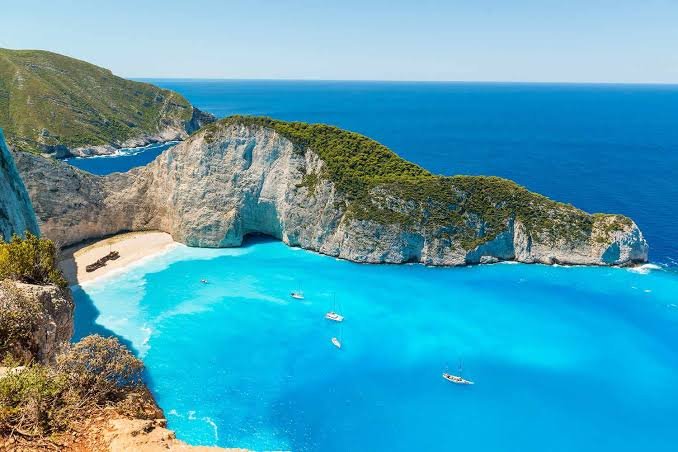
Navagio is the shipwreck beach, and it is one of the most recognizable coastlines in the world. A rusted freighter sits on white pebbles between limestone cliffs, and the water is a deep electric blue. You reach it by boat, and you cannot stay long.
Sand and facilities: White pebble. No facilities on the beach. Boats anchor offshore.
Getting there: Boat tour from Zakynthos Town or Agios Nikolaos, roughly 20 to 30 euros per person (confirm current prices with the operator).
Cost: Boat tour 20 to 30 euros.
Crowd level and timing: Extremely crowded. Go on the earliest boat. The beach is sometimes closed due to cliff collapse risk.
Porto Katsiki, Lefkada
Porto Katsiki is a dramatic beach at the base of towering white cliffs, with turquoise water and white pebbles. The access is via a steep staircase, which keeps some people away and keeps the beach less crowded than Myrtos.
Sand and facilities: White pebble. Organized with loungers, one taverna at the top.
Getting there: Drive from Lefkada Town about 45 minutes, then descend a long staircase.
Cost: Lounger sets 10 to 15 euros (check current prices).
Crowd level and timing: Busy in August. The staircase makes it quieter than the road-accessible beaches.
The best beaches on the Greek mainland and Halkidiki
Most Greek beach guides ignore the mainland entirely, which is a mistake. The Peloponnese and Halkidiki have genuinely excellent beaches, and they are easier to reach from Athens than most islands.
Voidokilia, Peloponnese
Voidokilia is a perfect omega-shaped lagoon on the Messinian coast, backed by sand dunes and a nature reserve. It is one of the best beaches in mainland Greece and almost unknown to international travelers.
Sand and facilities: Fine sand, shallow lagoon, no facilities.
Getting there: Drive from Pylos about 15 minutes, or from Kalamata about 1 hour.
Cost: Free.
Crowd level and timing: Quiet. Best in June and September.
Kalogria, Peloponnese
Kalogria is a long sandy beach on the northwest coast of the Peloponnese, backed by a pine forest and a protected wetland. It is one of the best beaches in Greece for a full day of swimming and walking.
Sand and facilities: Sand, partially organized, tavernas nearby.
Getting there: Drive from Patras about 45 minutes.
Cost: Lounger sets 8 to 12 euros (confirm current prices).
Crowd level and timing: Moderate. Best in June and September.
Sani Beach, Halkidiki
Sani is a long sandy beach on the Kassandra peninsula in Halkidiki, with shallow water and a marina at one end. It is one of the most popular beaches in northern Greece and a good base for a family holiday.
Sand and facilities: Fine sand, fully organized, restaurants and marina.
Getting there: Drive from Thessaloniki about 1 hour.
Cost: Lounger sets 10 to 20 euros (check current prices).
Crowd level and timing: Busy in July and August. Best in June and September.
What is the Meltemi wind, and how does it affect Greek beaches?
The Meltemi is the dominant summer wind in the Aegean, blowing from the north across the Cyclades from roughly June through September. It is the single most important planning fact about Greek beaches that most guides skip.
On a moderate day, the Meltemi keeps temperatures bearable and clears the haze. On a strong day, it whips sand across the beach, makes umbrellas dangerous, and turns the water choppy on the north-facing coasts. Ferries get delayed. Beach days get ruined.
The practical rule I follow is simple. If the Meltemi is forecast strong, go to the south or west coast of whichever island you are on. The wind is weakest there. On Milos, that means the south coast beaches. On Naxos, it means the western beaches. On Mykonos, it means the southern beaches. The Ionian islands are largely sheltered from the Meltemi, which is a real advantage in July and August.
Check the wind forecast the night before a beach day. It takes two minutes and saves a lot of frustration.
When is the best time to visit Greece’s beaches?
The best months are late May, June, and September. The water is warm, the beaches are not at their peak crowd levels, and the Meltemi is milder. July and August are the busiest and hottest months, with the strongest winds and the highest prices.
May to early June
Warm enough to swim, quiet beaches, good prices. Water can still be cool in early May.
Mid-June to mid-July
The sweet spot. Warm water, manageable crowds, Meltemi still building.
Late July to August
Peak season. Hottest, most crowded, strongest Meltemi, highest prices. Book everything months ahead.
September to early October
The best month of the year for Greek beaches. Warm water, fewer crowds, lower prices.
What are the biggest mistakes people make at Greek beaches?
I have made most of these, and I have watched other travelers make the rest. The pattern is usually the same: not planning around the wind, not budgeting for loungers, and not bringing the right shoes.
Ignoring the Meltemi forecast
This is the single biggest mistake. A strong Meltemi day on the wrong coast is a wasted beach day. Check the forecast and pick your coast accordingly.
Not budgeting for lounger and umbrella sets
Greece does not have free beach chairs. Lounger sets run 10 to 30 euros, and some beach clubs on Mykonos charge far more with minimum spends. Budget accordingly.
Wearing the wrong shoes on pebble beaches
Myrtos, Navagio, and Porto Katsiki are pebble, not sand. Water shoes make them far more comfortable. Without them, walking on hot pebbles is genuinely painful.
Arriving midday at famous beaches
Elafonisi, Balos, Navagio, and Paradise Beach all get slammed by tour boats and buses between 11 AM and 2 PM. Go early or go late.
Not booking ferries ahead
Inter-island ferries sell out in July and August, especially the faster catamarans. Book on the official ferry operator sites or through a comparison platform weeks ahead (check current fares with the operator).
Skipping travel insurance
Greece is generally safe, but scooter accidents, ferry cancellations, and medical issues on remote islands add up. Our guide to travel insurance for travelers covers the basics.
Underestimating the sun
Greek summer sun is strong. Sunscreen, a hat, and shade are essential. I have watched people ruin their trip on day one by skipping sun protection because the wind made it feel cooler than it was.
Frequently asked questions
What is the best beach in Greece?
Elafonisi in Crete and Balos Lagoon are the two most famous beaches in Greece, with pink-tinted sand and shallow turquoise water. Both get extremely crowded in July and August. For a quieter alternative, Plaka Beach on Naxos and Vroulidia on Sifnos are excellent.
Which Greek island has the best beaches?
Crete has the widest range of beaches, from pink sand at Elafonisi to the white rock at Balos. Naxos has the best all-round beach scene for families. Milos has the most dramatic coastline, with Sarakiniko and Kleftiko. Mykonos is the best for beach clubs and parties.
How much does it cost to rent a lounger on a Greek beach?
Lounger and umbrella sets typically run 10 to 20 euros on most organized beaches (confirm current prices with the beach operator). Beach clubs on Mykonos charge 20 to 50 euros or more, sometimes with minimum spends. Free public beach areas exist on almost every beach.
When is the best time to visit Greece’s beaches?
September is the best month, with warm water, fewer crowds, and lower prices. Late May and June are also excellent. July and August are peak season, with the hottest weather, strongest Meltemi winds, and highest prices.
What is the Meltemi wind and why does it matter?
The Meltemi is a strong north wind that blows across the Aegean and Cyclades from roughly June to September. It can ruin a beach day on a north-facing coast, delay ferries, and make umbrellas dangerous. Check the forecast and choose south or west-facing beaches on windy days.
Which Greek beaches are best for families?
Elafonisi in Crete has a shallow lagoon that is ideal for young children. Plaka and Agios Prokopios on Naxos are long, shallow, and well organized. Kolymbithres on Paros has calm water and natural rock shelter. Avoid Navagio and Myrtos, which have steep access and strong currents.
Do I need a car to visit Greek beaches?
For some, yes. Beaches like Vroulidia on Sifnos, Myrtos on Kefalonia, and Falassarna on Crete require a car. Others, like Plaka and Agios Prokopios on Naxos, Faliraki on Rhodes, and Paradise on Mykonos, are reachable by bus. Renting a car is often the most flexible option, but check whether your license and insurance cover it.
Are Greek beaches sandy or pebbly?
Both, depending on the island. Crete, Naxos, and the Peloponnese have mostly sandy beaches. The Ionian islands, including Kefalonia, Lefkada, and Zakynthos, have white pebble beaches. Milos is a mix of sand, pebble, and volcanic rock. Water shoes are worth packing regardless of where you go.
Plan your trip: booking platforms we trust
I use these platforms because each one fits a different part of a Greek island trip. Ferries and inter-island travel are best researched on the official operator sites, but flight and hotel comparison starts on Kayak and Booking.com. Agoda is often stronger for Greek island hotels and guesthouses. Vrbo is the right call for family groups staying a week or more, and GetYourGuide handles the boat tours to Balos, Kleftiko, and Navagio that most of these beaches require.
Booking.com
Hotel search across the Greek islands and mainland.
Agoda
Strong for Greek island hotels and guesthouses.
Kayak
Flights into Athens, Crete, and island airports.
Expedia
Flight and hotel packages for multi-island routes.
Vrbo
Family villas and rentals for longer island stays.
GetYourGuide
Boat tours to Balos, Kleftiko, and Navagio.
TripAdvisor
Reviews and restaurant finds before you book.
WakaAbuja does its best to keep all information accurate at the time of publishing. Prices, policies, and availability change regularly. Always verify with official sources before you travel. We are not liable for errors caused by outdated information. Travel insurance is strongly recommended.