
A Trip to Prague: How Many Days You Need, What to See, and What It Really Costs
A trip to Prague works best at three to four days, which covers the Old Town, Charles Bridge, Prague Castle, the Jewish Quarter, and a neighborhood evening without rushing. Budget travelers can manage on roughly 60 to 80 dollars per day, mid-range travelers around 120 to 180 dollars, and luxury travelers from 300 dollars upward, excluding flights (confirm current rates with your hotel and airline). The Czech koruna is still the local currency, so pay in CZK rather than accepting the merchant’s dollar conversion, which typically adds 3 to 5 percent to every transaction (check the current rate with your bank before you travel).
Prague is the rare European capital where the tourist version and the real version sit one street apart. Walk 200 metres off the Charles Bridge, and the prices drop, the crowds thin, and the city starts to feel like somewhere people actually live. I have spent a week in Prague twice, once in peak summer and once in late November, and both trips taught me the same lesson.
The plan matters less than the neighborhood you base yourself in and the order you visit things. Here is the version I wish I had before my first visit.
Jump to: How many days | Itinerary | What it costs | Where to stay | Getting around | Mistakes to avoid | FAQ
Key takeaways
- Three to four days is the right length for a first Prague trip. Two days feels rushed, and a week lets you add day trips to Kutna Hora or Cesky Krumlov.
- Most Western passport holders can stay visa-free in the Schengen area for up to 90 days within any 180-day period (confirm the rules with the Czech Ministry of Foreign Affairs).
- A 24-hour Prague public transport ticket costs 120 CZK, and a 72-hour ticket is around 330 CZK (confirm current fares on the DPP official site).
- Prague Castle grounds are free to walk, but entry to the main buildings requires a circuit ticket starting around 250 CZK (check the current price on the official castle site).
- Beer costs less than water in many restaurants, often 45 to 65 CZK for a half liter (confirm current prices on the menu before ordering).
- Always pay in CZK. Merchants who offer to charge your card in your home currency add a markup of 3 to 5 percent (check with your bank before you travel).
How many days do you actually need for a trip to Prague?
Three days is the minimum for a first visit, and four is better. The Old Town, Charles Bridge, Prague Castle, and the Jewish Quarter fill two days without rushing. The third day is for a neighborhood like Vinohrady or Letna, and the fourth is for a day trip to Kutna Hora, which has a bone church that sounds gimmicky and is not.
Prague is compact enough that you can walk between most sights, which means a rushed trip is technically possible. I have seen people arrive on a Friday morning and leave Sunday afternoon, and they all say the same thing afterward. They saw the bridge, the castle, and the astronomical clock, and they missed everything that makes Prague worth a return. Give it three days minimum; four if you can spare it.
Maya’s honest take: “Three days is the correct number for Prague. Two days is a preview, not a trip, and anyone telling you a weekend is enough has never seen the city after dark.”
What does a realistic 3-day Prague itinerary look like?
This plan keeps each day on one side of the river so you are not crossing the Charles Bridge four times in one afternoon. It assumes you are staying in Old Town or Nove Mesto, which is where most first-timers should base themselves.
Day 1: Old Town and the Jewish Quarter
Start at Old Town Square before 9am. The astronomical clock chimes on the hour, and the square gets dense with tour groups after 10am. Walk to the Jewish Quarter, where the Old-New Synagogue and the Old Jewish Cemetery are worth the combined ticket, which runs around 500 CZK (confirm the current price at the Jewish Museum’s official site). Lunch at a casual restaurant in Old Town, then walk to the Charles Bridge in the late afternoon. Sunset is the best time to see it, but also the busiest. Go early in the morning on day two instead if you want it to yourself.
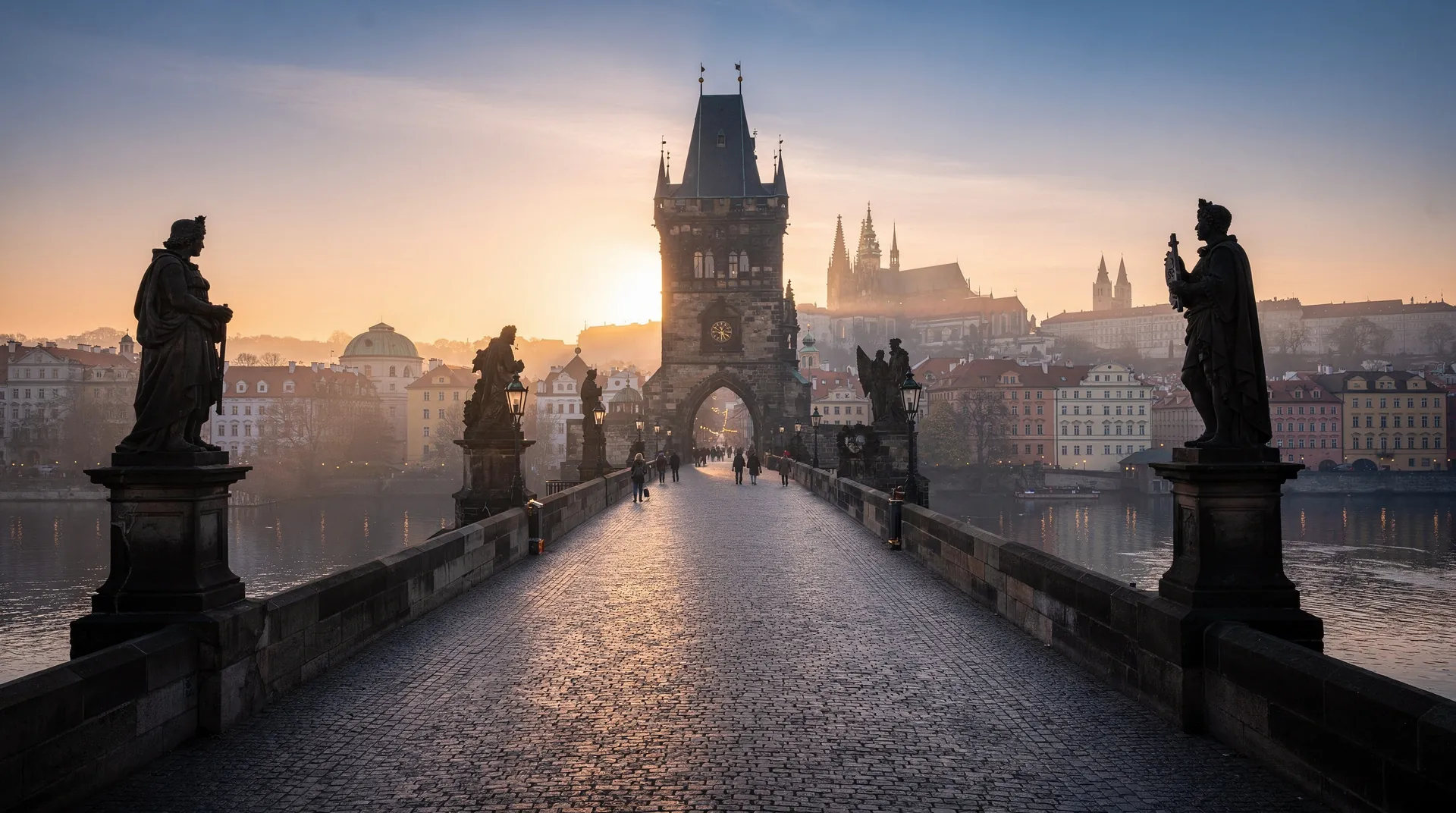
Day 2: Prague Castle and Mala Strana
Cross the Charles Bridge at sunrise, which is genuinely empty before 7am. Walk up Nerudova Street to Prague Castle, and start with the cathedral, which is free to enter up to a certain point (check the official castle site for current access rules). Buy the circuit ticket for the Old Royal Palace and Golden Lane, which runs around 250 to 350 CZK (confirm the current price at the castle’s official site).
After descending, walk through Mala Strana, stop at the Lennon Wall, and finish the afternoon at the Strahov Monastery library, which has one of the most beautiful reading rooms in Europe.
Day 3: Vinohrady, or Letna, and a beer hall dinner
Spend the morning in Vinohrady, which is the neighborhood Prague residents actually live in. The coffee is better, the restaurants are cheaper, and the streets are quieter than Old Town. Walk to Riegrovy Sady Park for the view of the city, then have lunch at one of the pubs nearby. In the late afternoon, go to Letna Park for another view over the river and the bridges.
Finish with dinner at a traditional beer hall like Lokal or U Fleku, where a half liter of Pilsner costs 45 to 65 CZK (confirm current prices on the menu).
Maya’s honest take: “Cross the Charles Bridge before 7am on day two, not at sunset on day one. It is a completely different experience, and you get the photographs everyone else is fighting for.”
Best for a 3-day trip
- Old Town Square before 9am and the Jewish Quarter on day one
- Charles Bridge at sunrise and Prague Castle on day two
- Vinohrady or Letna and a beer hall dinner on day three
Worth considering
- Adding a day trip to Kutna Hora, about 75 minutes by train from Prague main station (check current fares with the operator)
- Booking a Prague food tour if you want to understand the Czech pub menu before you order on your own
How much does a trip to Prague actually cost?
Prague has become noticeably more expensive over the last five years, but it is still cheaper than Vienna, Munich, or Copenhagen. The savings are real if you avoid the tourist center at mealtimes and use public transport instead of taxis.
Budget travelers staying in hostels or budget hotels, eating at casual pubs and street food, and using the metro and trams should plan on roughly 60 to 80 dollars per person per day, excluding flights (confirm current hotel rates on Booking.com). Mid-range travelers in a three-star or four-star hotel with restaurant meals and one paid attraction daily should budget around 120 to 180 dollars per person per day.
Upscale travelers in a five-star Old Town property with fine dining start near 300 dollars per person per day (check current rates with each property).
Flights to Prague Václav Havel Airport from within Europe typically run 80 to 250 dollars round trip depending on origin and season, while from North America the range is closer to 700 to 1,200 dollars (check current fares on Kayak before booking). The hidden costs are the ones people forget. Public transport tickets must be validated in the yellow machines before you board, and inspectors issue fines of 1,000 CZK for unvalidated tickets (confirm the current fine with DPP).
Restaurants charge a cover charge of 20 to 60 CZK per person, and tipping in Czech restaurants is expected at around 10 percent for good service.
Best ways to save
- Eat lunch at a pub or canteen outside Old Town, where a full meal costs 120 to 180 CZK (confirm current prices on the menu)
- Buy a 72-hour transport ticket if you plan to use trams and the metro daily (check the current fare on the DPP site)
- Visit in November or early March, when hotel rates drop and the city is quieter
Worth considering
- A Prague Card if you plan three or more paid attractions (check the current price and inclusions)
- Staying in Vinohrady or Zizkov, where hotel rates drop and the L train equivalent is still fast
Where should you stay on a trip to Prague?
Stay in Old Town or Nove Mesto if this is your first visit and you want to walk to the main sights. The trade-off is noise and higher prices. Mala Strana on the castle side of the river is quieter and more atmospheric, but you will cross the bridge every time you want to be in the center. Vinohrady and Zizkov are where Prague residents live, with better restaurants and lower hotel rates, but you will rely on the tram or metro for sightseeing.
For budget travelers, look at hostels and budget hotels in Nove Mesto or Zizkov, where rates drop noticeably outside peak season (check current rates on Hotels.com or Booking.com). For families or groups, an apartment rental in Vinohrady or Mala Strana often works out cheaper than two hotel rooms, and Vrbo is a good place to compare. I would avoid hotels directly on Old Town Square unless you enjoy hearing the astronomical clock every hour through your window at 2am.
How do you get around Prague without spending a fortune?
Prague’s public transport network is excellent, and the metro, trams, and buses share one ticket system. A 30-minute ticket costs 30 CZK, a 90-minute ticket around 40 CZK, a 24-hour ticket 120 CZK, and a 72-hour ticket around 330 CZK (confirm current fares on the DPP official site). Buy tickets from the yellow machines at metro stations or via the PID Litacka app, and validate them before boarding. Inspectors do check, and the fine for an unvalidated ticket is 1,000 CZK (confirm the current fine with DPP).
The airport is connected to the city by bus 119 to Nadrazi Veleslavin metro station, or by the Airport Express bus to the main train station, which costs around 100 CZK (confirm the current fare on the DPP site). Taxis and rideshares from the airport run 600 to 900 CZK depending on traffic and time of day (confirm the fare with your driver or app before you ride). Within the center, walking is genuinely faster than any vehicle between 10am and 6pm.
What do first-time Prague visitors get wrong?
Accepting card payment in your home currency. When a merchant or ATM offers to charge you in dollars or euros, decline. The conversion adds 3 to 5 percent to every transaction, and it adds up over a week (check with your bank before you travel).
Not validating public transport tickets. Buying a ticket is not enough. You must stamp it in the yellow machines before boarding, and inspectors issue 1,000 CZK fines (confirm the current fine with DPP).
Eating on Old Town Square. The setting is beautiful and the food is priced for the view. Walk two or three blocks into the side streets and prices drop while the quality improves, every time.
Only seeing the tourist center. The Old Town, Charles Bridge, and the castle are worth seeing, but Prague is at its best in Vinohrady, Zizkov, and Letna. Give one day to a neighborhood away from the center.
Underestimating the cobblestones. Prague’s old streets are hard on the feet and unforgiving on rolling luggage. Pack shoes with grip and a bag you can carry if you are staying in a building with no lift.
Visiting in peak summer without booking ahead. July and August bring heat, crowds, and higher hotel prices. Book at least two to three months ahead if you travel then, or shift to May or September for a better trip at a lower price (check current rates with your chosen hotel).
Frequently asked questions
Do I need a visa for a trip to Prague?
Most travelers from the US, UK, Canada, Australia, and the EU can stay visa-free in the Czech Republic and the wider Schengen area for up to 90 days within any 180-day period. Your passport must be valid for at least three months beyond your planned departure, and six months is safer. Confirm the specific rules with the Czech Ministry of Foreign Affairs before you travel.
Is 3 days enough for a Prague trip?
Yes, three days is enough to see the Old Town, Charles Bridge, Prague Castle, the Jewish Quarter, and one neighborhood without rushing. Add a fourth day if you want a day trip to Kutna Hora or Cesky Krumlov. Two days feels rushed, and a week lets you see the city properly plus a day trip.
How much does a 3-day Prague trip cost?
Budget travelers should plan on about 60 to 80 dollars per person per day, excluding flights, so around 180 to 240 dollars for three days (confirm current hotel rates and transport fares). Mid-range travelers should budget 120 to 180 dollars per day, and upscale travelers from 300 dollars per day. Attractions, food, and hotel choice drive the biggest differences.
Is Prague safe for tourists?
Prague is generally safe in the areas tourists visit, including Old Town, Mala Strana, and Nove Mesto. Pickpocketing and phone snatching happen on crowded trams and around Charles Bridge, so keep your bag zipped and in front of you. Avoid unlicensed taxis and money exchange booths with unclear rates.
Should I pay in euros or Czech koruna in Prague?
Always pay in Czech koruna (CZK). Merchants who offer to charge your card in euros or dollars add a markup of 3 to 5 percent to every transaction. Use a card with no foreign transaction fees and always choose CZK at the terminal (check with your bank before you travel).
How do you get from Prague Airport to the city center?
Take bus 119 from the airport to Nadrazi Veleslavin metro station, then take the metro A line into the center, which takes about 40 minutes total and costs a standard 90-minute transport ticket around 40 CZK (confirm the current fare on the DPP site). The Airport Express bus to the main train station costs about 100 CZK and takes roughly 35 minutes. Taxis and rideshares from the airport run 600 to 900 CZK depending on traffic (confirm the fare with your driver or app before you ride).
Plan your trip: booking platforms we trust
I use these platforms because they consistently surface useful inventory and clear pricing for Prague, and I have booked through most of them personally. The links below are affiliate links, which means WakaAbuja may earn a small commission if you book through them at no extra cost to you. Pick the one that matches your trip, not all of them.
Booking.com
Best for Old Town and Mala Strana hotels with free cancellation.
Kayak
Compare flights into Prague Václav Havel and nearby hubs before you commit.
GetYourGuide
Prague Castle tours, food tours, and day trips to Kutna Hora.
Expedia
Flight and hotel packages if you want a bundled Prague trip.
Vrbo
Apartments and rentals for families and longer stays in Vinohrady.
WakaAbuja does its best to keep all information accurate at the time of publishing. Prices, policies, and availability change regularly. Always verify with official sources before you travel. We are not liable for errors caused by outdated information. Travel insurance is strongly recommended.