advertisement
Norway’s best places to visit combine dramatic fjords, Arctic landscapes, historic cities, and scenic villages worth planning a trip around.
Fact-Checked By: Maya Whitfield, Senior Travel Editor at WakaAbuja
The best places to visit in Norway are Lofoten for dramatic islands, Bergen for fjord access, Bryggen, Geirangerfjord for the classic cruise view, Preikestolen for the most famous hike, and Tromsø for Northern Lights in winter. Most travelers need 10 to 14 days to cover the highlights without rushing. Expect to budget around $150 to $250 per day for food, transport, and accommodation in peak season (confirm current rates on the official sites).
Norway’s biggest planning problem is not finding beautiful places. It is figuring out how many of them you can actually see and when. I have planned three Norway trips from scratch, and the hardest part was always the same: everything looks close on a map until you realize the fjords are six hours apart by ferry and the roads close in winter.
This guide is built around that reality. You will get the 20 spots worth planning around, plus how long each one needs, what it costs, the best month to go, and whether you can reach it without a car.
Jump to: At-a-glance table | Northern Norway | Western fjords | Oslo and around | Central and south | How many days | Best time to go | Mistakes to avoid | FAQ
Key takeaways
- Norway is long and thin. Do not try to cover the north and the fjords in one week. Pick a region and go deep.
- Lofoten, Bergen, Geirangerfjord, Preikestolen, and Tromsø are the five names that appear on every serious list, and they earn it.
- Public transport is excellent but slow. Ferries and trains take longer than you expect, so build in buffer days.
- Summer (June to August) gives you midnight sun and open mountain roads. Winter (November to March) gives you Northern Lights and closed passes.
- Norway is expensive. Budget around $150 to $250 per day for a mid-range trip in summer (confirm current rates on the official sites).
- Booking trains and ferries early saves real money. The Flåm Railway and Bergen Line sell out in peak season.
- You do not need a car for Bergen, Oslo, or Tromsø. You do need one for Lofoten, Geiranger, and the Atlantic Road if you want flexibility.
Norway’s best places at a glance
Use this as your starting filter. The days column assumes you want to actually see the place, not just check it off. Costs are rough daily estimates for one person in summer, covering accommodation, food, and local transport (confirm current rates on the official sites).
Lofoten
Region: North
Days: 3 to 4
Best: June to August
Cost: $180 to $250 per day (check current rates)
Bergen
Region: West
Days: 2
Best: May to September
Cost: $170 to $230 per day (check current rates)
Geirangerfjord
Region: West
Days: 1 to 2
Best: May to September
Cost: $150 to $220 per day (check current rates)
Pre-K stolen
Region: West
Days: 1
Best: April to October
Cost: $100 to $150 per day (check current rates)
Tromsø
Region: North
Days: 2 to 3
Best: September to March
Cost: $160 to $220 per day (check current rates)
Oslo
Region: East
Days: 2
Best: May to September
Cost: $180 to $250 per day (check current rates)
Svalbard
Region: Arctic
Days: 3 to 4
Best: February to May
Cost: $200 to $300 per day (check current rates)
Flåm
Region: West
Days: 1
Best: May to September
Cost: $130 to $180 per day (check current rates)
What are the best places to visit in Northern Norway?
Northern Norway is where the postcard images come from. The light is different up here, the mountains rise straight out of the sea, and in winter the aurora is a real nightly possibility rather than a lucky accident. The trade-off is distance. Getting between northern destinations takes time, and the weather can change plans fast.
I spent four days in Lofoten in late June and never saw full darkness. That sounds romantic until you realize your body has no idea when to sleep. Bring an eye mask.
1. Lofoten Islands
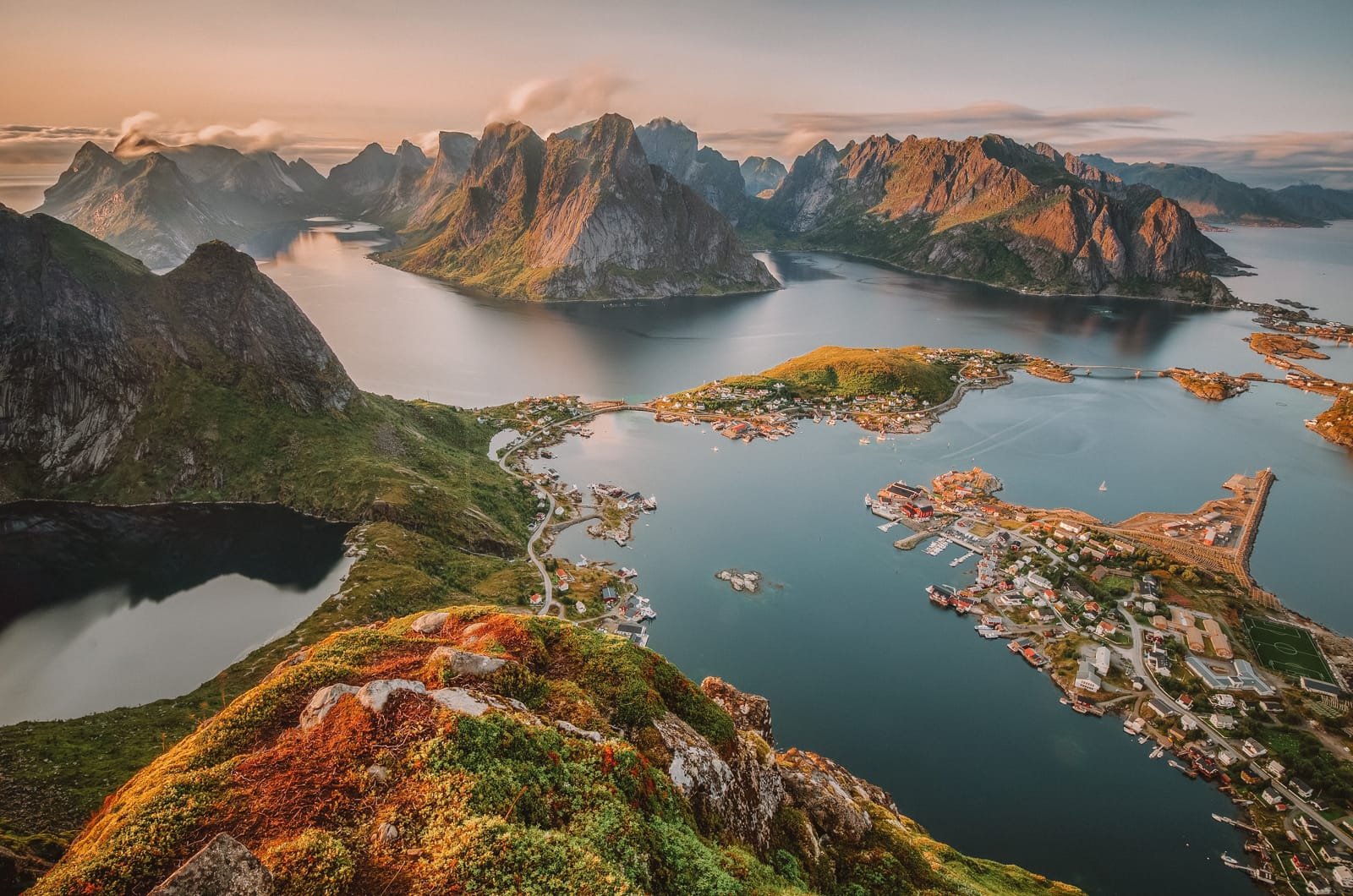
Lofoten is the single most photogenic place in Norway, and it is not close. Reine, Hamnøy, and Å are the villages you have seen on Instagram, and they look exactly like that in person. The islands are connected by bridges and tunnels, so you can drive the whole chain in a few hours. Hiking Reinebringen takes about two hours round trip and delivers the view everyone comes for.
How to get there: fly to Leknes or Svolvær from Oslo or Bodø, or take the ferry from Bodø to Moskenes. Days needed: 3 to 4. Best season: June to August for midnight sun, February to April for Northern Lights and fewer crowds. Car-free option: buses connect the main villages, but they are infrequent, so a car or rental bike is better if you want to explore.
2. Tromsø
Tromsø is the largest city in Northern Norway and the most practical base for aurora hunting. It sits right on the aurora oval, which means clear nights in winter often deliver. The cable car to Fjellheisen gives you a city and fjord view in ten minutes. The Arctic Cathedral is worth a quick stop. In summer, Tromsø is a good base for midnight sun hikes and whale safaris.
How to get there: direct flights from Oslo, Bergen, and several European cities. Days needed: 2 to 3. Best season: September to March for Northern Lights, June to July for midnight sun. Car-free option: yes, Tromsø is walkable and has good buses. Book a Northern Lights tour if you do not want to drive yourself. I used GetYourGuide to compare aurora tours and it was the easiest way to sort the good operators from the weak ones.
3. North Cape (Nordkapp)
North Cape is the northernmost point in mainland Europe and a genuine bucket-list marker. The plateau sits 307 meters above the Barents Sea, and on a clear day the view feels like the edge of the world. The visitor center has exhibits and a restaurant, which is useful because there is nothing else up there.
How to get there: drive from Alta or Honningsvåg, or take a bus from Honningsvåg in summer. Days needed: 1. Best season: June to August, as the road can close in winter. Car-free option: yes in summer via the Honningsvåg bus, but you still need to reach Honningsvåg first, usually by flight or coastal ferry.
4. Svalbard
Svalbard is not mainland Norway. It is an Arctic archipelago halfway to the North Pole, and it feels like another planet. Longyearbyen is the main settlement, with more snowmobiles than cars and polar bears roaming outside town. You cannot leave the settlement without a guide and a rifle. That is not a joke; it is the law.
How to get there: direct flights from Oslo and Tromsø to Longyearbyen. Days needed: 3 to 4. Best season: February to May for snowmobile and aurora trips, and June to August for hiking and midnight sun. Car-free option: you do not need a car, but you do need guided tours for anything outside town.
What are the best places to visit in Western Norway and the fjords?
Western Norway is fjord country. This is where the UNESCO-listed landscapes live, where the waterfalls are measured in hundreds of meters, and where the roads switchback so hard that buses have turning circles painted on the pavement. Bergen is the gateway, and everything else radiates out from there.
My honest advice: do not try to see all the fjords. Pick two. Geiranger and Nærøyfjord are the two that deliver the most for the least travel time.
5. Bergen
Bergen is Norway’s second city and the most useful base for fjord trips. Bryggen, the UNESCO-listed wharf with the colorful wooden buildings, is the centerpiece. The Fløibanen funicular takes you up Mount Fløyen for a city view that justifies the ticket price, around $15 to $20 round trip (confirm the latest price directly with the operator). The fish market is touristy but still worth a walk-through.
How to get there: the Bergen Line train from Oslo is one of the most scenic rail journeys in Europe, about seven hours. Days needed: 2. Best season: May to September. Car-free option: yes, Bergen is very walkable, and you can book fjord tours that leave from the city center.
6. Geirangerfjord
Geirangerfjord is the classic Norway image: a narrow blue fjord with the Seven Sisters waterfall cascading down one side and abandoned farms clinging to the cliffs. The view from the Dalsnibba Skywalk, 1,500 meters above sea level, is the best single panorama in the country. The ferry through the fjord from Geiranger to Hellesylt takes about an hour and is the cheapest way to see the waterfall up close.
How to get there: drive or take a bus from Ålesund or Oslo, or arrive by cruise ship. Days needed: 1 to 2. Best season: May to September, as the mountain roads close in winter. Car-free option: summer buses and ferries connect the area, but service is limited outside July and August.
7. Preikestolen (Pulpit Rock)
Preikestolen is a flat-topped cliff 604 meters above Lysefjord, and it is the most popular hike in Norway. The trail is 8 kilometers round trip with about 500 meters of elevation gain, and most people take four to five hours. The reward is a view straight down the fjord that makes the effort worth it. Go early. By 10 a.m. in July the trail is a queue.
How to get there: drive or take the ferry and bus from Stavanger, about an hour each way. Days needed: 1. Best season: April to October. Car-free option: yes, the Pulpit Rock bus from Stavanger runs daily in summer and is the easiest way without a car.
8. Trolltunga
Trolltunga is the other famous cliff hike, a rock formation that juts horizontally out of the mountain 700 meters above Lake Ringedalsvatnet. The full hike is 27 kilometers round trip with 1,100 meters of elevation, and it takes 10 to 12 hours. This is not a casual walk. You need proper boots, food, water, and a start before 8 a.m.
How to get there: drive to Skjeggedal from Odda, or take the bus from Odda in summer. Days needed: 1 full day. Best season: June to September, and only with a guide outside July and August. Car-free option: yes in summer via the Trolltunga bus from Odda.
9. Flåm and the Flåm Railway
The Flåm Railway is one of the steepest standard-gauge railways in the world, climbing 866 meters over 20 kilometers. The journey takes about an hour and passes waterfalls, deep valleys, and tiny mountain farms. Flåm itself is a small village at the head of Aurlandsfjord, and the fjord cruise from Flåm to Gudvangen is a common add-on. Book both in advance, as peak summer departures sell out.
How to get there: the Bergen Line stops at Myrdal, where you change to the Flåm Railway. Days needed: 1. Best season: May to September. Car-free option: yes, this is one of the easiest car-free destinations in Norway.
10. Atlantic Road
The Atlantic Road is an 8-kilometer stretch of highway that hops between small islands over a series of bridges, with the open sea on both sides. It is a driving experience, not a destination, and the best time to do it is in bad weather, when the waves crash over the road. The nearby town of Kristiansund is a good base.
How to get there: drive from Molde or Kristiansund, about 30 to 45 minutes. Days needed: half a day. Best season: year-round, but summer is more comfortable. Car-free option: no practical option; you need a car for this one.
What are the best places to visit in Oslo and around?
Oslo is often treated as a transit stop on the way to the fjords. That is a mistake. The city has world-class museums, a walkable waterfront, and easy day trips to forests and islands. Two days is enough to cover the highlights without rushing.
11. Oslo Opera House
The Opera House is designed so you can walk on the roof. That alone makes it worth a visit. The angled white marble slopes rise straight out of the fjord, and the view from the top takes in the whole harbor. Entry to the building is free, and guided tours run daily for around $15 to $20 (confirm the latest price directly with the operator).
12. Vigeland Park
Vigeland Park is the world’s largest sculpture park by a single artist. Gustav Vigeland spent 40 years creating more than 200 bronze and granite figures, and the park is free to enter. The Monolith, a 17-meter tower of intertwined bodies, is the centerpiece. It takes about two hours to walk the whole park properly.
13. Viking Ship Museum and Bygdøy
The Bygdøy peninsula holds several of Oslo’s best museums, including the Viking Ship Museum (currently closed for renovation; check the official site for reopening), the Fram Museum, and the Kon-Tiki Museum. You can reach Bygdøy by ferry from the city center in about 15 minutes.
14. Nidaros Cathedral, Trondheim
Trondheim is Norway’s third city and the historic capital of the Viking age. Nidaros Cathedral is the northernmost medieval cathedral in the world and the traditional coronation church for Norwegian kings. The city itself has a strong student energy and a good food scene. It is also a natural stop on the way north or south by train.
15. Røros
Røros is a UNESCO-listed former mining town with wooden buildings that have survived since the 1600s. It is small, quiet, and genuinely charming, especially in winter when the streets are covered in snow and the horses pull sleds. It is a good stop between Oslo and Trondheim.
What are the best places to visit in Central and Southern Norway?
Central and Southern Norway are the parts most travelers skip. That is a shame, because this is where you find Norway’s best hiking, its highest waterfalls, and its most authentic small towns. If you have more than ten days, spend two or three of them here.
16. Jotunheimen National Park
Jotunheimen is home to the highest peaks in Northern Europe, including Galdhøpiggen at 2,469 meters. The Besseggen Ridge hike is the most famous day hike in Norway, a 6- to 8-hour traverse between two lakes of different colors. The trail is exposed and not for beginners, but the views are unmatched.
17. Vøringsfossen
Vøringsfossen is one of Norway’s most visited waterfalls, with a 182-meter drop into a canyon. The viewing platform is accessible, and the falls are powerful even in late summer. It is an easy stop on the road between Bergen and Oslo.
18. Kjeragbolten
Kjeragbolten is a boulder wedged between two cliffs 984 meters above Lysefjord. The hike is 10 kilometers round trip with steep sections and some scrambling, and it takes 6 to 8 hours. Standing on the boulder is the photo everyone wants, but the hike itself is the real achievement.
19. Kristiansand
Kristiansand is the gateway to Southern Norway and a popular summer destination for Norwegians themselves. The old town, Posebyen, has white wooden houses, and the nearby zoo and amusement park make it family-friendly. It is a good stop on the ferry route from Denmark.
20. Rjukan
Rjukan is a small industrial town in a deep valley that receives no direct sunlight in winter. To solve this, the town built giant mirrors on the mountainside to reflect sun into the square. The Krossobanen cable car takes you up for a view of the valley and the mirrors. It is a genuinely unusual place.
How many days do you need in Norway?
Most travelers need 10 to 14 days to cover the main highlights without rushing. A one-week trip works if you stick to one region, such as the western fjords or Lofoten. Three weeks lets you add the north and Svalbard without feeling like you are always in transit.
One week
Fly into Bergen, spend two days there, take the fjord tour to Geiranger, and finish with the Flåm Railway. This is the classic western fjord loop, and it works well without a car.
Two weeks
Add Oslo and the Bergen Line train in one direction, then fly north to Tromsø or Lofoten for three or four days. This gives you both the fjords and the Arctic, which is the combination most people actually want.
Three weeks or more
You can add Svalbard, the Atlantic Road, Trondheim, and Jotunheimen. At this length, consider a one-way car rental between regions to avoid backtracking.
If you are booking transport between regions, compare flight prices on Kayak before you commit. Domestic Norwegian flights are often cheaper than the train when booked early.
What is the best time to visit Norway?
The best time to visit Norway depends on what you want. June to August gives you midnight sun, open mountain roads, and the warmest weather. September to March gives you Northern Lights, snowy landscapes, and lower prices outside the Christmas holidays. May and September are the sweet spots for fewer crowds and still-decent weather.
Northern Lights season
The aurora is visible from late September to late March, with the best odds in October, February, and March. You need dark skies, clear weather, and patience. Tromsø, Svalbard, and the Lofoten Islands are the most reliable bases.
Midnight sun season
Above the Arctic Circle, the sun does not set from late May to late July. In Lofoten and Tromsø, you can hike at midnight in full daylight. This is the season for hiking, kayaking, and road trips.
Hiking season
The main hiking season runs from late June to early September. Some trails, including Trolltunga and Besseggen, do not open until the snow melts, usually in late June or early July. Always check trail status before you go, as conditions vary year to year.
What mistakes do first-time visitors to Norway make?
I made most of these on my first trip, so this list is not theoretical. Avoiding them will save you money, time, and frustration.
Trying to see too much
Norway looks small on a map of Europe, but the distances are real and the terrain is slow. A route that looks like four hours of driving can take eight with ferries and photo stops. Pick fewer places and stay longer.
Underestimating costs
Norway is one of the most expensive countries in Europe. A simple lunch can cost $20 to $30, and a beer is often $10 to $15 (confirm current prices locally). Budget accordingly, or plan self-catering meals and use supermarkets.
Booking peak-season transport late
The Flåm Railway, the Bergen Line, and the main coastal ferry routes sell out weeks in advance in July and August. Book as soon as your dates are fixed. I once paid double for a last-minute Bergen to Oslo train because I waited too long.
Ignoring the weather
Norwegian weather changes fast, even in summer. A sunny morning can turn into cold rain by afternoon. Bring layers, a waterproof shell, and proper footwear regardless of the season.
Assuming you need a car everywhere
Bergen, Oslo, Tromsø, and Flåm are all easy without a car. Lofoten, Geiranger, and the Atlantic Road are much harder without one. Plan your transport strategy per region, not for the whole trip at once.
Skipping travel insurance
Hiking in Norway carries real risk, and medical evacuation is expensive. Travel insurance is not optional if you plan to do any of the major hikes.
Frequently asked questions about visiting Norway
How many days do you need to visit Norway?
Most travelers need 10 to 14 days to see the main highlights without rushing. One week works if you focus on a single region like the western fjords or Lofoten. Three weeks lets you add Northern Norway and Svalbard.
Is Norway expensive to visit?
Yes, Norway is one of the most expensive countries in Europe. Budget around $150 to $250 per day for a mid-range trip covering accommodation, food, and transport (confirm current rates on the official sites). You can reduce costs by self-catering, traveling in shoulder season, and booking transport early.
Do you need a car to visit Norway?
It depends on where you go. Bergen, Oslo, Tromsø, and Flåm are easy without a car thanks to trains, ferries, and buses. Lofoten, Geirangerfjord, and the Atlantic Road are much easier with a rental car, especially outside peak summer.
What is the best time to see the Northern Lights in Norway?
The aurora is visible from late September to late March, with the best odds in October, February, and March. Tromsø, Svalbard, and the Lofoten Islands are the most reliable bases. You need dark skies, clear weather, and patience.
What are the best places to visit in Norway without a car?
Bergen, Oslo, Flåm, and Tromsø are all easy without a car. The Flåm Railway, the Bergen Line, and the coastal express ferry connect many of the top destinations. For Lofoten and Geirangerfjord, summer buses exist but are limited outside July and August.
Is Norway better in winter or summer?
It depends on your priorities. Summer gives you midnight sun, open hiking trails, and warmer weather. Winter gives you Northern Lights, snowy landscapes, and fewer crowds, but many mountain roads and trails close. If you want both, visit in September or March.
What is the most beautiful place in Norway?
Most travelers rank Lofoten and Geirangerfjord as the most beautiful places in Norway. Lofoten offers dramatic island scenery and fishing villages, while Geirangerfjord delivers the classic fjord view with waterfalls and steep cliffs. Both are worth planning a trip around.
Do I need travel insurance for Norway?
Yes, travel insurance is strongly recommended, especially if you plan to hike Preikestolen, Trolltunga, or Kjeragbolten. Medical evacuation in remote areas is expensive, and standard health insurance often does not cover it. Travel insurance is not optional for adventure travel in Norway.
Plan your trip: booking platforms we trust
I use these platforms when planning my own Norway trips. They are reliable for comparing prices, reading recent reviews, and booking with confidence. I have noted what each one is best for so you can go straight to the one that fits your needs.
Agoda
Best for Asian hotel deals and sometimes surprising Nordic rates.
General hotel search with strong filter options and free cancellation deals.
Best for flight and hotel packages if you want to bundle and save.
Flight price comparison across multiple airlines and booking sites.
Family cabins and vacation rentals, useful for Lofoten and fjord stays.
Tours and activities, including Northern Lights chases and fjord cruises.
Loyalty rewards bookings, which is good if you collect stamps toward free nights.
Reviews and restaurant finds, useful for Bergen and Oslo dining.
WakaAbuja does its best to keep all information accurate at the time of publishing. Prices, policies, and availability change regularly. Always verify with official sources before you travel. We are not liable for errors caused by outdated information. Travel insurance is strongly recommended.